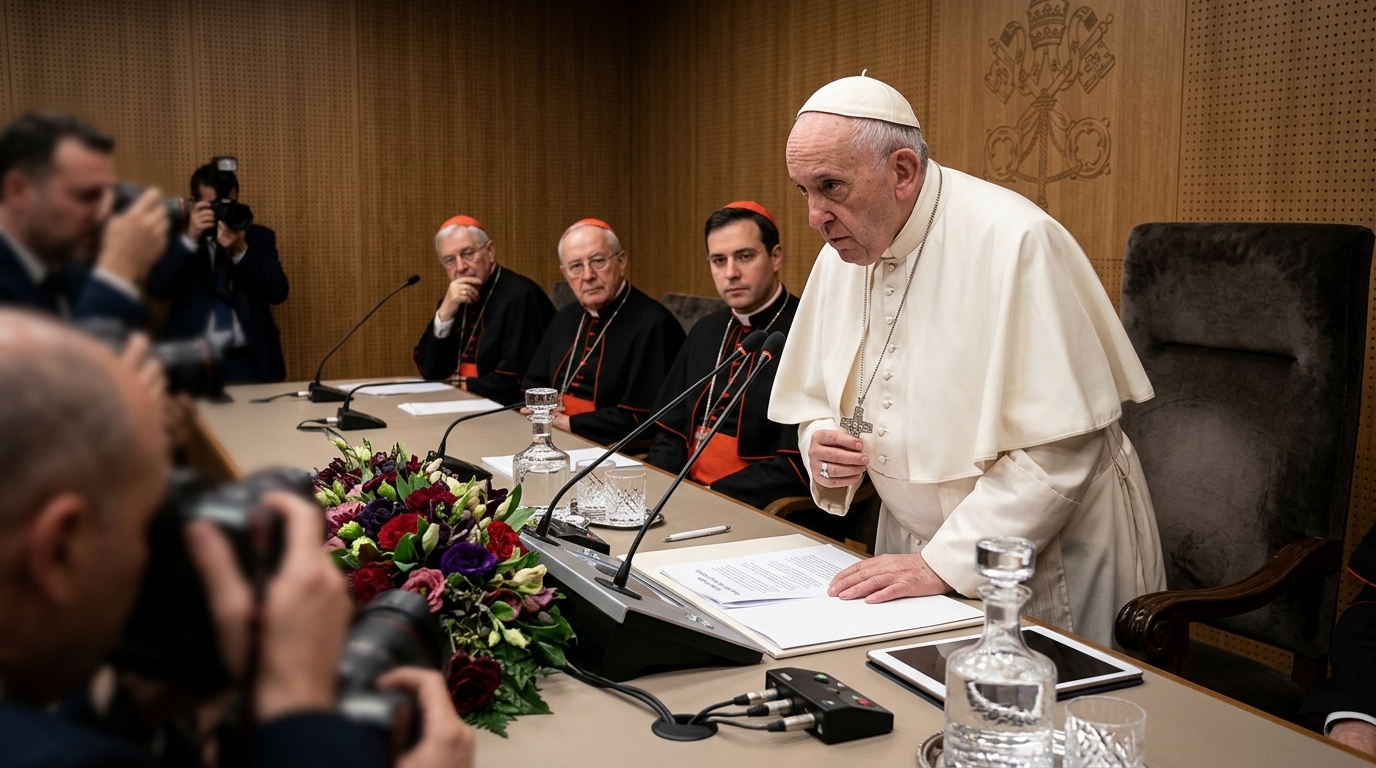
In an era where the digital revolution appears to be moving at speeds that elude human comprehension, the Vatican has chosen to return to the roots of mythology and moral philosophy to deliver a resonant message. Pope Leo, during his recent address for World Communications Day, surprised the international audience by referencing Gandalf, the iconic wizard from J.R.R. Tolkien’s 'The Lord of the Rings.' The reference was far from accidental: the Pontiff used Gandalf’s refusal to wield the One Ring as a potent metaphor for the necessity of 'disarming' Artificial Intelligence (AI).
The Metaphor of the One Ring
Pope Leo emphasized that Artificial Intelligence, in its current trajectory, carries the risk of transforming into a tool of absolute dominion, akin to Sauron’s Ring. "Even with the best of intentions," the Pontiff noted, "the possession of a power that can supersede human judgment and conscience inevitably leads to the corruption of the spirit." Just as Gandalf rejected the Ring knowing its power would turn him into a tyrant, humanity must learn to set boundaries on the development of AI to prevent it from becoming an uncontrollable force of oppression.
The Pope’s choice of Tolkien is not merely a play for pop-culture relevance. Tolkien, a devoutly Catholic writer, often explored the conflict between organic life and 'the Machine'—which he defined as the desire for immediate efficiency and domination over the world. Pope Leo revives this critique, arguing that AI risks becoming the ultimate 'Machine,' stripping the human experience of its inherent mystery, spontaneity, and freedom.
'Disarming' the Algorithms
But what does it mean to 'disarm' a technology that is not inherently a weapon? For the Vatican, the term refers to decoupling AI from the logic of pure efficiency and total control. The Pope called upon developers and tech leaders to become 'artisans of hope,' creating systems that enhance human dignity rather than substituting it.
"Technology must be stripped of its illusion of omniscience," he stated emphatically.
This disarmament is built upon three fundamental pillars:
- Transparency of Intent: Algorithms must not operate as 'black boxes' that make life-altering decisions without accountability or explanation.
- Algor-ethics: The integration of ethical values into the very architecture of code, an initiative the Vatican has championed through the 'Rome Call for AI Ethics.'
- Human Agency: Ensuring that the final decision, particularly regarding ethics, life, and death, remains firmly in human hands.
Artisans of Hope in a Digital World
The concept of 'artisans of hope' serves as the Pope’s central vision for the future. In a world where AI can generate art, text, and code, the Pontiff asks what remains for the human person. His answer is 'hope'—not as a passive feeling, but as an active, creative deed that cannot be simulated by any neural network. Artisans of hope are those who use technology to bridge divides, heal social wounds, and promote peace, rather than polarizing public opinion through algorithmic echo chambers.
This address arrives at a critical juncture as the European Union and the United States work to finalize regulatory frameworks for AI. The Vatican’s intervention adds a spiritual and ethical dimension often absent from the technocratic discussions in Brussels or Silicon Valley. Pope Leo is not calling for the abolition of AI, but for its total subordination to human spirituality and the common good.
The Geopolitics of Ethics
The call for disarmament also carries a clear political weight. In a world on the brink of a new cold war—this time over AI supremacy—the Vatican positions itself as a neutral moral arbiter. The Pope warned that utilizing AI for military purposes or the suppression of human rights constitutes the ultimate betrayal of human genius. "If we allow the machine to decide who lives and who dies, we will have lost our soul before the battle even begins," he concluded.
In conclusion, the reference to Gandalf was not a mere literary flourish, but a stern warning against the temptation of absolute power. In Tolkien’s legendarium, salvation did not come from the mighty, but from the small and humble who possessed the empathy to refuse power. Pope Leo invites modern society to find its 'inner Gandalf' and resist the allure of a digital ring that promises everything but demands our very humanity in return.