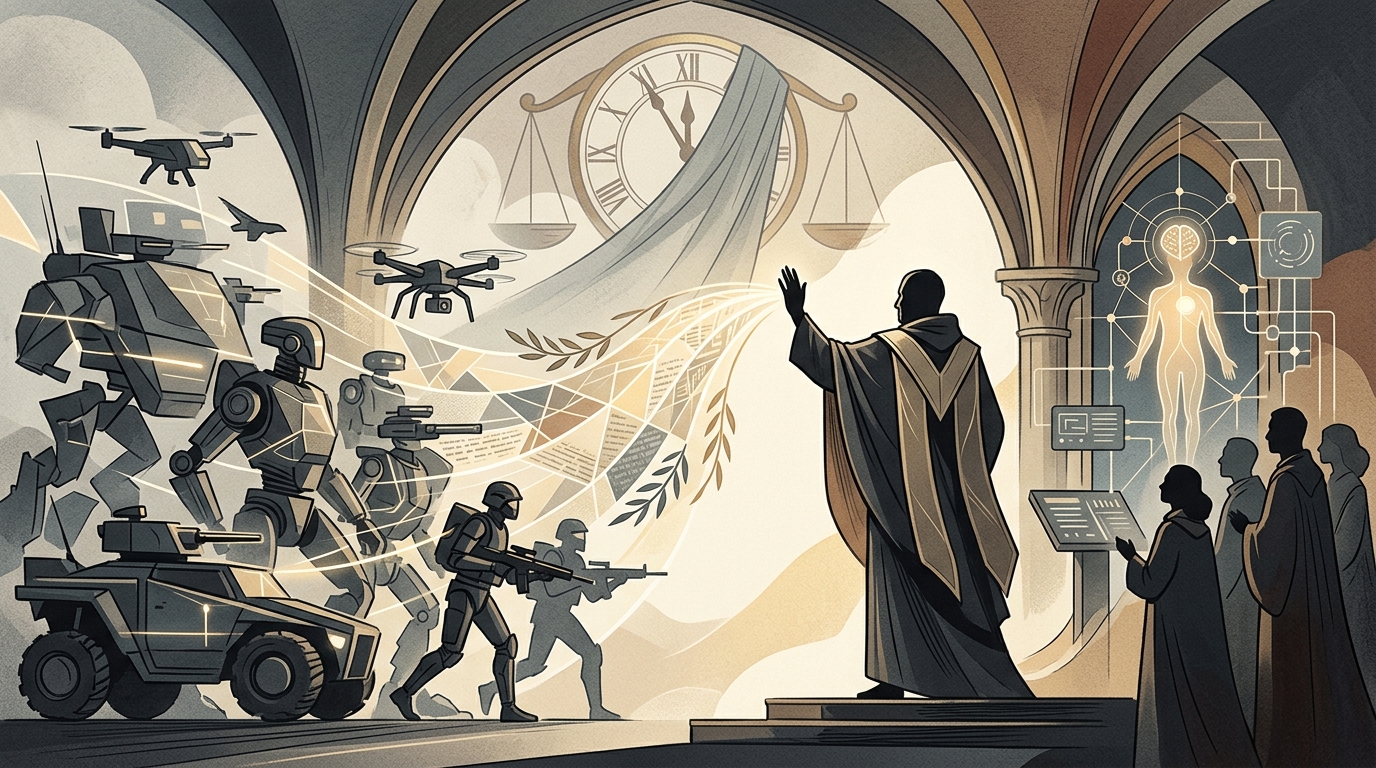
In an era where technological advancement moves at a pace that often outstrips society's ability to grasp its consequences, Pope Francis has made a historic intervention. During ongoing international deliberations regarding the future of warfare technology, the Pontiff reiterated his staunch opposition to Lethal Autonomous Weapons Systems (LAWS), commonly known as 'killer robots.' His position is clear and non-negotiable: Artificial Intelligence lacks, and can never acquire, the moral judgment required for the decision to take a human life.
The Loss of Human Agency
The Vatican's central argument focuses on the concept of 'meaningful human control.' The Pope argues that delegating the decision of life and death to an algorithm is a fundamental affront to human dignity. Machines, no matter how sophisticated, operate based on statistical probabilities and predefined data. They lack empathy, mercy, and the ability to perceive the context of a situation in the way a human being does.
'No machine should ever choose to take the life of a human being,' the Pope emphasized, highlighting that the use of AI in warfare risks turning conflict into a cold, mathematical process where responsibility is diffused and ultimately vanishes. When a robot commits a war crime, who bears the responsibility? The programmer, the manufacturer, or the commander who pressed the activation button? This legal and ethical vacuum is what particularly concerns the Holy See.
'Algor-ethics' as a Response to Technocracy
Pope Francis does not limit himself to criticism; he proposes a new framework he calls 'Algor-ethics.' This involves integrating ethical principles into the very design of algorithms. This initiative, which began with the 'Rome Call for AI Ethics' in 2020, has gained support from tech giants like Microsoft and IBM, as well as international organizations.
Algor-ethics posits that technology must serve humanity and not vice versa. In the context of autonomous weapons, this means that AI should be used exclusively for defensive purposes that do not involve autonomous targeting of humans, or for supporting human decision-making, always keeping a human 'in the loop.'
Geopolitical Challenges and the Laws of War
Despite the calls from the Pope and numerous Non-Governmental Organizations, the international community remains divided. Major powers such as the US, Russia, and China are investing billions in the development of autonomous systems, fearing that a ban would leave them at a disadvantage against their rivals. The Pope, however, warns that this new arms race is more dangerous than the nuclear one, as AI is more accessible and less controllable.
- The lack of transparency in algorithms (the 'black box' problem) makes it impossible to administer justice.
- The risk of war escalation increases when decisions are made in milliseconds by machines.
- The potential for such weapons to be used by terrorist organizations or authoritarian regimes is extremely high.
'Artificial Intelligence is a tool with immense potential for good, but in the service of war, it becomes the ultimate enemy of humanity,' the Vatican statement notes.
In conclusion, Pope Francis's intervention is not merely a religious stance but a profound political and humanitarian appeal. In a world fascinated by the efficiency of machines, the Pontiff reminds us that the essence of our civilization lies in our ability to choose what is good, even in the most difficult circumstances—an ability that no silicon chip will ever be able to replicate.