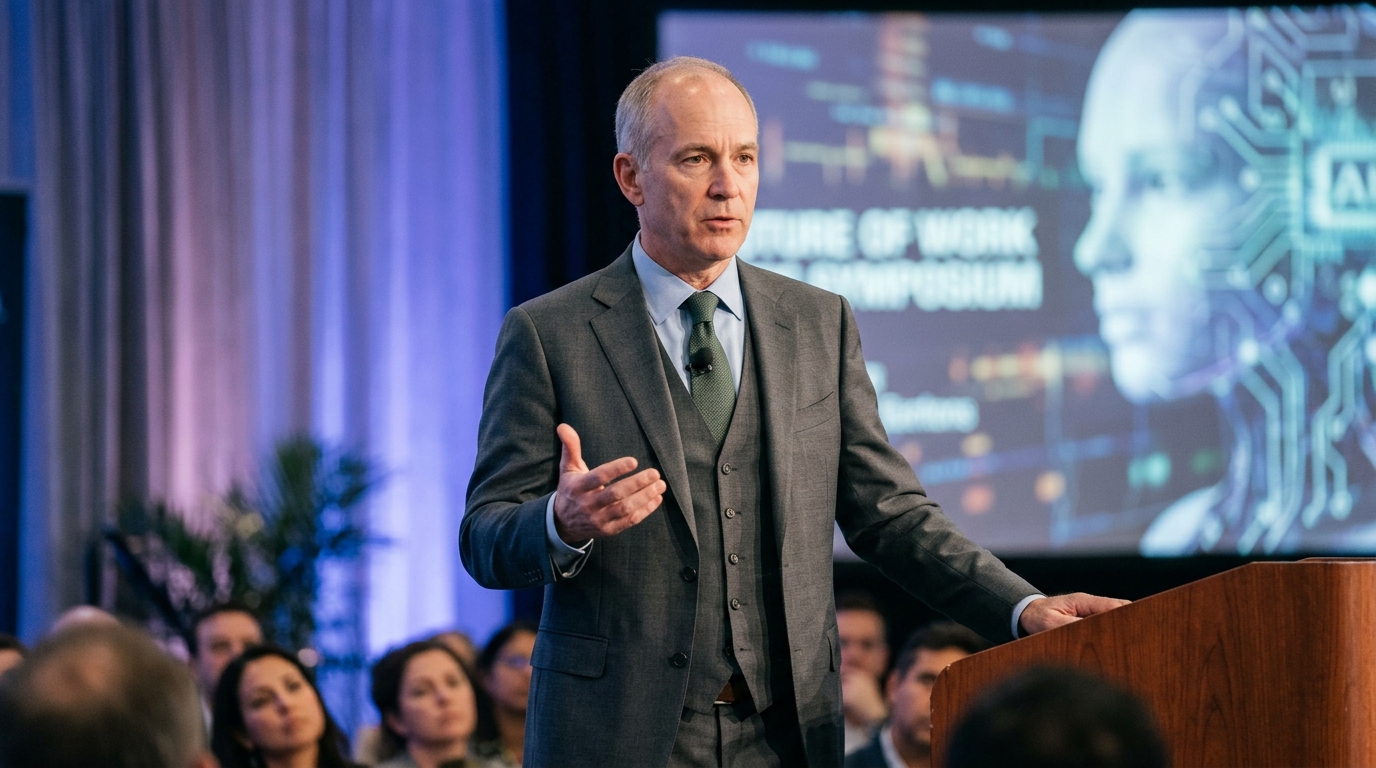
The era of strategic ambiguity regarding Artificial Intelligence (AI) in global boardrooms is coming to an end, replaced by a harsh but necessary dose of realism. Dan Schulman, the former CEO of PayPal and current Chairman of the Board at Verizon, delivered a powerful wake-up call at the Fortune Global Forum. His message was uncompromising: CEOs must stop hiding behind corporate buzzwords like "productivity gains" and start being honest about the fact that AI will inevitably lead to significant job cuts.
The End of Corporate Euphemisms
For several years, the narrative surrounding automation and AI has focused on "augmentation"—the idea that technology will simply free humans from mundane tasks to focus on higher-value work. While this holds true in some sectors, Schulman argues that using this rhetoric to mask large-scale workforce reductions is disingenuous. When a generative AI model can perform the work of multiple entry-level analysts or customer service representatives at a fraction of the cost, the outcome is often displacement, not just evolution.
Schulman suggests that terms like "organizational streamlining" or "digital optimization" are often used as shields to deflect the social and internal backlash of layoffs. However, this lack of candor creates a "trust deficit." Employees are acutely aware of the capabilities of the tools being integrated into their workflows. When leadership fails to acknowledge the obvious risks to job security, it erodes the cultural foundation of the company and breeds a climate of anxiety and resentment.
The Trust Deficit and the Social Contract
Schulman’s intervention arrives at a critical juncture for the global labor market. As AI integration accelerates, the traditional social contract—where loyalty and performance guarantee stability—is being rewritten by algorithms. The Chairman's call for transparency is rooted in the belief that honesty is a strategic asset. If a company is upfront about its transition plan, it retains the moral authority to lead its workforce through the change.
- Transparency enables proactive career pivoting for employees.
- Obfuscation leads to sudden shocks that damage employer branding and societal stability.
- Corporations must balance their investment in AI hardware with an equal investment in human transition.
By being open about job losses, Schulman argues, leaders can facilitate a more orderly transition. This includes providing longer notice periods, more robust severance packages, and genuine pathways for reskilling. Without this transparency, the private sector risks losing its "social license to operate" as public backlash against AI-driven inequality grows.
Reskilling: Reality Check vs. Corporate Myth
A central pillar of the AI transition is the promise of "reskilling." We are frequently told that while AI will take some jobs, it will create others. Schulman, however, points out a structural problem: the speed of AI displacement may far outpace the speed of human retraining. If CEOs are not honest about which roles are disappearing, the efforts to retrain the workforce will be misaligned and ineffective.
"You cannot have an honest conversation about the future if you are not honest about the present," Schulman’s stance implies.
In practice, this means shifting corporate responsibility from quarterly earnings targets to long-term human capital management. If a company knows that 20% of its back-office functions will be automated within three years, telling the truth today allows for a phased transition rather than a catastrophic Friday afternoon email. Schulman’s background at PayPal, where he championed employee financial wellness, adds significant weight to his argument that a company's health is inextricably linked to the well-being of its workers.
Conclusion: A New Paradigm for Leadership
Dan Schulman’s call for radical honesty is a direct challenge to the prevailing norms of Silicon Valley and Wall Street. In an environment where markets often reward headcount reductions with stock price surges, advocating for transparency and social responsibility is a bold move. Yet, it may be the only way to navigate the coming "AI winter" of labor relations.
The integration of AI into the global economy represents a pivotal moment in human history. It offers the potential for unprecedented efficiency and wealth creation. However, if that wealth is built on a foundation of deception and discarded livelihoods, the social and political consequences will be severe. Schulman is reminding his peers that true leadership isn't just about managing technology—it's about managing the human impact of that technology with integrity and courage.