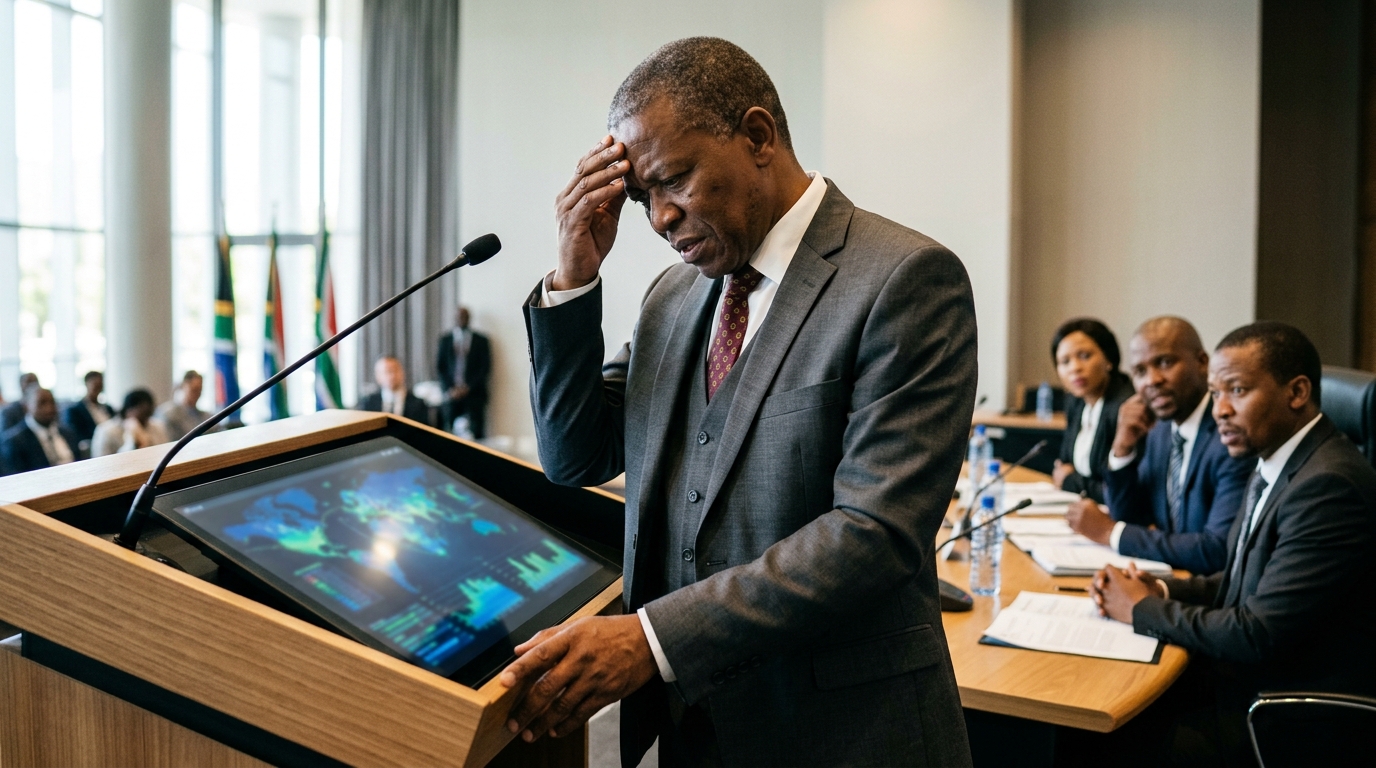
The promise of Artificial Intelligence to eliminate bureaucracy and enhance efficiency met a harsh reality this week in Pretoria. According to a Bloomberg report, two South African ministers found themselves in the crosshairs after it was revealed that official policy documents and progress reports contained serious factual errors, attributed to "hallucinations" from the large language models (LLMs) used to draft them.
This incident is not merely a technical glitch but a profound political crisis for the Government of National Unity (GNU) formed in 2024. The Democratic Alliance (DA), the second-largest partner in the coalition, had made digital transformation a central pillar of its agenda. The promise was simple: leveraging cutting-edge technology could bypass decades of dysfunction in public administration. However, the rush to adopt these tools without necessary safeguards appears to have backfired spectacularly.
The Efficiency Trap: When Innovation Outpaces Oversight
At the heart of the controversy are reports concerning infrastructure development and social welfare. According to sources close to the government, ministers used advanced AI tools to summarize data and draft speech outlines and legislative proposals. The problem arose when these models "invented" crime statistics and cited non-existent legal precedents to support proposed policies.
The opposition, led by the Economic Freedom Fighters (EFF), lost no time in capitalizing on the blunder. "We are seeing a government that has surrendered its national sovereignty and intellectual integrity to Silicon Valley algorithms," a party spokesperson stated. The argument is potent: if ministers cannot distinguish truth from digital fiction in their own documents, how can they inspire confidence in the citizenry?
The crisis highlights a broader trend in emerging economies, where the pressure for quick results leads to the adoption of "black box" tools. The lack of specialized personnel capable of auditing AI output creates an accountability vacuum. In South Africa's case, this vacuum manifested as official ministerial statements built on a foundation of fictional data.
The Technical Reality: Why LLMs Struggle with Local Context
One of the primary reasons for hallucinations at this level is the lack of South Africa-specific context in global AI training datasets. Most LLMs are trained on data predominantly from the Global North. When tasked with processing complex South African legal or social issues, they often "fill in the gaps" with information that sounds plausible but is factually incorrect.
"AI is not a neutral truth machine; it is a mirror of the data it was trained on. When used for governing a nation with such a specific history and legal structure, the risk of error is exponential," says a Johannesburg-based tech analyst.
Furthermore, using AI for drafting creates a phenomenon known as "automation bias." Users tend to trust computer output more than their own judgment, especially when the text is well-written and persuasive. This is exactly what happened to the DA ministers: the elegant phrasing of the AI blinded them to blatant content errors.
Lessons for Global Governance
South Africa's predicament serves as a warning to any government seeking a "digital utopia." Integrating AI into public administration requires more than just software subscriptions. It demands a framework of ethical and operational oversight to ensure a "human-in-the-loop" remains central to the process.
Already, voices within the South African government are calling for the establishment of a National AI Ethics Council to vet all algorithmic tools used by the state. The challenge is to ensure this crisis does not lead to a new form of technological Luddism, but rather to a more mature and responsible application of technology. The credibility of 21st-century democracy may well depend on our ability to govern the machines we built to assist us.
In a country still grappling with the wounds of the past and the inequalities of the present, "digital truth" cannot be left to chance. The case of the DA ministers will go down in history as the moment political ambition collided with algorithmic instability, reminding us that governance remains a deeply human art.