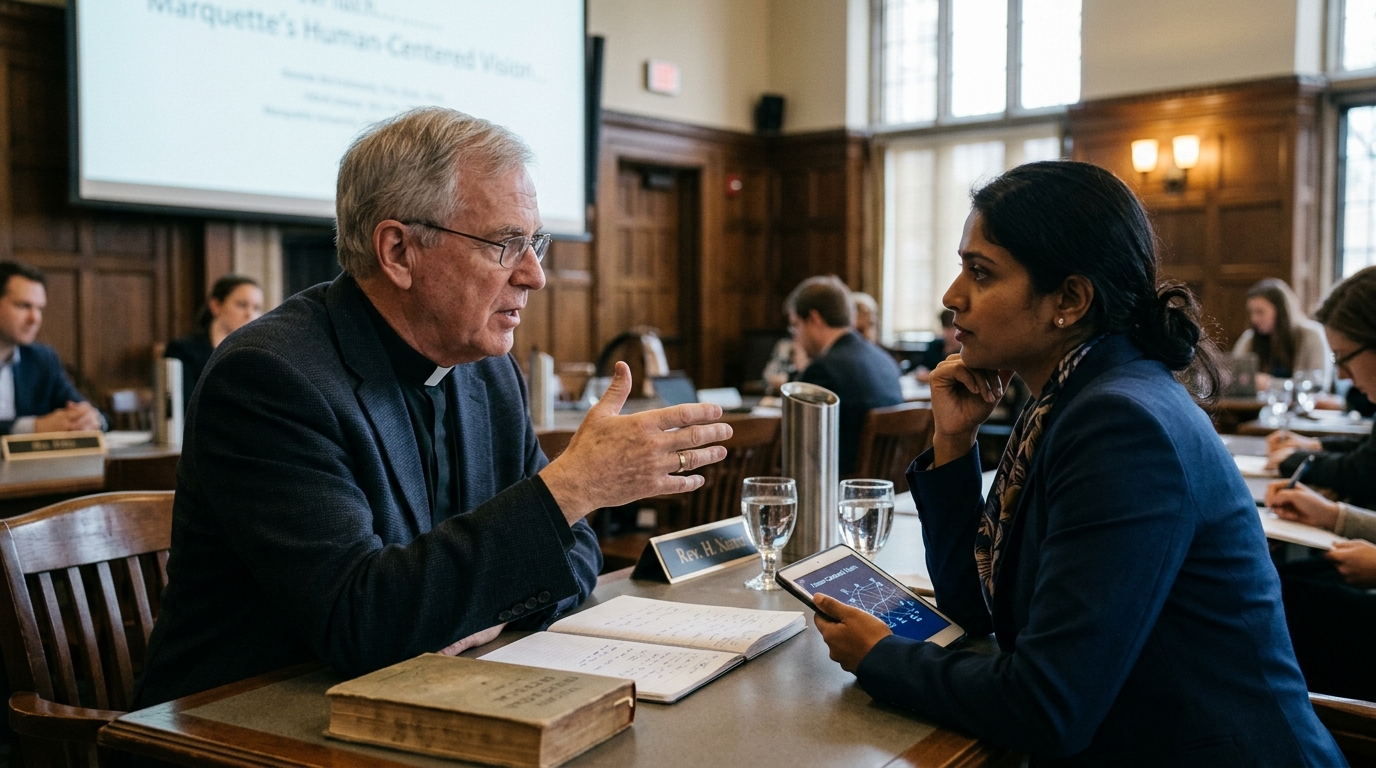
In an era where Artificial Intelligence (AI) is radically transforming the social and economic landscape, the search for ethical foundations often leads us to unexpected sources. Recently, the academic community at Marquette University highlighted a striking parallel between Pope Leo XIII’s encyclical 'Rerum Novarum' and contemporary efforts toward human-centered AI. This connection is not merely historical but deeply political and social, posing the fundamental question: How can we ensure that technological progress serves human dignity rather than the other way around?
The Legacy of Rerum Novarum in the 21st Century
The encyclical Rerum Novarum, published in 1891, was the Catholic Church's response to the challenges of the Industrial Revolution. Pope Leo XIII defended workers' rights, the dignity of labor, and the need for social justice in the face of unchecked exploitation. Today, as we stand on the threshold of the Fourth Industrial Revolution, these principles resonate with renewed intensity. AI, while offering immense potential, carries the risk of reducing humans to mere data points within an opaque algorithm.
Marquette University, as a Jesuit institution, integrates these values into its AI research. Their approach focuses not just on the technical prowess of models, but on their ethical constitution. The concept of 'Cura Personalis' (care for the whole person) translates in the digital age as the need for transparent, fair, and accountable algorithms that do not replicate biases or undermine human agency.
Algor-ethics: The Catholic Church’s New Challenge
The Vatican, under the leadership of Pope Francis, has introduced the term 'algor-ethics,' continuing the tradition started by Leo XIII. The idea is simple yet radical: ethics must be embedded in the design of algorithms from the very beginning (ethics by design). It is not enough to fix the consequences of bad technology; we must program it with the common good in mind.
- Transparency: Algorithms must not operate as 'black boxes.'
- Fairness: Avoiding discrimination against vulnerable social groups.
- Responsibility: Who is accountable when an AI system makes a wrong decision?
- Human Oversight: The final decision must always remain in human hands.
At Marquette, researchers are working on tools that allow developers to test their models for ethical gaps. This 'chemistry' between theology and computer science creates a new framework for software development, where efficiency is not the sole criterion for success.
Labor in the Age of Automation
One of the central points of Rerum Novarum was the protection of the worker. Today, AI threatens to replace not only manual but also cognitive labor. Marquette’s approach argues that technology should function as an 'augmentation' of human labor rather than a substitute that leads to marginalization. Ethical AI means creating systems that free humans from repetitive tasks, allowing them to focus on creative and socially beneficial activities.
"Technology is a product of human creativity, but it must remain a tool in the service of humanity, not a tyrant that imposes its own logic on social coexistence."
In conclusion, the connection between Pope Leo’s encyclical and modern research at Marquette reminds us that humanity’s great questions remain unchanged. Whether it is the steam engines of the 19th century or the Large Language Models (LLMs) of the 21st, the stake is the same: preserving the sanctity of the human person in a rapidly changing world.