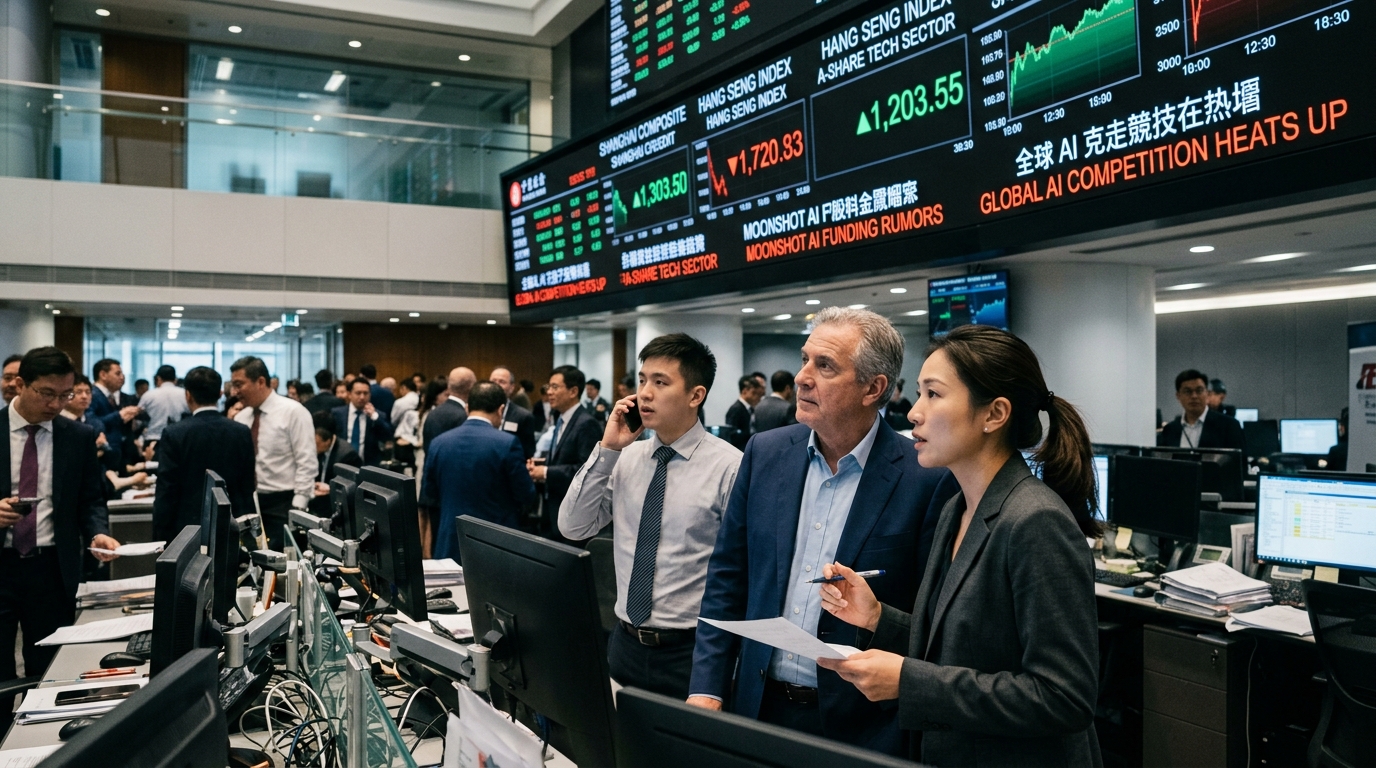
In the rapidly shifting landscape of global technology, the news that Chinese startup Moonshot AI has raised a staggering $2 billion, propelling its valuation to $20 billion, is more than just a business success story. It is a definitive statement of intent from Beijing and Asia’s tech titans. At a time when the United States is intensifying efforts to restrict China’s access to critical semiconductors, the emergence of Moonshot AI as a world-class 'decacorn' proves that the battle for AI supremacy is entering a new, more aggressive phase.
The Rise of a Decacorn: Breaking Down the $20 Billion Valuation
Moonshot AI, founded by the charismatic Yang Zhilin—a world-renowned researcher with a pedigree from Google and Meta—has successfully secured the backing of giants like Alibaba, Tencent, and HongShan (formerly Sequoia China). The company’s flagship product, the Kimi chatbot, has caused a stir in the tech community due to its unprecedented ability to handle massive 'context windows.' While most models struggle to maintain coherence over long texts, Kimi can process hundreds of thousands of Chinese characters—and now millions—allowing users to analyze entire books, legal documents, or complex codebases in a single prompt.
This technical prowess is no accident. Yang Zhilin has focused on model architectures that prioritize efficient long-term memory, a field where Moonshot AI appears to be outpacing even established Western players. The ability of an AI to 'remember' and connect information from the beginning of a massive file to its end is the 'Holy Grail' for enterprise applications, ranging from financial analysis to medical research.
Context is King: The Kimi Advantage
What sets Moonshot AI apart from the plethora of LLM developers is its laser focus on utility. In the Chinese market, where efficiency and integration are paramount, Kimi has become a favorite among professionals. By solving the 'memory' problem, Moonshot has moved beyond the gimmickry of simple chat and into the realm of high-level cognitive labor. This focus on long-context capabilities is a strategic move to differentiate itself from Baidu’s Ernie Bot or Alibaba’s Tongyi Qianwen.
The $2 billion funding round is particularly notable because it features both Alibaba and Tencent as lead participants. These two companies are historical rivals, often competing for dominance in every sector from payments to gaming. Their joint investment in Moonshot AI suggests a strategic consolidation, a 'national champion' approach to ensure that China has a viable competitor to OpenAI’s GPT-4 and Anthropic’s Claude.
Navigating the Silicon Curtain: Sanctions and Sovereignty
The geopolitical backdrop cannot be ignored. As the US Department of Commerce tightens export controls on H100 and A100 chips, Chinese AI firms are forced to innovate under pressure. Moonshot AI’s success suggests that software optimization may be the key to bypassing hardware bottlenecks. By creating more efficient training algorithms, Moonshot can extract more performance from the hardware it currently possesses.
"Moonshot AI represents a shift in the global AI hierarchy. It is no longer just about who has the most chips, but who has the most elegant architecture to utilize them," notes a senior analyst at a major Hong Kong investment bank.
Furthermore, the Chinese government’s regulatory stance, led by the Cyberspace Administration of China (CAC), remains a critical factor. Moonshot AI has navigated these waters skillfully, ensuring its models comply with local data and content regulations while maintaining a competitive edge. This balance of innovation and compliance is the blueprint for the next generation of Chinese tech leaders.
In conclusion, Moonshot AI’s $20 billion valuation marks the end of the era of Silicon Valley’s undisputed hegemony. China now possesses the talent, the data, and the capital to lead the next revolution. The question is no longer whether China will catch up to the West, but how these two distinct ecosystems will interact in a digital world that is increasingly defined by sovereign boundaries.