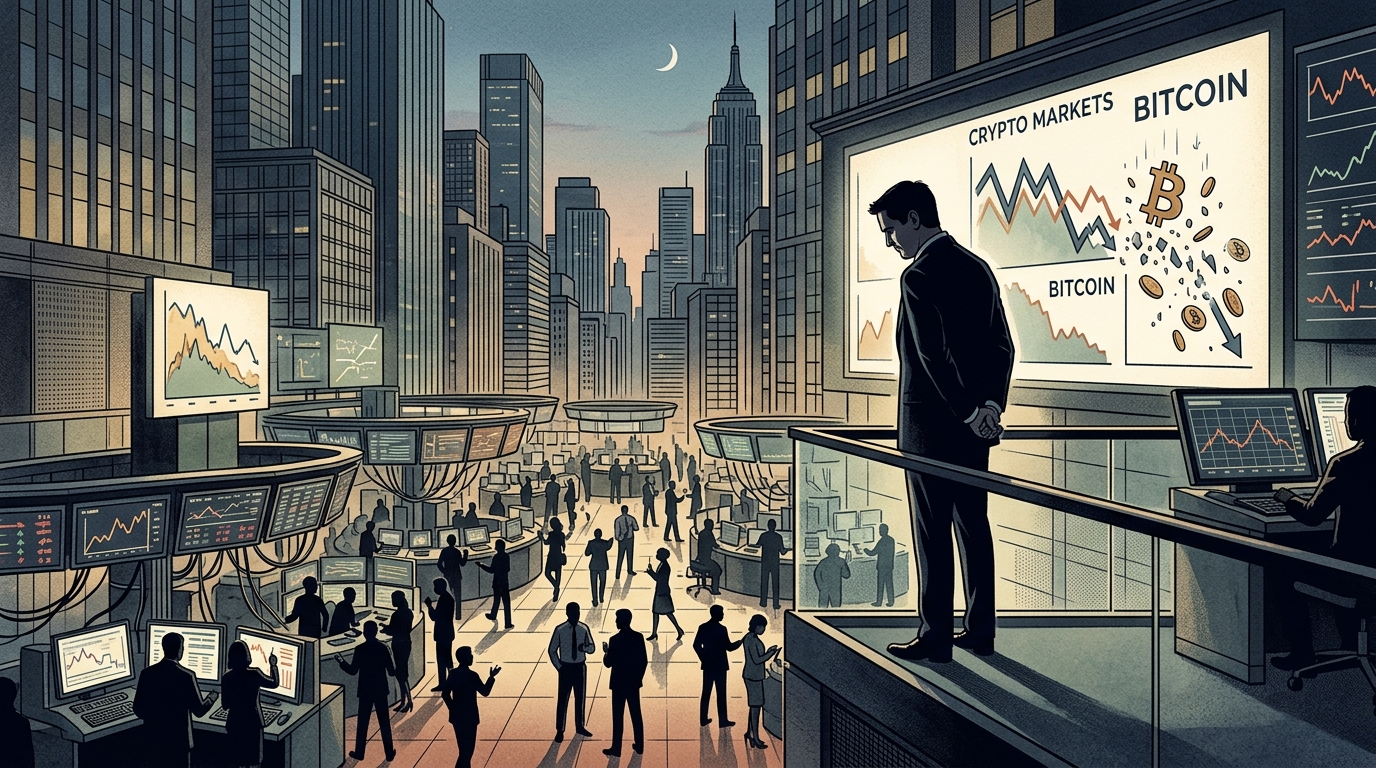
The financial world was sent into a tailspin this week as Mark Cuban, the billionaire owner of the Dallas Mavericks and one of crypto's most vocal proponents, announced a significant pivot in his investment philosophy. In a candid interview, Cuban expressed profound disappointment with Bitcoin, stating that the asset has failed to live up to its most critical promise: acting as a reliable hedge against inflation and market volatility.
The Death of the 'Digital Gold' Narrative
For nearly a decade, the core argument for Bitcoin's existence was its scarcity. Proponents labeled it "Digital Gold," suggesting that in times of rampant money printing and geopolitical instability, Bitcoin would remain a stable store of value. However, the market performance of 2025 and early 2026 has systematically dismantled this theory. Instead of moving inversely to traditional markets, Bitcoin has shown a near-perfect correlation with high-risk tech stocks. When the Federal Reserve tightened liquidity, Bitcoin didn't just dip—it plummeted.
"It’s not the hedge that I expected it to be," Cuban remarked. He noted that during the recent global inflationary spikes, investors didn't flock to Bitcoin; they fled to the safety of the U.S. Dollar and physical gold. This realization has forced many institutional players to reconsider whether Bitcoin is an actual asset class or merely a high-beta play on tech liquidity. For Cuban, the lack of decoupling from traditional equity markets is a fatal flaw for an asset that claimed to be an alternative to the system.
Utility vs. Speculation: The Missing Link
Cuban’s critique goes deeper than just price action. He has long been a fan of the underlying blockchain technology, particularly Ethereum’s ability to execute smart contracts. However, he now views Bitcoin as a stagnant asset. In a world where Artificial Intelligence is driving immediate, tangible gains in productivity, Bitcoin’s "buy and hold" (HODL) culture feels increasingly archaic. "If an asset doesn't generate cash flow, provide a service, or solve a unique problem, its value is purely psychological," Cuban argued.
This shift reflects a broader trend in the 2026 investment landscape. The "hype cycles" of the early 2020s have been replaced by a demand for fundamental value. As AI agents begin to manage portfolios and automate complex financial tasks, the manual and often risky nature of managing crypto wallets and private keys seems like a relic of a less efficient era. Cuban suggests that without a massive leap in utility, Bitcoin risks becoming the "Beanie Babies of the digital age."
Regulatory Pressures and the Rise of CBDCs
Beyond market performance, the regulatory environment has become a minefield. From the SEC’s aggressive enforcement to the EU’s stringent MiCA II framework, the "Wild West" days of crypto are over. Cuban pointed out that the increased oversight has stripped away the anonymity and ease of use that originally attracted many users. Furthermore, the emergence of Central Bank Digital Currencies (CBDCs) has provided a state-sanctioned alternative for those seeking digital efficiency without the volatility of decentralized coins.
Cuban also highlighted the persistent security issues that plague the industry. "We were promised a decentralized utopia, but what we got was a landscape of hacks, lost keys, and complex interfaces that the average person can't navigate safely," he said. For a billionaire who prides himself on investing in scalable, user-friendly technologies, the friction inherent in the Bitcoin ecosystem has become a dealbreaker.
Conclusion: The Great Realignment
Mark Cuban’s departure from the Bitcoin camp is more than just one man’s change of heart; it is a signal of the Great Realignment in global finance. The era of speculative excess is being replaced by a focus on technological integration and real-world impact. While Bitcoin may maintain a niche as a speculative vehicle for risk-tolerant traders, its dream of becoming a global reserve currency or a universal hedge appears to be fading. As we move further into 2026, the focus is shifting toward assets that offer both stability and technological utility—two things Cuban believes Bitcoin has failed to provide.
"The market is telling us something, and we have to listen. Bitcoin had its chance to be the world's safety net, but it chose to be just another ticker symbol on the Nasdaq." — Mark Cuban