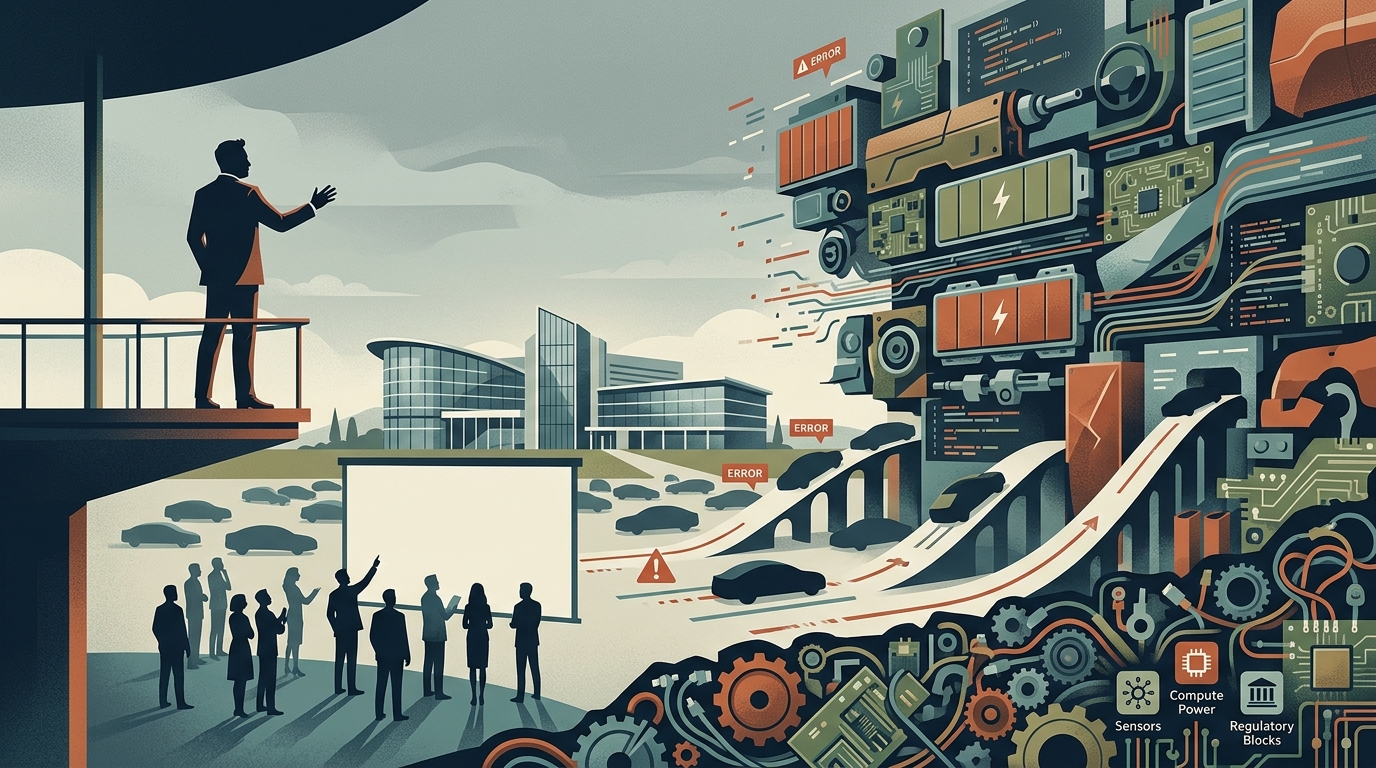
In a moment of rare, albeit forced, candor during the Q1 2026 earnings call, Elon Musk confirmed what many analysts had long feared: Hardware 3 (HW3), the computer powering approximately 4 million Tesla vehicles on the road today, may never be capable of supporting "unsupervised" Full Self-Driving (FSD). This statement marks a significant turning point in the company's history, as it collapses a promise made repeatedly since 2016—that every Tesla sold contains all the necessary hardware for future full autonomy via software updates.
The Technical Reality Behind the Admission
The evolution of Tesla's FSD has shifted from traditional rule-based programming to an "end-to-end" neural network architecture. While this approach has dramatically improved driving behavior, it requires immense computational power. HW3, introduced in 2019 as the "world's best processor" for autonomous driving, now appears to be suffocating under the weight of increasingly complex AI models. Musk admitted that fitting these models into the constraints of HW3 requires "massive effort" and that there is no guarantee the final result will meet the safety standards for driving without human supervision.
The issue is not just processing speed, but also memory and data bandwidth. Newer Hardware 4 (HW4) and the upcoming Hardware 5 (AI5) models possess significantly greater capabilities, allowing Tesla to train larger and more capable neural networks. For HW3 owners, this means their vehicle may forever remain in a state of "supervised" autonomy, where the driver must be ready to take control at any moment, effectively nullifying the promise of a vehicle that could operate as an autonomous Robotaxi.
Consumer Outrage and Legal Implications
The reaction from the Tesla owner community was immediate and intense. Many purchased the FSD package for thousands of dollars (up to $15,000 at certain times) with the explicit assurance that their car's hardware was sufficient. The admission that HW3 might not be enough opens the door to class-action lawsuits and legal challenges worldwide. Tesla has promised free hardware upgrades in the past if deemed necessary, but upgrading from HW3 to HW4 is not a simple "plug-and-play" process, as it requires different wiring, cameras, and cooling systems.
- Approximately 4 million vehicles are directly affected by this limitation.
- The resale value of older models is expected to take a significant hit.
- Elon Musk's credibility regarding timelines and technical capabilities is under scrutiny.
Musk mentioned that the company would try to offer an upgrade to HW3 owners, but technical difficulties make this promise dubious. If Tesla is forced to retrofit millions of vehicles with new computers and cameras, the cost could run into billions of dollars, significantly impacting its financial results at a time when competition from China is squeezing profit margins.
The Shift to Cybercab and the Future of Autonomy
This admission also explains why Tesla is focusing so heavily on the new "Cybercab," a vehicle designed from the ground up for full autonomy without a steering wheel or pedals. The Cybercab will use Hardware 5 (AI5), which is specifically designed to handle the massive volume of data required for unsupervised driving. However, this leaves existing Tesla customers feeling that their vehicles are "last-generation products" before the technology they paid for has even been completed.
"It is a bitter truth for millions of supporters who believed in the vision. Technology moves faster than the hardware's ability to support it, and in Tesla's case, this gap has just become official."
In conclusion, Tesla is at a critical crossroads. On one hand, progress in artificial intelligence is impressive and promises a future without accidents. On the other hand, the failure to fulfill promises to existing customers creates a crisis of trust that could affect the brand for years to come. The market is no longer just looking at what Tesla's software can do, but whether the company can honor the contract of trust it signed with its millions of drivers.