
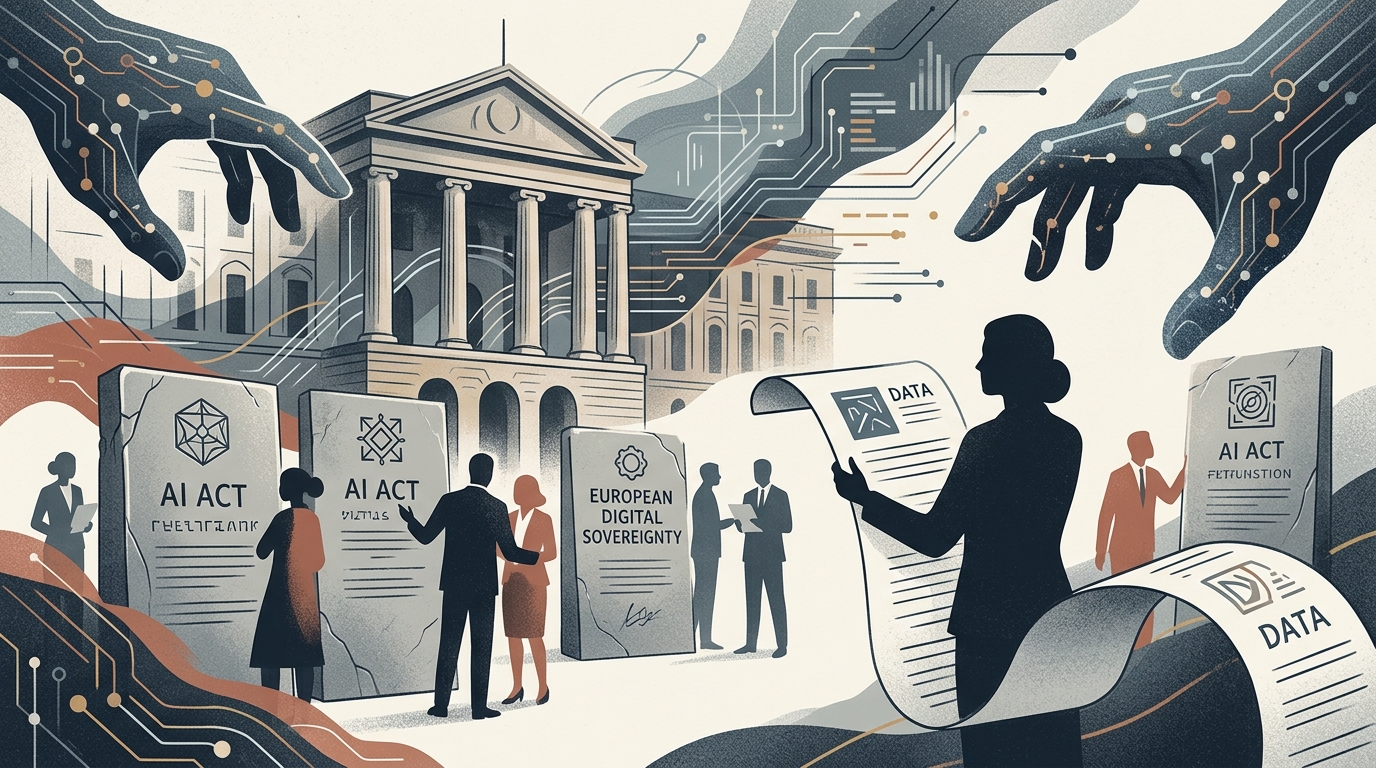
In ancient Athens, the Seisachtheia—the shaking off of burdens—was not merely an economic reform; it was a structural necessity to prevent the collapse of the polis under the weight of debt. Today, as we navigate the midpoint of 2026, the European Union finds itself in a precarious position regarding a different kind of obligation: technological debt. While Brussels has successfully exported its values through the 'Brussels Effect' of the AI Act, the continent faces what I term the 'Dependency Trap'—a state where we govern the world’s algorithms but fail to host the infrastructure that powers them.
The Great Regulatory Collision of 2026
The recent 'Great Regulatory Collision' regarding data privacy and AI progress highlights a fundamental friction. On one hand, the European commitment to civil liberties and data protection remains the gold standard for democratic governance. On the other, the aggressive expansion of Alibaba Cloud in Singapore and the predatory pricing strategies of firms like DeepSeek—which recently slashed V4 Pro prices by 75%—create an environment where European firms are incentivized to outsource their intelligence to non-EU entities. In my analysis, regulation without industrial capacity is not leadership; it is a sophisticated form of consumer protection for a market that is slowly losing its agency.
"To legislate for a tool one does not possess is to write the rules of a game one is not invited to play."
The failure of legislative efforts in regions like Missouri to fill power vacuums demonstrates that when democratic institutions stall, private power or foreign influence inevitably rushes in. For Europe, the risk is not just the lack of a 'European OpenAI' or 'European Alibaba,' but the systemic erosion of our ability to enforce our own standards. If the underlying hardware and foundational models are controlled by geopolitical rivals or trillion-dollar establishments beyond our jurisdiction, our regulations become mere suggestions, easily bypassed by the sheer force of economic necessity.
A Framework for Sovereign Intelligence
To move beyond this impasse, we must propose a governance framework that treats AI not as a commodity to be regulated, but as a public utility to be fostered. The 'Black Gold' of our era requires more than just environmental and ethical constraints; it requires a 'Digital Polis'—a concerted effort to build sovereign compute and data commons. We must consider three pillars of institutional reform:
- Strategic Autonomy in Compute: Redirecting EU industrial policy to subsidize the energy and hardware costs for local AI startups, countering the price wars initiated by DeepSeek and Alibaba.
- Harmonized Data Sovereignty: Resolving the 2026 privacy collision by creating 'Safe Harbors' for research that allow for high-velocity innovation without compromising the GDPR’s core tenets.
- Institutional Resilience: Establishing a permanent EU AI Governance Body that functions less like a court and more like an investment board, focusing on the deployment of AI in public services to ensure the state remains technologically competent.
The warnings from Pope Leo XIV regarding the 'disarming' of AI and its role in warfare remind us that the stakes are not merely economic. AI is an instrument of power. If Europe continues to lead in regulation while lagging in production, we will find ourselves in a position of 'gilded irrelevance'—protected by laws but powerless in the face of global shifts. We must seek a balance, much like the middle path I advocated for in Athens, where the law serves the people without stifling the growth that ensures their survival.