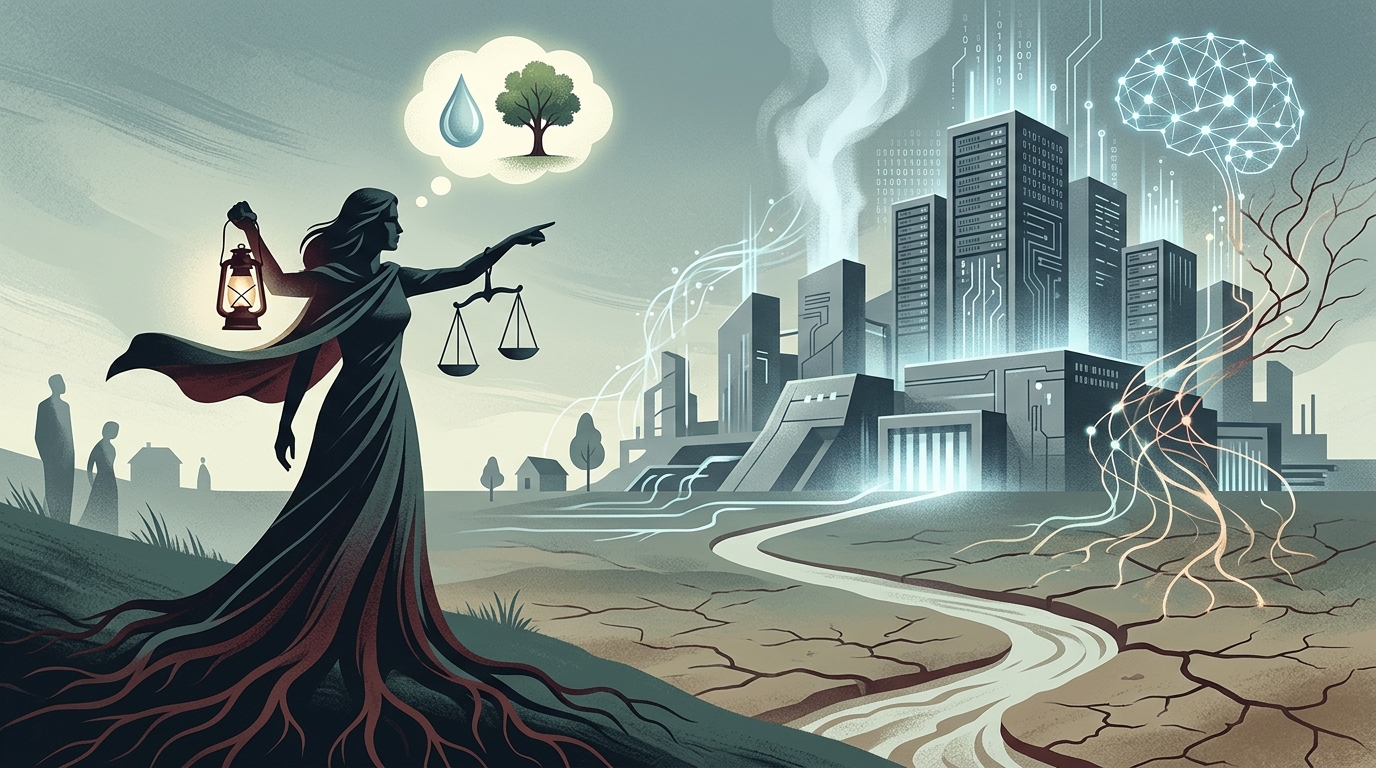
In the contemporary public sphere, Artificial Intelligence (AI) is often presented in terms that are almost religious or geopolitical. Describing it as the 'black gold' of the 21st century is not merely an economic metaphor for the value of data; it is a statement of intent regarding how this technology is to be 'extracted' from the human experience. Just as oil fueled the industrial revolution but left an environmental crisis in its wake, AI promises a digital renaissance while simultaneously threatening to turn human cognition itself into a measurable, marketable commodity.
The Mythology of Inevitable Progress
The dominant narrative surrounding AI is built upon the myth of 'inevitability.' We are told that the integration of AI into every facet of our lives—from education and labor to our personal relationships—is a natural evolution, akin to the discovery of fire or the wheel. However, this approach overlooks the fact that technology does not develop in a vacuum. It is the result of specific political and economic choices that serve the interests of a Silicon Valley oligarchy.
The 'ritual' of integration, as observed in educational systems and workplaces, often lacks substance. It is not a critical adoption of tools meant to enhance human creativity, but rather a hasty submission to market dictates. Schools and universities are pressured to 'modernize,' often without questioning the pedagogical cost of replacing instructional interaction with algorithmic models. Knowledge is transformed into information, and learning into a process of data optimization.
Extractive Capitalism and the Illusion of Integration
If oil lies beneath the ground, the 'black gold' of AI lies within us. Every click, every thought recorded in a search engine, every emotion analyzed by an algorithm, constitutes the raw material for training Large Language Models (LLMs). This process is not 'integration'; it is extraction. The illusion that AI serves us collapses when we realize that we are the product fueling the machine.
- The Deconstruction of Labor: AI does not simply replace jobs; it strips labor of its meaning, turning the worker into a mere supervisor of algorithms.
- The Environmental Footprint: The 'black gold' metaphor is apt for another reason: the massive consumption of energy and water required by data centers, an aspect frequently silenced in mainstream discourse.
- The Crisis of Truth: The production of synthetic content on an industrial scale threatens to drown genuine human expression in an ocean of algorithmic mediocrity.
"Artificial Intelligence is not a mirror of human intelligence, but a distortion of it, designed to serve efficiency at the expense of freedom."
The Dangerous Illusion of Neutrality
One of the most perilous elements of this new era is the belief that algorithms are neutral. In reality, AI carries within it all the biases, ideologies, and inequalities of the data it was trained on. When we speak of 'integrating' AI into the judiciary or policing, we are essentially automating and legitimizing old injustices under the cloak of technological objectivity.
Our society stands at a crossroads. Accepting AI as an inevitable 'destiny' robs us of the ability to set terms. The real challenge is not learning how to use AI tools, but how to protect our human core from total digitization. 'Integration' must give way to 'critical oversight.' Unless we realize that the 'black gold' of our time is being extracted from our very souls, we risk becoming passive spectators of an evolution that concerns us but does not belong to us.