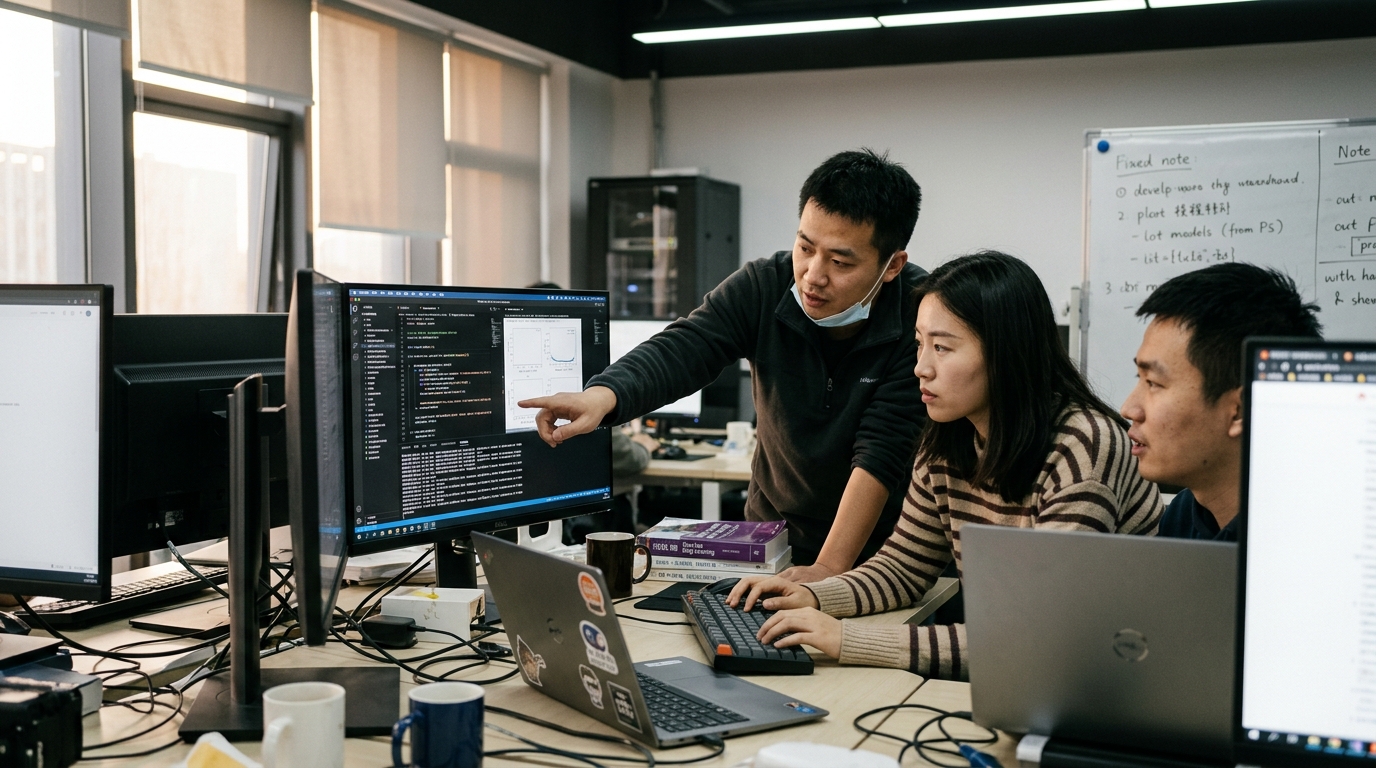
In a move that underscores China's strategic pivot toward democratized access to high-performance computing, the National Supercomputing Internet (NSI) has announced the launch of a limited-time free dialogue service for the DeepSeek-V4 model. This development, first reported by AASTOCKS, is not merely a promotional stunt but a clear demonstration of Beijing's ability to synthesize state-owned infrastructure with the cutting edge of Artificial Intelligence research.
The Convergence of Infrastructure and Intelligence
DeepSeek-V4 represents the pinnacle of Chinese efforts to create Large Language Models (LLMs) that can compete on equal footing with counterparts from OpenAI and Google. Built upon a sophisticated Mixture-of-Experts (MoE) architecture, V4 promises enhanced logical reasoning, coding proficiency, and a deep understanding of both Chinese and English. However, the real story lies not in the model itself, but in its distribution mechanism.
The National Supercomputing Internet functions as a sort of 'power grid' for computational power, interconnecting various supercomputing centers across the Chinese territory. By offering DeepSeek-V4 for free for a limited period, the NSI aims to attract developers and researchers who would traditionally rely on private cloud platforms. This centralized management allows for optimal resource allocation, ensuring that AI training and inference are not bottlenecked by specialized hardware shortages, despite international restrictions.
Geopolitical Implications and Self-Reliance
This move comes at a critical juncture for the global technological landscape. As the United States continues to tighten export controls on high-end semiconductors to China, Beijing is responding by fortifying its domestic AI value chain. DeepSeek-V4 has been optimized to run efficiently on domestically produced AI accelerators, proving that China can deliver world-class results even under a regime of sanctions.
- Boosting domestic research through free access to cutting-edge resources.
- Reducing dependence on foreign software and hardware ecosystems.
- Showcasing the power of the National Supercomputing Internet as a unified platform.
- Positioning DeepSeek as the dominant accessible model in the Asian market.
The strategy of 'Sovereign AI' pursued by China differs radically from the Silicon Valley model. While in the US, development is driven by private sector giants with massive capital, in China, we see a tight integration between the state, research institutes, and companies like DeepSeek. This allows for a more coordinated approach to solving scale-related problems, though it raises questions regarding data control and information freedom.
The Future of Computing as a Public Utility
The free availability of DeepSeek-V4 via the NSI suggests that China now views AI computational power as a public utility, akin to water or electricity. This approach could dramatically accelerate AI adoption in fields such as biology, materials science, and industrial manufacturing, where the cost of compute has previously been a significant barrier.
"The integration of our most advanced models into national infrastructure is not just a technical achievement, but a commitment to the technological progress of the entire nation," a DeepSeek spokesperson noted during the launch.
However, challenges remain. Maintaining such a network requires vast amounts of energy and constant equipment upgrades. Furthermore, the global competition for talent means that China must offer more than just free access: it must foster an ecosystem that encourages innovation and entrepreneurship without the constraints that often accompany state oversight. DeepSeek-V4 is the tool, but success will be judged by how the next generation of Chinese scientists utilizes it.