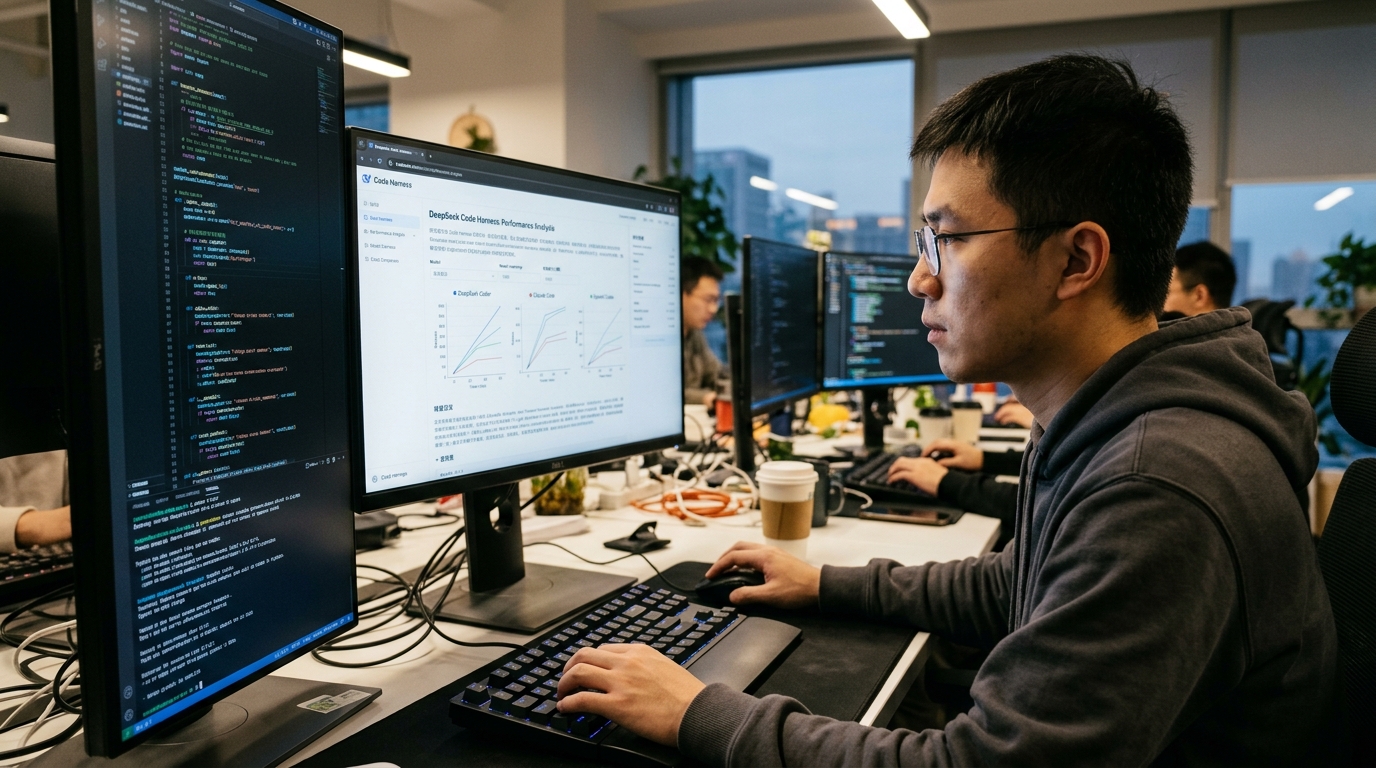
In the rapidly shifting landscape of Artificial Intelligence, the battle for dominance in software development is entering a new, more aggressive phase. DeepSeek, the Hangzhou-based research lab that has consistently disrupted Silicon Valley with its high-efficiency models, has announced the formation of a specialized development team for its 'Code Harness' project. This move is far more than a simple iteration of existing tools; it is a direct strategic challenge to Anthropic’s Claude Code and OpenAI’s Codex-powered ecosystem.
The Strategic Shift: From Autocomplete to Autonomous Execution
Until recently, AI's contribution to programming was largely confined to 'intelligent completion.' Tools like GitHub Copilot, built on the Codex framework, offered code snippets that developers had to manually verify and integrate. However, 2025 and early 2026 have seen a definitive pivot toward 'agentic' systems. Anthropic’s Claude Code set a high benchmark by allowing AI to interact directly with the terminal, execute test suites, and fix bugs in real-time without constant human prompting.
DeepSeek’s 'Code Harness' aims to capture this new frontier. The term 'harness' implies the creation of a controlled environment where the AI doesn't just generate code but 'governs' it. Internal sources suggest the team is focusing on a closed-loop feedback system where the AI can predict algorithmic failure before execution, utilizing advanced reasoning techniques similar to OpenAI’s o1 series, but at a fraction of the computational cost and latency.
Why DeepSeek is an Existential Threat to US Tech Giants
DeepSeek is not a conventional market player. It has repeatedly proven its ability to train world-class models, such as DeepSeek-V3, using significantly fewer resources than its Western counterparts. By leveraging Multi-head Latent Attention (MLA) and Mixture-of-Experts (MoE) architectures, DeepSeek has delivered performance that rivals GPT-4o while remaining economically accessible and often open-weights.
- Cost and Accessibility: While Anthropic and OpenAI keep their top-tier models behind premium APIs and subscriptions, DeepSeek tends to democratize access, attracting millions of developers across Asia and Europe who are price-sensitive but performance-oriented.
- Specialized Coding Prowess: DeepSeek-Coder is already a favorite among software engineers for its nuanced understanding of complex dependencies within massive repositories, often outperforming general-purpose models in niche languages.
- Agility: The formation of the Code Harness team indicates a level of organizational agility that the bureaucratic structures of American Big Tech often struggle to match.
The Geopolitical Dimension of Software Autonomy
This development cannot be viewed in isolation from the broader geopolitical context. Amidst strict export controls on high-end AI chips to China, the necessity for hyper-efficient AI software has become a mother of invention. DeepSeek has turned these constraints into a competitive advantage, optimizing its algorithms to perform on less powerful hardware. 'Code Harness' is expected to be the pinnacle of this effort: a tool that allows Chinese enterprises—and the global developer community—to build software with minimal human intervention, effectively bypassing the need for US-centric development stacks.
"We are no longer in an era where AI helps us write code. We are in an era where AI manages the systemic complexity that human minds can no longer fully grasp," notes a leading industry analyst.
Challenges and the Future of the Engineering Profession
Despite the momentum, DeepSeek faces significant hurdles. Code safety, security vulnerabilities, and intellectual property rights remain contentious. Code Harness will need to prove that it does not introduce 'hallucinated' security flaws and that it respects the complex licensing of open-source software. Furthermore, competition from Microsoft’s GitHub, which is now integrating multi-model support into Copilot Extensions, makes the market incredibly fragmented.
In conclusion, DeepSeek’s Code Harness initiative signals the end of the American monopoly on AI-driven development tools. If the Chinese firm successfully delivers a system that combines the agentic intelligence of Claude Code with the cost-efficiency of its own models, the fundamental process of building global software will be irrevocably changed. The developers of 2026 are no longer 'writers'; they are 'orchestrators' of powerful AI agents.