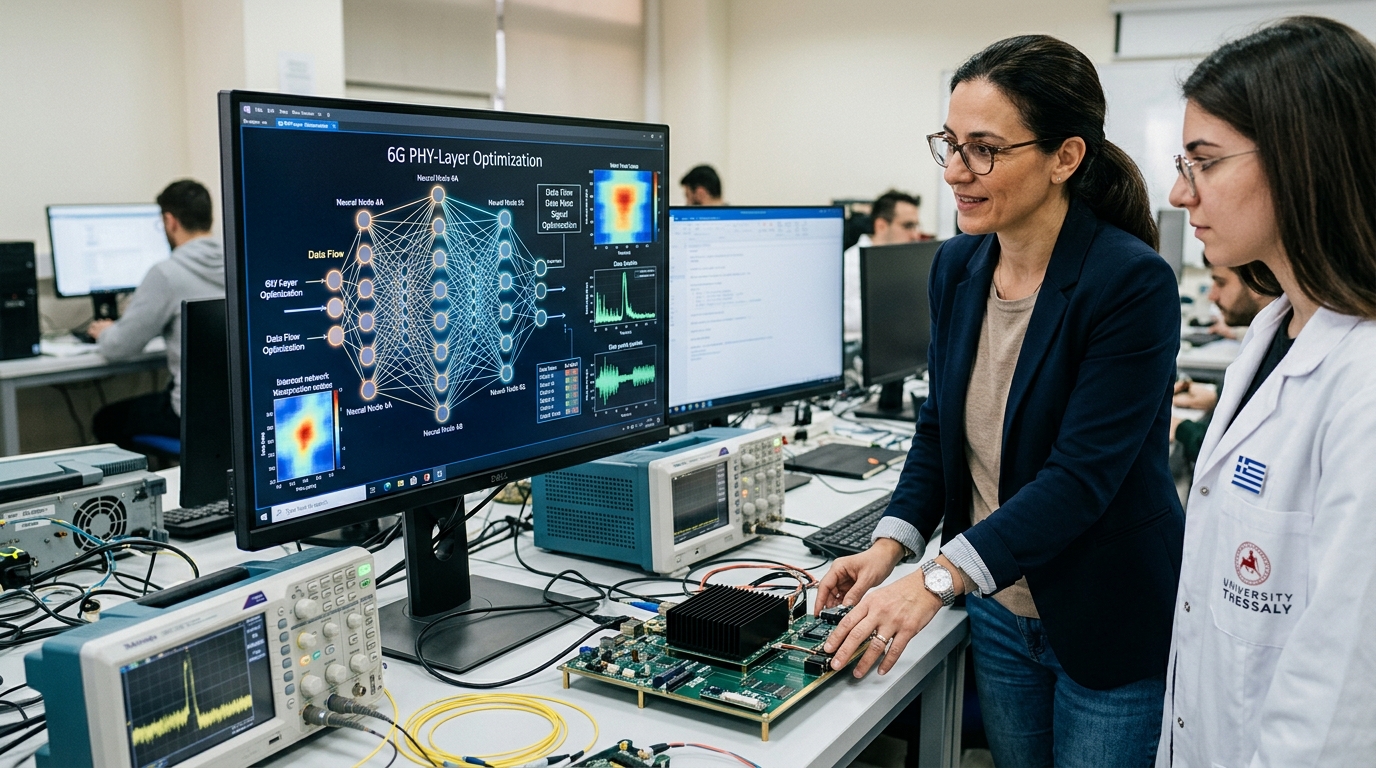
In an era where digital sovereignty has become the new frontier of geopolitical competition, Greece is asserting its presence in the most advanced technological developments. The Telecommunications and Networks Laboratory of the University of Thessaly (UoT) is emerging as a central pillar of European research into 6G, integrating Artificial Intelligence (AI) into the very core of telecommunications infrastructure. This is not merely a speed upgrade; it is a radical paradigm shift in how machines, humans, and the environment interact.
The 6G Architecture: Beyond the Limits of 5G
While the world is still grappling with the full potential of 5G, the research community in Volos and Lamia is already laying the foundations for the next decade. 6G promises speeds reaching 1 Terabit per second, but its true innovation lies in ultra-low latency and the ability to "sense" the physical environment. The UoT Laboratory focuses on developing intelligent surfaces and self-adjusting networks, utilizing machine learning algorithms to optimize data transmission in real-time.
The use of Terahertz (THz) frequencies represents one of the greatest challenges. These frequencies offer massive bandwidth but suffer from limited range and sensitivity to obstacles. The Greek research team is developing AI-based solutions that allow the network to predict user movement and direct signal beams with millimeter precision, overcoming the physical constraints of wave propagation.
The Convergence of AI and Telecommunications
In the vision of the University of Thessaly, AI is not just a support tool but the "operating system" of the network. Research is centered on so-called "Native AI," where network functions—from energy management to security—are executed by distributed AI models. This enables the creation of "Digital Twins" of entire cities, where the 6G network acts as the nervous system connecting billions of sensors.
- Automated spectrum management to prevent interference.
- Energy efficiency through smart deactivation of network segments during low demand.
- Embedded cybersecurity that identifies threats before they manifest.
The significance of this research extends to medicine, supporting real-time telesurgery, and to autonomous driving, where network reliability is a matter of life and death. The Laboratory participates in numerous European programs (Horizon Europe), collaborating with industry giants and proving that the Greek academic community can produce cutting-edge technology for the global market.
Economic and Social Impact
The success of the Telecommunications and Networks Laboratory has a direct impact on reversing the brain drain. By offering young researchers the opportunity to work on world-class projects without leaving the country, UoT is creating an innovation ecosystem in the Greek provinces. This hub attracts investment and creates high-specialization jobs, boosting the local economies of Thessaly and Central Greece.
"6G is not just an evolution of mobile phones; it is the infrastructure upon which the society of 2030 will be built, with AI acting as the invisible orchestrator," lab sources note.
However, challenges remain. The need for massive investment in fiber optic infrastructure, essential for interconnecting 6G base stations, and the regulatory framework for data privacy in a network that "sees" everything, are areas of intense concern. The University of Thessaly does not limit itself to the technical aspects but actively participates in the dialogue regarding the ethical and social implications of these technologies, ensuring that progress remains human-centric.