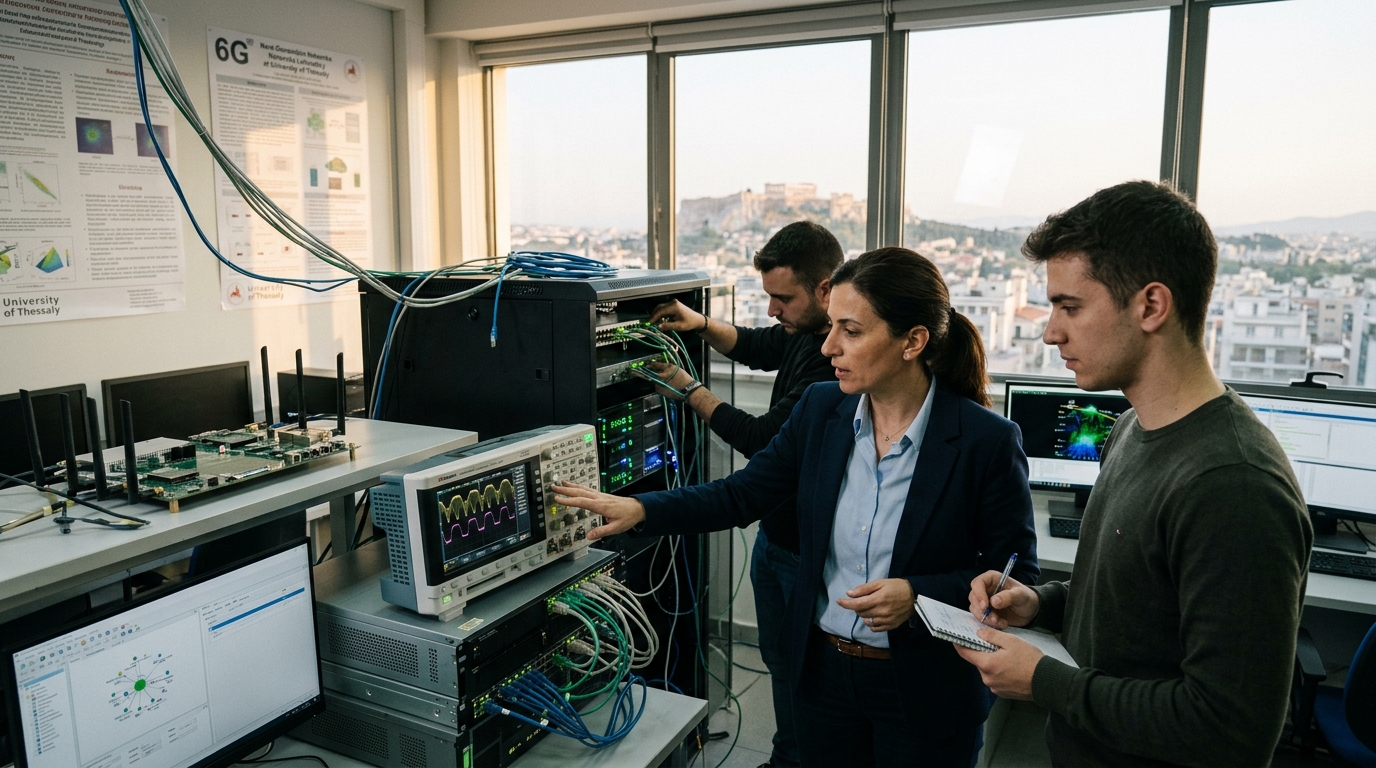
In the global technological arena, the discussion surrounding 6G is no longer just about data transfer speeds; it is about creating an "intelligence network." In Greece, the Telecommunications and Networks Laboratory (TNL) of the University of Thessaly stands at the forefront of this endeavor, serving as one of the primary research pillars connecting academic excellence with the global industry. The research conducted there is not confined to the narrow limits of theory but extends to the development of protocols and architectures that will allow the networks of the future to "think" and adapt in real-time.
Artificial Intelligence as the Heart of 6G
While 5G revolutionized device connectivity (IoT), 6G is expected to revolutionize the connectivity of intelligence. At the University of Thessaly's laboratory, researchers are working on the concept of the "AI-native network." This means that Artificial Intelligence is not merely an application running on top of the network, but an integral part of its very architecture. The use of Machine Learning allows for the optimization of network resources, traffic prediction, and automatic fault repair before users even notice a problem.
This integration requires immense computational power and specialized algorithms capable of operating at the "edge" of the network (Edge Computing). TNL focuses particularly on Federated Learning, a method that allows AI models to be trained across multiple devices simultaneously while ensuring user data privacy. This approach is critical for applications such as autonomous driving and telemedicine, where latency must be near-zero and security must be absolute.
The University of Thessaly on the International Map
The laboratory's success is no accident. Through its participation in numerous European programs (such as Horizon Europe), the University of Thessaly collaborates with technology giants and top-tier international universities. This outward-looking approach allows Greek researchers to access cutting-edge infrastructure and co-shape the standards that will govern telecommunications over the next decade. 6G research also aims to utilize Terahertz (THz) frequencies, which promise speeds up to 100 times faster than 5G, paving the way for the full integration of holographic communication and Digital Twins.
Furthermore, the laboratory emphasizes sustainability. 6G networks are being designed to be energy-efficient, using AI to power down portions of the infrastructure when there is no demand, thereby reducing the environmental footprint of telecommunications. This "green" dimension of technology is a central axis of the European Union's strategy, and TNL is at the forefront of this transition.
From Research to Economic Growth
The laboratory's activity has a direct impact on the local and national economy. The creation of an innovation ecosystem around the University of Thessaly attracts investment and creates high-specialization jobs. In a period where Greece is striving to reverse the brain drain, laboratories of this kind offer young scientists the opportunity to work on cutting-edge technologies without having to leave the country. Connecting research with the labor market is vital, and TNL serves as a bridge, preparing the next generation of engineers for the challenges of the 4th Industrial Revolution.
"6G is not just an evolution of mobile phones; it is the nervous system of a society built on data and intelligence," researchers at the lab note.
In conclusion, the Telecommunications and Networks Laboratory of the University of Thessaly proves that the Greek periphery can produce global innovation. The convergence of 6G and Artificial Intelligence is no longer a distant science fiction scenario but a reality being shaped daily in the labs of Volos and Larissa, laying the foundations for a world that is more connected, more intelligent, and more human.