In the heart of the European automotive landscape, the battle for electromobility leadership is no longer fought solely on assembly lines, but in data laboratories. The recently announced partnership between the BMW Group and the University of Zagreb marks a pivotal moment for European industrial strategy. This collaboration, focusing on the use of Artificial Intelligence (AI) to optimize battery cell production, highlights how academic research can provide solutions to some of the most pressing challenges in modern manufacturing.
The Digital Transformation of the Production Process
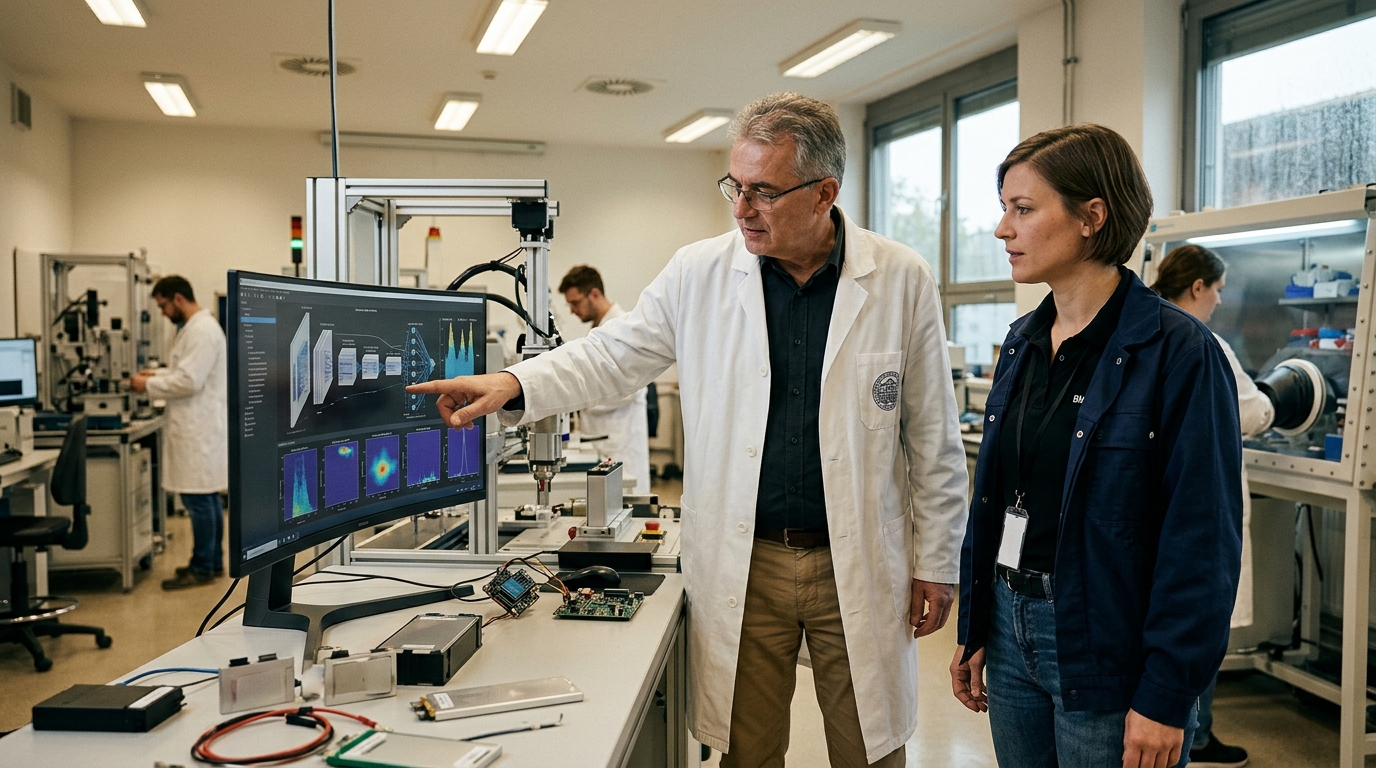
Battery cell production is an exceptionally complex process requiring surgical precision. Even the slightest deviations in production conditions—such as humidity, temperature, or material purity—can lead to defective products, increasing costs and the environmental footprint. This is precisely where Artificial Intelligence steps in. Through collaboration with the Faculty of Mechanical Engineering and Naval Architecture at the University of Zagreb, BMW aims to develop machine learning models that analyze vast amounts of data in real-time.
These models are not limited to mere defect detection. The ambition is to create "predictive systems" capable of anticipating a failure before it even occurs, allowing for automatic machine adjustments. In this way, BMW aims to drastically reduce the scrap rate, which remains one of the biggest hurdles in lithium-ion battery manufacturing.
Why Zagreb? The Emergence of a New Tech Hub
The choice of the University of Zagreb is no coincidence. Croatia, though a small nation, has emerged as a dynamic hub of technological innovation in the Balkan region, partly due to the success of companies like Rimac Technology. The University of Zagreb boasts a strong tradition in applied sciences, and this partnership offers students and researchers the opportunity to work on real-world industrial problems of a global scale.
- Knowledge exchange between BMW engineers and academic researchers.
- Development of algorithms tailored to the specificities of battery production.
- Cultivation of a new generation of scientists combining mechanical engineering with data science.
Strategic Importance for European Autonomy
Beyond the technical aspects, this collaboration carries deep political and economic significance. Europe is desperately trying to reduce its dependence on Asian battery suppliers, primarily from China. Developing domestic production technology that is more efficient and less costly is the only way for European automakers to remain competitive. The use of AI allows BMW to accelerate learning cycles, compressing years of experience into a few months of digital analysis.
"Our collaboration with the University of Zagreb is an excellent example of how academic excellence and industrial practice can combine to shape the future of mobility," BMW representatives stated.
Conclusions and Outlook
As BMW prepares for the launch of its "Neue Klasse"—the next generation of electric vehicles—optimizing battery production becomes a matter of survival. The shift toward Artificial Intelligence is no longer an option but a necessity. The success of this venture will be judged by the ability of algorithms to function within the demanding factory environment and by the stability of the bridge currently being built between Munich and Zagreb.