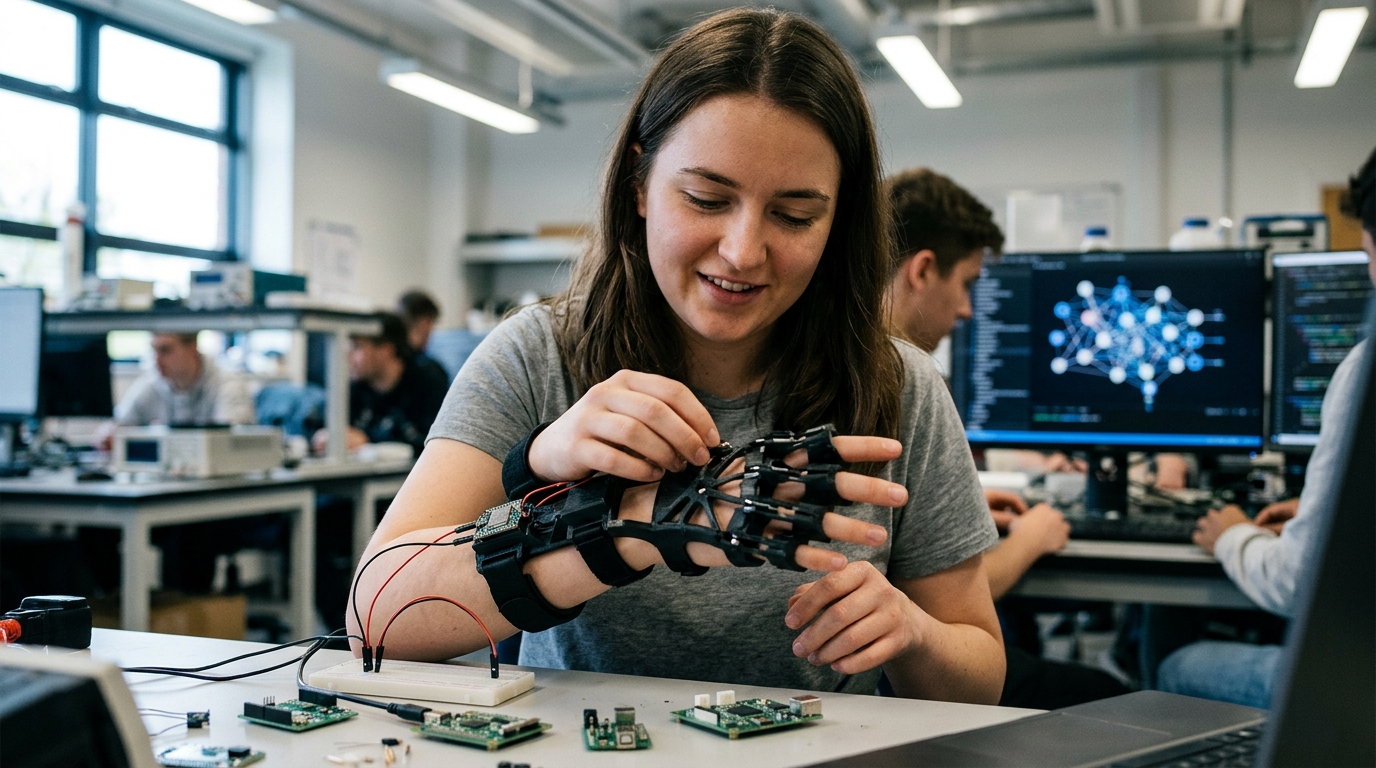
At the intersection of robotics and neuroscience, a group of young researchers has achieved what only a few years ago seemed like a science fiction scenario. The news that students have developed a wearable device—an exoskeleton—that allows individuals with paralysis or motor impairments to move their hands through Artificial Intelligence is not just a technical milestone; it is a profound promise for a more inclusive world.
The Technology Behind the Movement
The device functions as a bridge between intention and action. Utilizing advanced electromyography (EMG) sensors, the system "reads" the faint electrical signals emitted by muscles, even when they are insufficient to trigger physical movement. This is where Artificial Intelligence steps in. Through neural networks, the device is trained to recognize patterns in these signals and translate them into specific commands for the exoskeleton's mechanical actuators.
The most impressive aspect of this endeavor is its adaptability. Every user has a unique neuromuscular profile. The AI is not static; it learns from the user in real-time, refining movement precision the more the device is utilized. This "closed-loop" learning enables delicate tasks, such as holding a glass or using a pen, which have traditionally been the greatest challenges for soft robotics.
From Laboratory to Daily Life
The challenge for these students was not only technical excellence but also accessibility. Existing solutions in the medical exoskeleton field often cost tens of thousands of dollars, making them prohibitive for the average patient. This specific team focused on using low-cost materials and 3D printing, dramatically reducing production costs without compromising safety.
- Use of lightweight alloys and fabrics for comfort during prolonged wear.
- Low-energy consumption algorithms for extended battery life.
- Smartphone app integration to monitor physiotherapy progress.
The significance of this development for physical therapy is immeasurable. The device does not merely offer functionality; it acts as a rehabilitation tool. By promoting neuroplasticity, it helps the brain forge new neural pathways as the patient sees and feels their limb moving again, closing the loop of visual-motor feedback.
Ethical Implications and the Future of Assisted Living
As this technology matures, significant questions arise regarding the relationship between humans and machines. The integration of AI into the human body, even for therapeutic purposes, requires a strict ethical framework. Who owns the data collected by the sensors? How do we ensure the privacy of a user's "neural intent"?
"We aren't just building a tool; we are trying to return the dignity of autonomy," says one of the student team leads.
The future seems to belong to such hybrid solutions. The success of these students proves that AI innovation does not always require the billions of Big Tech giants. It requires empathy, deep problem-solving, and the courage to challenge the limits of what is possible. The journey from prototype to widespread clinical use is long, but the first step—or rather, the first movement of the hand—has already been taken.