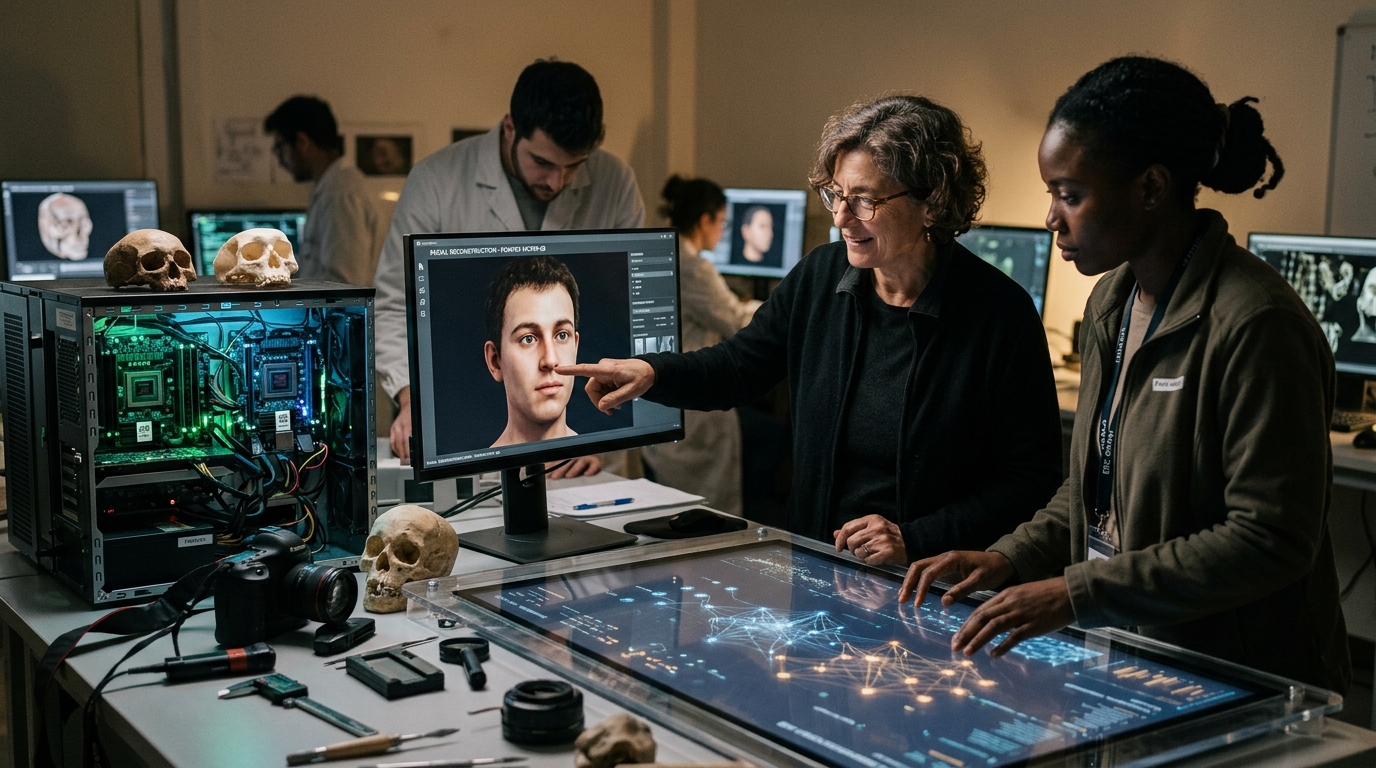
Pompeii, the city frozen in time by the eruption of Mount Vesuvius in 79 AD, has long been the ultimate symbol of archaeological preservation. However, the iconic plaster casts of the victims—first created by Giuseppe Fiorelli in the 19th century—remained, until today, anonymous, stony masks of agony. A new international research effort, leveraging Artificial Intelligence (AI) and forensic anthropology, promises to radically change how we perceive these individuals, giving them back their faces, complexions, and individuality.
The Technology Behind Digital Resurrection
The process begins with high-resolution 3D scanning of the plaster casts. These casts often contain skeletal remains, which provide the necessary anatomical foundation. Artificial Intelligence, through sophisticated Generative Adversarial Networks (GANs), takes over to 'fill in the blanks.' By analyzing thousands of data points from modern and ancient Mediterranean morphology, the AI predicts soft tissue thickness, the shape of the nose and lips, and the underlying facial muscle structure.
The most striking element of this research is the integration of genetic data. In cases where it was possible to extract DNA from bones within the casts, researchers were able to feed the AI information regarding eye color, hair type, and skin tone. The result is not merely an artistic depiction but a scientifically grounded reconstruction that brings the viewer face-to-face with a human being who lived two millennia ago.
From Plaster to Pixels: A New Archaeological Paradigm
The use of AI in archaeology is no longer a science fiction scenario. In Pompeii's case, technology allows for the overcoming of traditional reconstruction limitations. Traditional forensic artists often introduce subjective biases into their creations. Conversely, AI can process objective data at scale, ensuring a consistency that was previously impossible.
- Photogrammetry: Thousands of photos are combined to create a perfect digital twin of the cast.
- Neural Networks: Trained on vast anthropological datasets, they predict aging and unique facial features.
- Historical Cross-referencing: Results are compared with contemporary frescoes and statues to validate aesthetic accuracy.
This approach reveals stunning details. For instance, the reconstruction of a man found in the 'House of the Citharist' revealed features suggesting North African ancestry, confirming the multicultural character of the Roman Empire. Pompeii was not just an Italian town, but a crossroads of peoples and cultures.
Ethics and Digital Memory
However, 'resurrecting' the dead through AI raises significant ethical questions. Is it right to turn disaster victims into digital exhibits? Researchers argue that this process restores the human dignity of the victims. Instead of viewing them as anonymous objects of suffering, we see them as individuals with personality. This 'digital repatriation' allows the public to connect emotionally with history in a way that texts and ruins cannot achieve.
"Artificial Intelligence does not replace the archaeologist; it provides a lens that can pierce through the veil of time," states one of the lead researchers.
In the future, it is expected that visitors to the Pompeii archaeological site will be able, through Augmented Reality (AR) applications, to see these faces 'living' within the ruins of their homes, creating an unprecedented immersive historical experience.
Conclusion
The AI-driven reconstruction of Pompeii's faces marks a milestone for digital archaeology. It reminds us that technology, when used with respect and scientific rigor, can serve as the bridge connecting us to our past. Pompeii is no longer just a city of ash and stone; it is a city of people who, thanks to algorithms, can finally look us in the eye once more.