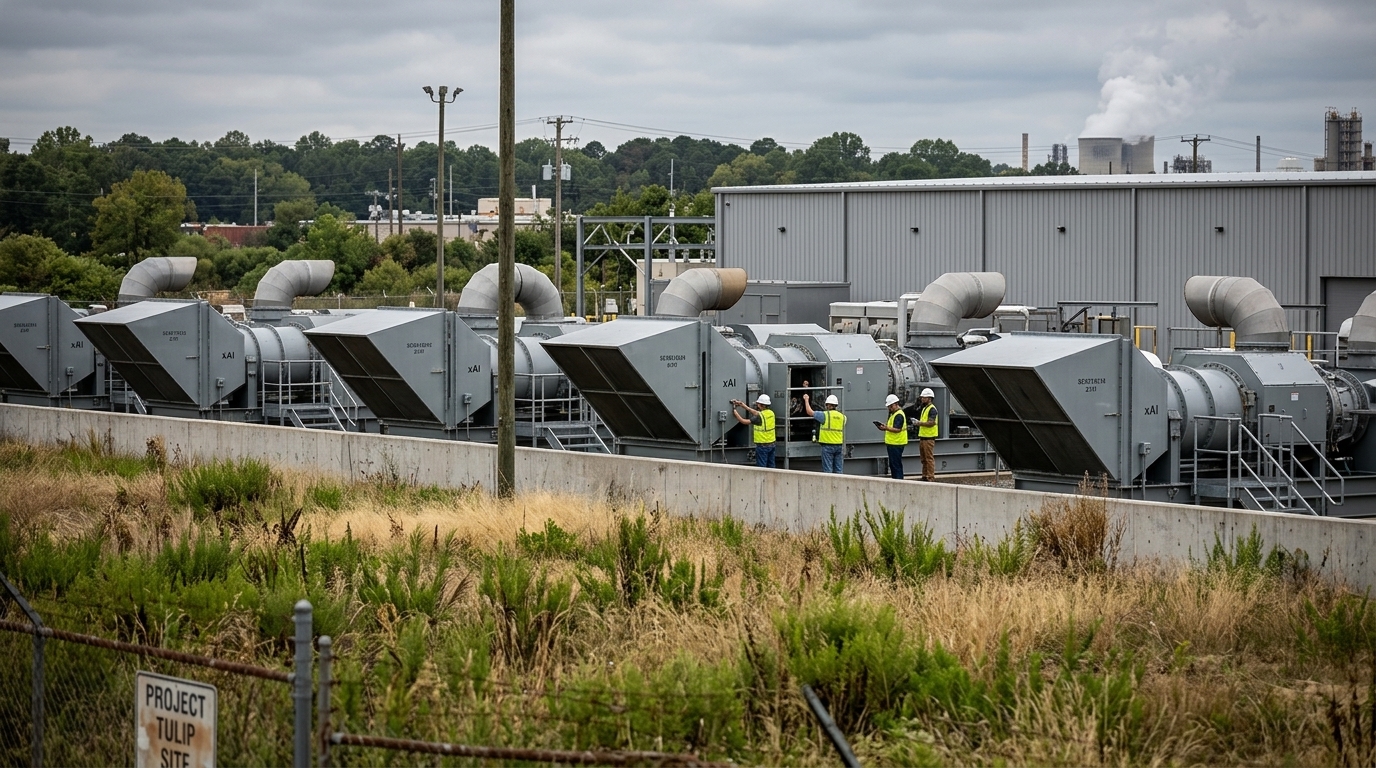
In the heart of Memphis, Tennessee, the collision between the breakneck speed of artificial intelligence development and environmental regulation is reaching a boiling point. xAI, Elon Musk’s artificial intelligence startup, is moving forward with the installation of 19 additional gas turbines to power its "Colossus" supercomputer, despite an ongoing legal battle over the facility's impact on local air quality. This move, revealed through internal emails obtained by Wired, underscores the staggering energy costs of the race for AI supremacy.
The Colossus Expansion and the Power Deadlock
The Colossus supercomputer is widely cited as one of the most powerful in the world, featuring a cluster of 100,000 Nvidia H100 GPUs. However, operating such a behemoth requires electrical power that the local utility, Memphis Light, Gas and Water (MLGW), cannot immediately provide at scale. The demand is estimated at 150 megawatts—enough to power a medium-sized city.
To bridge the gap until grid upgrades are completed, xAI has turned to portable gas turbines. With the addition of 19 new units, the total number of turbines on-site appears to be approaching or exceeding 40. These generators burn natural gas to produce electricity on-site, emitting nitrogen oxides (NOx), which contribute to smog and respiratory illnesses.
Legal and Community Backlash
The Southern Environmental Law Center (SELC) has already filed a lawsuit, alleging that xAI is operating these turbines without the necessary air quality permits. The South Memphis area, where the facility is located, is a predominantly Black community that has historically borne the brunt of industrial pollution. Activists are calling it a case of "environmental racism," arguing that a multi-billion dollar tech firm is bypassing rules designed to protect public health simply to save time.
"It is galling to see a company accelerate its operations while knowing it is in violation of community protection rules," said a representative from a local advocacy group. "AI cannot be built on the back of our citizens' health."
The Musk Strategy: Speed Above All
Elon Musk’s approach is no surprise to those who have followed his trajectory at Tesla and SpaceX. The "move fast and break things" philosophy is now being applied to data infrastructure. xAI is in a fierce competition with OpenAI and Google, and every day of delay in training large language models (like Grok) is viewed as a strategic failure.
However, the use of gas turbines is seen by many as a regressive solution at a time when the tech industry is promising a "green" transition. While Microsoft and Google are investing in nuclear energy and renewables, xAI is choosing the fastest and most polluting route. MLGW has stated it is working to provide permanent grid power, but the process takes years—time Musk is unwilling to lose.
The Future of AI and the Environmental Toll
The Memphis situation serves as a warning sign for what is to come globally. As AI demand grows exponentially, urban energy infrastructures will face unbearable pressure. The question is whether regulators will be able to enforce rules against giants that have the resources to treat fines as a mere "cost of doing business."
The court's decision regarding xAI's turbines will set a significant precedent. If the company succeeds in retroactively legitimizing the use of these generators, we may see other Silicon Valley players follow suit, turning data centers into autonomous, yet polluting, energy islands.