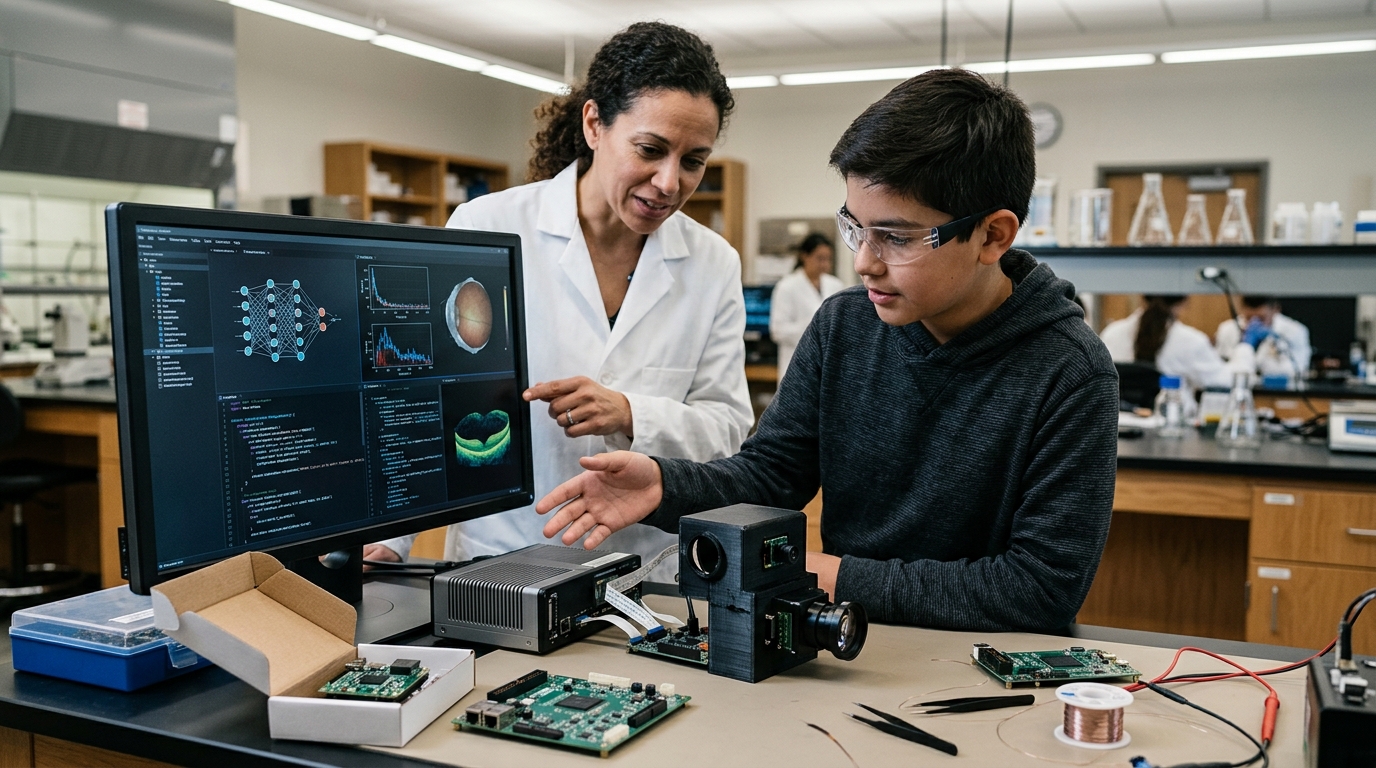
In the rapidly evolving landscape of artificial intelligence, we often look for the next breakthrough in the glass towers of Silicon Valley or the hallowed halls of elite research universities. However, a recent story from the Orange County Department of Education (OCDE) serves as a potent reminder that true disruption can emerge from a middle school classroom. Advait Kulkarni, an eighth-grader at Oxford Academy, has developed an AI-powered tool designed to treat amblyopia, a condition commonly known as 'lazy eye'.
AI as a Visionary Healer
Amblyopia affects millions of children globally. The standard of care has remained largely unchanged for decades: patching the stronger eye for several hours a day to force the weaker eye to work harder. It is a process fraught with low compliance, as children find the patches uncomfortable and socially isolating. Kulkarni’s innovation, dubbed 'Amblyo-AI', seeks to replace the physical patch with a digital solution powered by machine learning and computer vision.
The system utilizes a standard webcam to monitor eye movements in real-time. By employing sophisticated algorithms, it can detect the gaze of the user and provide immediate feedback through gamified therapeutic exercises. Unlike static treatments, Amblyo-AI adapts to the user's progress. If the AI detects that the weaker eye is not engaging sufficiently, it modifies the visual stimuli on the screen to increase the challenge, effectively 'training' the brain to process visual information from both eyes more efficiently.
The Democratization of Innovation
The success of this project highlights a significant shift in 2026: the democratization of high-end technology. With open-source libraries like TensorFlow and PyTorch, and the accessibility of cloud computing, the barriers to entry for medical innovation have plummeted. Kulkarni’s achievement is not just a personal triumph but a testament to the modern STEM curriculum that prioritizes real-world problem-solving over rote memorization.
- Early exposure to neural networks and data science in secondary education.
- The use of synthetic data to train medical models without compromising patient privacy.
- A shift toward 'agile' healthcare solutions developed by end-users or those close to them.
This trend poses fascinating questions for regulatory bodies like the FDA. When a functional medical tool is developed by a teenager using off-the-shelf hardware and open-source software, the traditional multi-year clinical trial pathways seem increasingly archaic. While clinical validation is non-negotiable, there is a growing need for a 'Fast Track' for AI-driven assistive technologies that carry low risk but offer high reward.
Challenges and the Path Ahead
Despite the optimism, the rise of student-led AI medical tools is not without its hurdles. Data privacy remains a paramount concern; eye-tracking data is highly sensitive biometric information. Ensuring that these tools are 'secure by design' is a challenge that young innovators must be taught to navigate. Furthermore, there is the risk of medical misinformation or improper self-diagnosis if these tools are used without professional oversight.
"Technology is merely a tool. The real innovation lies in the creator's empathy—the ability to understand a patient's struggle and provide a solution that is as humane as it is effective," noted an OCDE educational consultant.
In conclusion, Advait Kulkarni’s project is a harbinger of a future where the next generation doesn't just consume technology but shapes it to heal. As AI becomes the native language of Generation Alpha, we can expect a surge in decentralized, grassroots innovation that tackles chronic health issues from entirely new angles. The classroom, it seems, has become the new laboratory for the future of medicine.