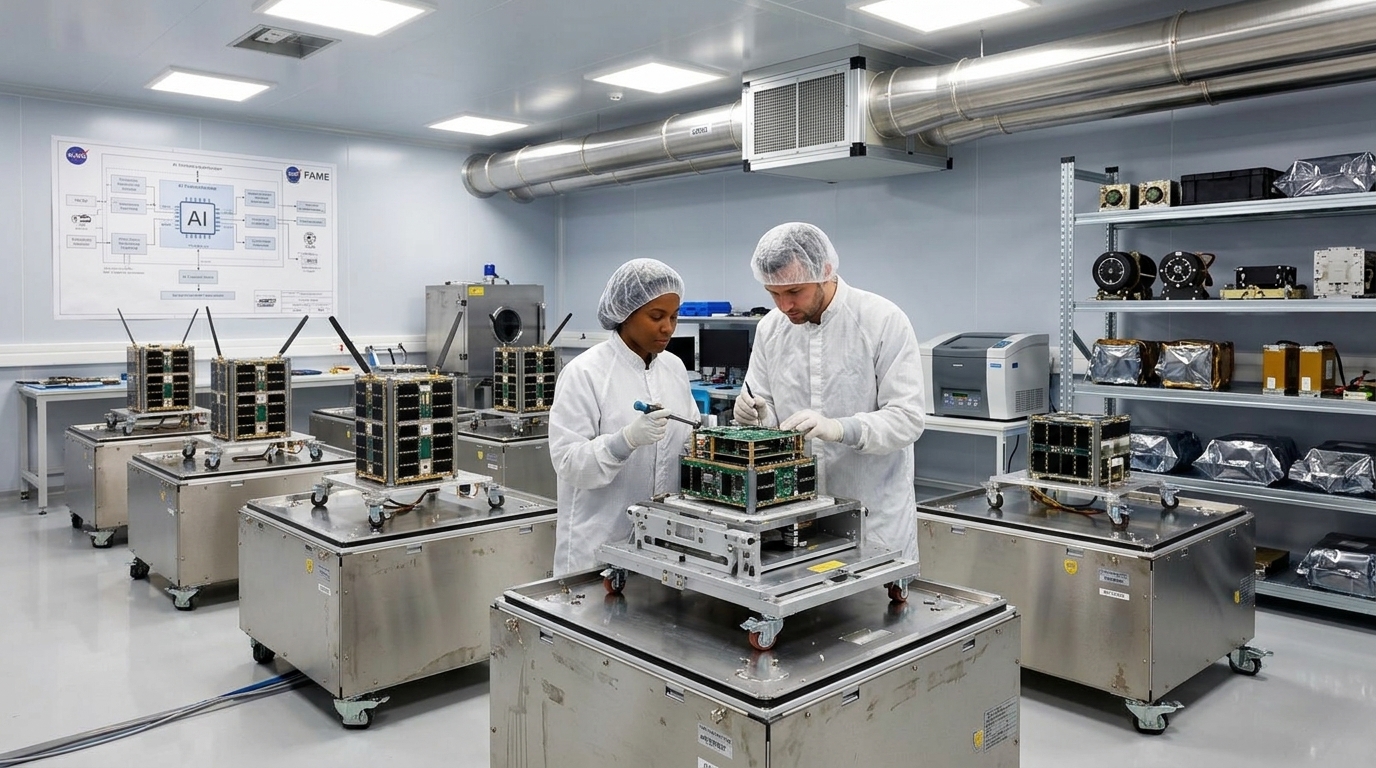
The era of satellites functioning as mere passive mirrors or simple sensors broadcasting massive volumes of raw data back to Earth is coming to an end. Open Cosmos, a company that has strategically established its presence in Greece and across Europe, is now at the forefront of this paradigm shift. By participating in NASA’s ambitious Flight Demonstration of Federated Autonomous MEasurement (FAME) program, Open Cosmos is proving that the future of space exploration lies not just in hardware, but in decentralized intelligence.
The Core Philosophy of the FAME Program
NASA’s FAME program is designed to demonstrate technologies that allow satellite constellations to communicate and make decisions autonomously, without constant tethering to ground control. Traditionally, the loop of data acquisition—downlinking to Earth, processing in data centers, and uplinking commands—has been the bottleneck of space operations. It is slow, bandwidth-heavy, and often fails in time-sensitive scenarios.
With the involvement of Open Cosmos, the focus shifts to "Edge AI"—processing data at the edge of the network, directly on the satellite. The satellites participating in FAME will be capable of identifying critical phenomena, such as the ignition of a forest fire or the sudden onset of a flood, and coordinating with fellow satellites to optimize observation. Open Cosmos provides the OpenConstellation platform, which enables diverse organizations to share data and resources in orbit, effectively creating a high-intelligence "space internet."
The Greek Connection and Strategic Economic Impact
Open Cosmos Greece plays a pivotal role in these developments. The participation of Greek engineers and researchers in NASA-vetted programs highlights Greece’s emergence as a significant player in the "New Space" economy. Developing AI software for space applications requires a high level of specialization, and the success of this collaboration proves that the Greek innovation ecosystem can compete on a global stage.
Investing in small satellite technology offers Greece tangible tools to address national challenges. For instance, using AI-enabled satellites for early fire detection in the Mediterranean can drastically reduce response times, saving lives and natural habitats. The collaboration with NASA provides the necessary technological transfer to ensure these solutions are both robust and scalable.
Federated Learning: A Collective Intelligence in Orbit
The technical cornerstone of Open Cosmos’s contribution involves Federated Learning. In this model, satellites train machine learning models locally using the data they collect. Instead of sending the raw, heavy data files back to Earth, they only share the "insights"—the updates to the model parameters—with other satellites or ground stations. This methodology preserves bandwidth and enhances data security.
- Drastic reduction in decision-making latency.
- Optimization of satellite power consumption.
- Resilience in operations even when ground communication is intermittent.
Under the FAME framework, Open Cosmos will demonstrate how its satellites can function as a unified, intelligent network. This "collective mind" in orbit will be able to analyze climate change indicators with unprecedented precision, monitoring ice cap melt or ocean temperature fluctuations in real-time, providing actionable intelligence to policymakers on Earth.
"Our collaboration with NASA on the FAME program is the ultimate validation of our vision: to make space accessible and useful through artificial intelligence," company representatives stated.
Toward an Autonomous Space Future
Participation in FAME is merely the starting point. Open Cosmos envisions a future where hundreds of small satellites form a protective and observational mesh around Earth. The integration of advanced AI models will allow these satellites to "understand" their environment and adapt their missions dynamically. In a world increasingly battered by the climate crisis, the speed and accuracy provided by AI in space are no longer a luxury—they are a necessity for planetary survival.