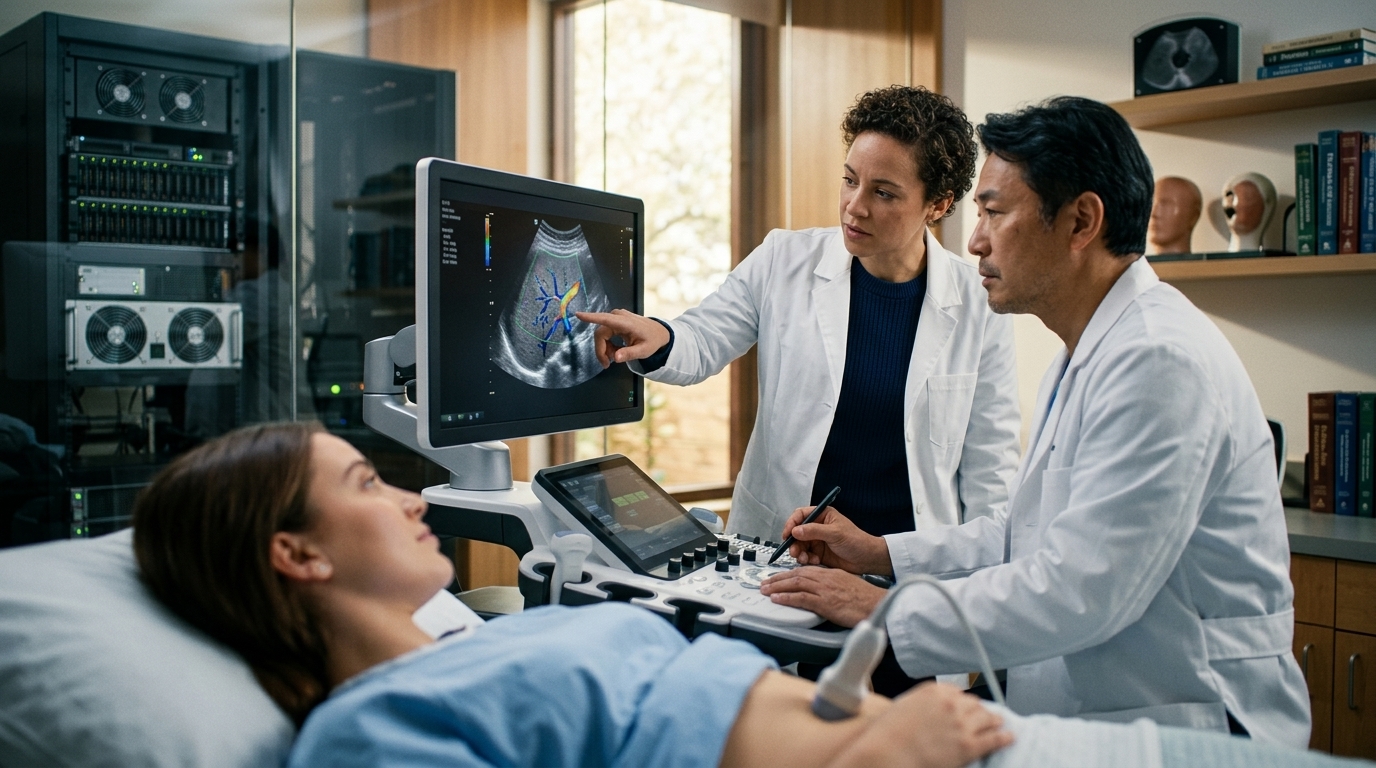
Medical imaging is standing at the threshold of a new era, where the boundaries between physics and artificial intelligence are becoming increasingly blurred. Traditionally, ultrasonography has relied on static signal processing algorithms that often limited image quality due to noise or physical obstructions within human tissue. However, NVIDIA's new approach with the NV-Raw2Insights-US model promises to fundamentally change the status quo by converting raw radiofrequency (RF) data into diagnostic intelligence through Physics-Informed AI.
From Image to Signal: The Power of Raw Data
For decades, ultrasound machines operated as "black boxes." The transducer received sound waves, converted them into electrical signals, and then a predefined hard-wired algorithm transformed them into the B-mode image seen by the physician. In this process, a vast amount of information was discarded. NV-Raw2Insights-US shifts this paradigm. Instead of being trained on post-processed images, NVIDIA's model is trained directly on raw RF data. This allows the AI to "hear" subtle variations in the acoustic return that the human eye—or a traditional algorithm—would typically ignore.
The use of Physics-Informed Neural Networks (PINNs) is the key differentiator here. Rather than the AI simply attempting to guess what is being imaged based on statistical probabilities, the model "knows" the laws of acoustics. It understands how waves refract, how they attenuate according to depth, and how they react to different tissue densities. Integrating this physical knowledge drastically reduces artifacts and enables the production of clear images even in challenging scenarios, such as patients with high body mass index or when imaging deep-seated organs.
Adaptive Real-Time Imaging
One of the most impressive features of NV-Raw2Insights-US is its adaptability. In traditional ultrasound, a technician must constantly adjust gain, focus, and other parameters to get a clear view. NVIDIA's new model can perform "adaptive beamforming," essentially reconfiguring how it processes signals in real-time based on the live input. This means the ultrasound becomes inherently smarter during the examination, optimizing resolution where it is needed most, such as at heart valves or delicate vascular structures.
- Noise reduction without losing edge detail in organ boundaries.
- Improved temporal resolution, allowing for better tracking of moving organs.
- Potential to run on less powerful hardware, making handheld devices as capable as high-end cart systems.
NVIDIA's strategy isn't just about software; it's about synergy. This architecture is optimized for the company's GPUs, allowing for the processing of billions of calculations per second with minimal latency. This is critical for interventional procedures, where a surgeon relies on ultrasound to guide a needle or scalpel in real-time with zero room for lag.
The Future of Diagnostics: Democratizing High-End Tech
The significance of this research extends far beyond the sophisticated hospitals of major metropolises. By embedding the complexity of physics directly into the algorithm, NVIDIA enables more affordable, portable ultrasound devices to produce images that previously required machines costing hundreds of thousands of dollars. This could bring high-quality diagnostics to remote areas or emergency field situations where traditional equipment is impractical.
Furthermore, the Raw2Insights approach paves the way for automated diagnostics. When AI has access to raw data, it can identify biomarkers invisible in the visual image, such as micro-changes in tissue elasticity that indicate early stages of cancer or fibrosis. The transition from "imaging" to "insights" is now a reality, and NV-Raw2Insights-US represents the first major step in this direction.
Conclusion
NV-Raw2Insights-US is not just another image enhancement algorithm. It is a fundamental rethink of how we interact with medical data. By combining the rigor of physics with the flexibility of deep learning, NVIDIA provides a tool that promises greater accuracy, speed, and accessibility in healthcare. As this technology is integrated into the next generation of medical devices, ultrasound will cease to be a subjective art and will become an objective, high-precision computational science.