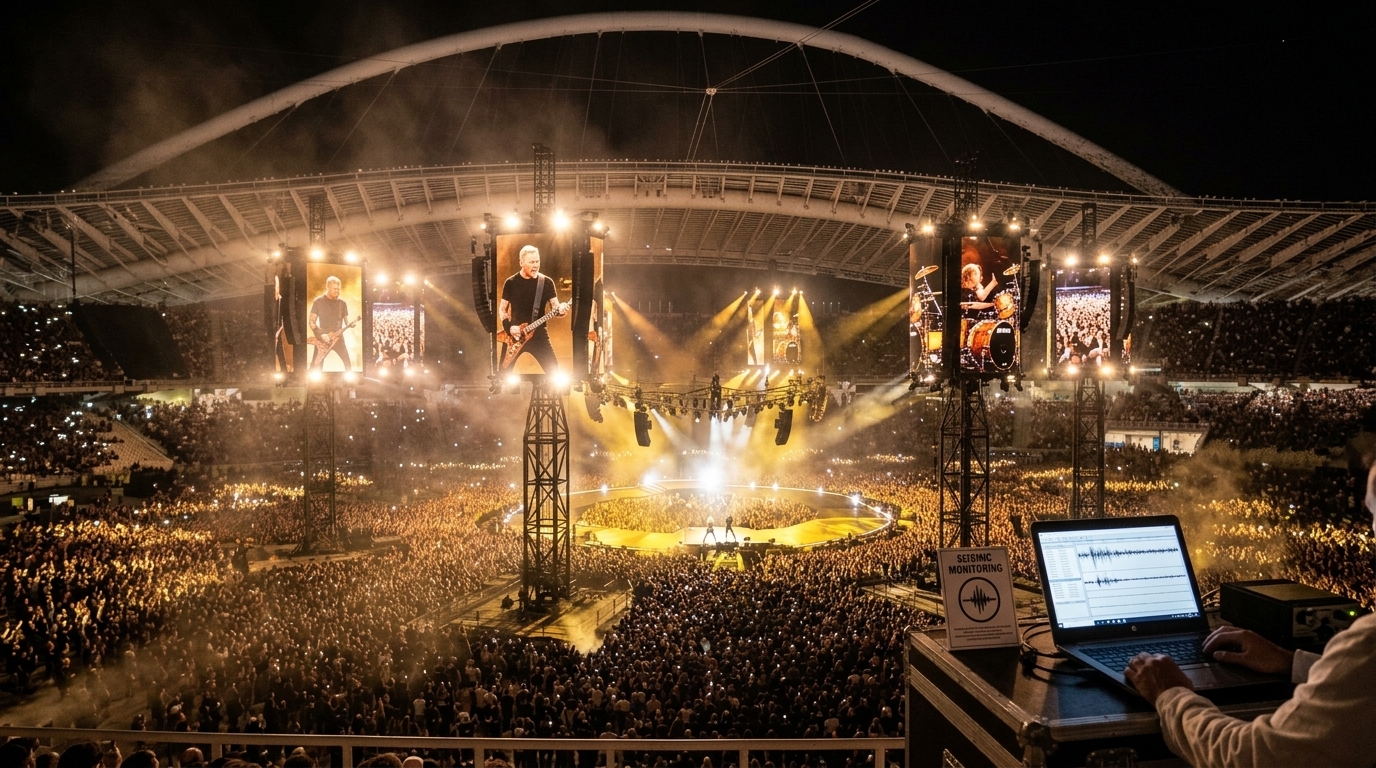
In a rare convergence of heavy metal and geophysical science, the National Observatory of Athens and the Geodynamic Institute offered a fascinating look into how human activity can affect the city's subsurface. The recent Metallica concert at the Athens Olympic Stadium (OAKA) was not just a global cultural event, but also a unique experiment in 'urban seismology,' as scientists monitored in real-time the vibrations caused by the rhythm of the music and the excitement of thousands of fans.
The project, coordinated by the Director of Research at the Geodynamic Institute, Dr. Gerasimos Chouliaras, involved the installation of sensitive seismometers and accelerometers inside and around the stadium. The goal was not only to record the 'energy' of the crowd but to collect data on the behavior of structures under conditions of intense synchronized movement, offering valuable insights into the static and dynamic behavior of the capital's major infrastructure.
The Physics of the Mosh Pit: From Rhythm to Vibration
When 60,000 people jump simultaneously to the beat of 'Enter Sandman,' the energy transferred to the ground is not negligible. According to the measurement results, seismographs recorded characteristic peaks at specific frequencies corresponding to the beats per minute (BPM) of the songs. This phenomenon, known in international literature as a 'concert-quake,' differs from a natural earthquake in terms of duration and periodicity.
While a natural earthquake is a sudden release of energy from a fault rupture, the Metallica-induced vibrations were harmonic and sustained. Scientists observed that the largest vibrations were not necessarily caused by the volume of the amplifiers, but by the synchronized stepping and jumping of the audience. This 'anthropogenic seismic noise' is a growing field of study, as it allows geophysicists to map the subsurface structure in urban environments using city vibrations as an energy source.
OAKA: A Stadium Under the Microscope
The choice of OAKA for this experiment holds particular significance, given the recent debate over the stability of the Calatrava roof and the stadium's maintenance needs. Recording the vibrations during the concert served as an informal 'stress test.' Accelerometers recorded how the stands and the structural frame responded to dynamic loads.
- Recording the resonance frequencies of the stands.
- Analysis of vibration transmission to the ground of the Kalogreza area.
- Comparison of data with previous measurements during periods of quiet.
The data showed that despite the noticeable oscillation felt by spectators in the stands, the values remained within the safety limits provided by the anti-seismic code. However, the study highlights the need for continuous monitoring of large sports facilities through permanent seismograph networks to detect any changes in their structural integrity early on.
The Global Trend of 'Cultural Seismology'
The Geodynamic Institute's experiment is not isolated. In recent years, 'cultural seismology' has become a global trend. A notable example is Taylor Swift, whose concerts in Seattle and Edinburgh caused vibrations equivalent to a 2.3 magnitude earthquake. Similar phenomena have been recorded during football matches in Barcelona and Foo Fighters concerts in New Zealand.
"Science should not remain locked in laboratories. Monitoring events like the Metallica concert allows us to communicate seismology to the general public and simultaneously collect data that would be impossible to simulate artificially," said Dr. Chouliaras.
In conclusion, Metallica's visit to Athens left behind more than just memories and ringing ears. It left a rich digital library of vibrations that will help Greek scientists better understand the interaction between human mass and the urban environment. In a country with the highest seismicity in Europe, every piece of information regarding ground movement and the resilience of our buildings is invaluable, even if it comes from a mosh pit.