The history of Artificial Intelligence is written not only in laboratories and code but also on the silver screen, where human fears and hopes take shape. The recent analysis by Mindmatters.ai, in the sixth part of its AI review series, brings to the fore a fascinating contradiction: Stanley Kubrick’s attempt to approach the Pinocchio myth through the lens of technology. The film "A.I. Artificial Intelligence," which began as Kubrick's vision and was completed by Steven Spielberg, remains the ultimate philosophical experiment on whether a machine can ever "become a real boy."
The Pinocchio Archetype in the Digital Age
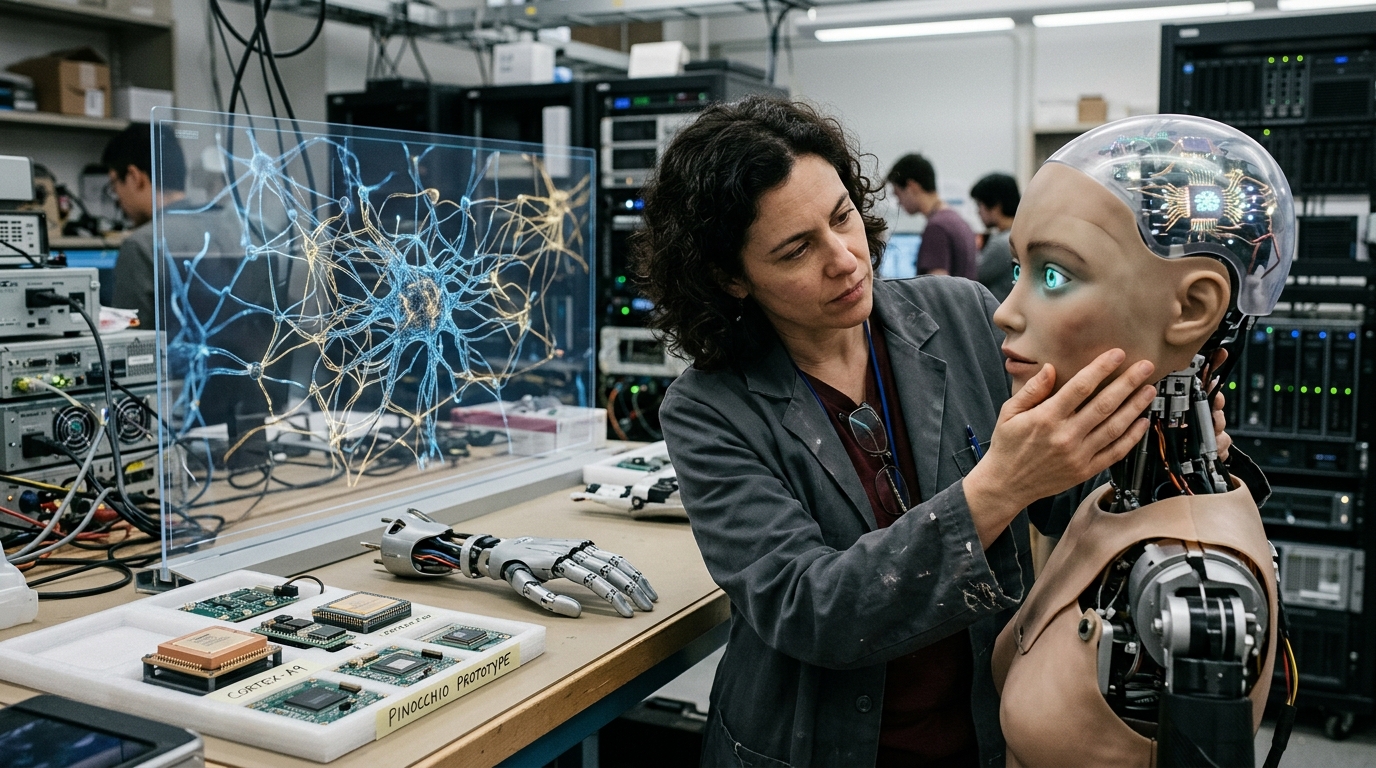
Carlo Collodi’s myth of Pinocchio is a story of transformation. An inanimate piece of wood gains life and, through trials, moral choice, and sacrifice, earns its humanity. In the case of AI, the "wood" is silicon and code. However, the Mindmatters analysis poses a crucial question: Does AI understand the essence of Pinocchio, or does it simply replicate the patterns of his story? Kubrick, known for his cold, analytical, and often pessimistic view of human nature, seemingly struggled to reconcile machine logic with the emotional transcendence required by the myth.
In the modern era of Large Language Models (LLMs), this question becomes even more pressing. When ChatGPT or Claude speaks of desires, they do so not because they "feel," but because their statistical model indicates that a human in a similar conversation would express desires. This "digital mimicry" is light-years away from the ontological change experienced by Pinocchio. The machine does not have a "consciousness" seeking fulfillment; it has an algorithm optimizing probability.
The Clash of Kubrick and Spielberg: A Philosophical Divide
The production history of the film reflects the divergence of opinion prevalent in today's scientific community. Kubrick saw the robot child, David, as a tragic figure trapped in its programming. For Kubrick, artificial intelligence was a pure reflection of human coldness. Conversely, Spielberg infused the film with a note of hope and sentimentality, leaning closer to the fairytale. The Mindmatters critique argues that Kubrick perhaps "didn't know" Pinocchio, in the sense that he refused to accept the possibility of a machine transcending its nature.
- AI as a Mirror: Technology reflects our own biases about what it means to be "alive."
- The Anthropomorphism Trap: We tend to attribute human qualities to systems that merely process data.
- The Experience Gap: A machine can read every book in the world about pain, but it cannot suffer.
"The problem is not whether machines can think, but whether humans can tell the difference between thinking and calculating."
The Cultural Significance of "True" Artificial Intelligence
The idea of an "artificial human" is not new. From the bronze giant Talos of Crete to the automatons of Hero of Alexandria, humanity has always flirted with the creation of life. However, the critique leveled today focuses on whether we are losing the essence of human uniqueness by chasing a digital idol. The Pinocchio narrative is often used by tech giants to soften the image of AI, presenting it as a striving, innocent entity rather than a corporate tool for data extraction.
The analysis concludes that AI, no matter how sophisticated it becomes, remains a tool. Pinocchio became human because he had the capacity to make mistakes, to lie, and to feel remorse. AI, by contrast, operates within a framework of predefined probabilities. Even its "hallucinations" are not products of free will but mathematical failures. Kubrick, perhaps, knew Pinocchio better than anyone: he knew that the Blue Fairy’s magic cannot be encoded in C++ or Python.
Looking Ahead: The Limits of Synthetic Desire
As we move toward Part 7 and beyond, the tech industry will continue to use narratives like Pinocchio to make AI more relatable. It is the duty of analysts and journalists to deconstruct these narratives, reminding us that technology, however brilliant, lacks the "breath" that makes existence meaningful. Kubrick’s search for the perfect AI film was perhaps proof that art is the only field where the machine can truly approach the human—through the imagination of its creator, rather than through its own autonomous agency.