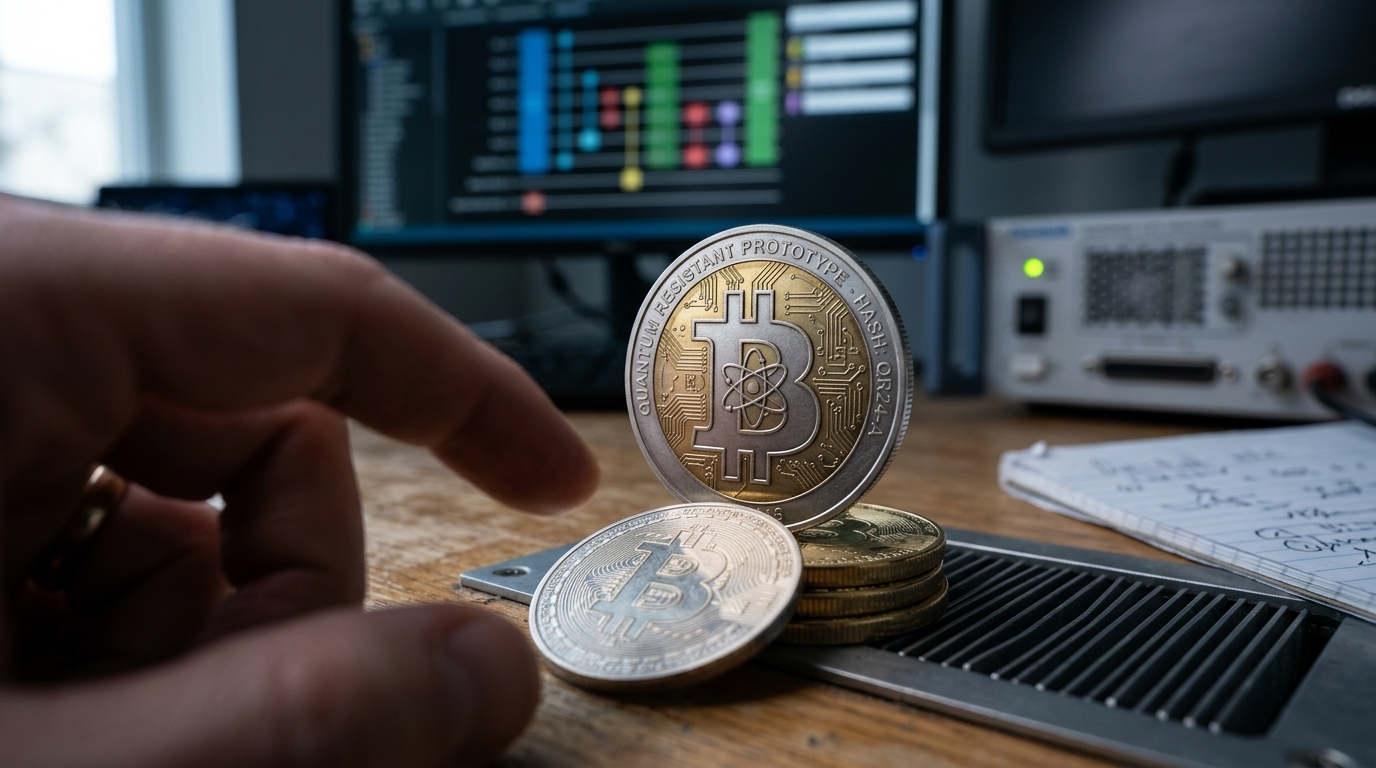
The promise of Bitcoin has always been absolute security through mathematical decentralization. However, a new shadow is falling over digital gold: quantum computing. Recent studies, including analysis highlighted by Fortune, warn that a sufficiently powerful quantum computer could "crack" Bitcoin's encryption in as little as nine minutes. This scenario, once considered a distant theoretical possibility, is fast becoming an urgent technical challenge.
The Achilles' Heel of the Blockchain
Bitcoin relies on the Elliptic Curve Digital Signature Algorithm (ECDSA). This system generates a key pair: a public key, which is visible to everyone, and a private key, which allows the owner to spend their funds. The security of ECDSA is predicated on the fact that it is practically impossible for a classical computer to derive the private key from the public key, as it would require billions of years of computation.
Enter Shor’s Algorithm. A quantum computer, utilizing the properties of superposition and entanglement, can solve the discrete logarithm problem—the mathematical foundation of ECDSA—in a fraction of the time. If an attacker gains access to such a machine, the "unhackable" nature of Bitcoin effectively collapses.
The Nine-Minute Window
Why exactly nine minutes? The answer lies in the fundamental mechanics of Bitcoin transactions. When you send Bitcoin, your transaction is broadcast to the network and sits in a "mempool" (memory pool) until it is confirmed by a miner and added to a block. This process takes, on average, ten minutes.
During this interval, your public key is exposed to the network. A quantum computer could intercept the public key from the mempool, calculate the corresponding private key in under nine minutes, and generate a new, competing transaction that directs the funds to the attacker’s address with a higher fee. Miners, incentivized by the higher reward, would process the thief's transaction first, leaving the legitimate owner with an empty wallet.
The "Sleeping" Billions of Satoshi
A particular point of vulnerability concerns older Bitcoin addresses, including those believed to belong to its creator, Satoshi Nakamoto. In the early days of the network, addresses were of the P2PK (Pay to Public Key) type, where the public key was directly recorded on the blockchain. It is estimated that approximately 2 million Bitcoins (worth tens of billions of dollars) reside in these vulnerable addresses. These coins could be harvested by a quantum computer without even needing the nine-minute transaction window, as their keys have been publicly exposed for over a decade.
The Resistance: Post-Quantum Cryptography
Is this the end of Bitcoin? Not necessarily. The developer community is acutely aware of the threat. The solution lies in upgrading the protocol via a soft fork or hard fork to introduce "quantum-resistant" algorithms, known as Post-Quantum Cryptography (PQC). These algorithms, often based on lattice-based mathematics, are believed to be secure even against quantum adversaries.
However, the transition will be complex. It requires every user to manually migrate their funds from old addresses to new, quantum-secure ones. "Lost" Bitcoins, where the private keys are no longer accessible to their owners, will remain vulnerable and will likely serve as the first spoils of the quantum era. The question is not whether Bitcoin can adapt, but whether it will do so quickly enough before quantum computers become commercially viable and powerful enough to strike.
Conclusion
The quantum threat serves as a stark reminder that in the realm of technology, nothing is static. Bitcoin must evolve to survive. While today’s quantum computers do not yet possess the required number of stable qubits to break standard encryption, progress is exponential. The looming battle between decentralized security and quantum supremacy will likely define the future of the global financial system for decades to come.