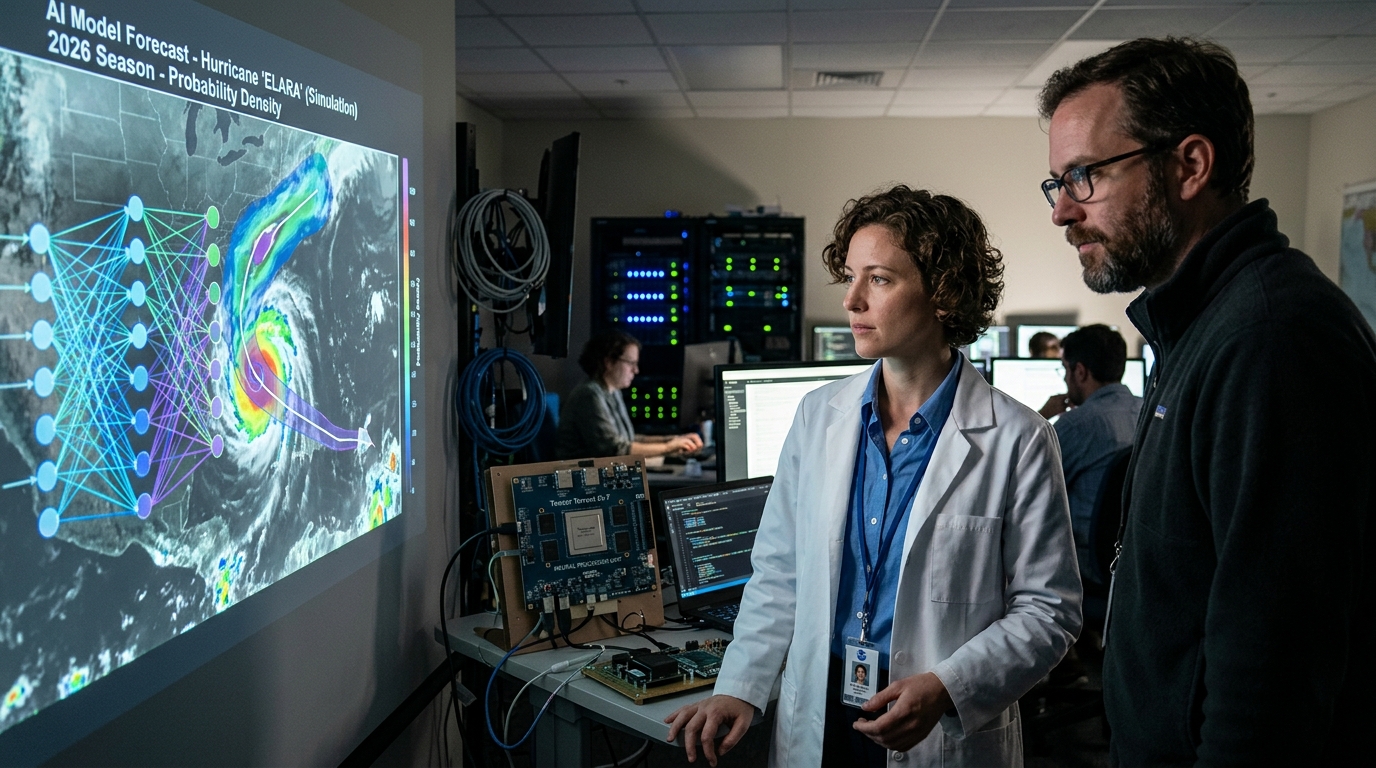
June 2, 2026, marks the beginning of another high-stakes hurricane season for Florida and the Gulf Coast. However, the atmosphere inside emergency operations centers has shifted. Traditional meteorology, which relied on massive numerical models requiring hours of supercomputing time, now has a formidable ally: Artificial Intelligence. This year is poised to be the first where machine learning models aren't just experimental toys but are actively driving life-saving decisions regarding evacuations and infrastructure protection.
A Quantum Leap in Speed and Accuracy
For decades, hurricane forecasting was the domain of Numerical Weather Prediction (NWP). Models like the GFS and the European ECMWF solved complex partial differential equations to simulate atmospheric behavior. While accurate, the process was notoriously slow. In 2026, the integration of AI models like Google DeepMind’s GraphCast and Huawei’s Pangu-Weather has rewritten the playbook. These systems can generate a 10-day forecast in under 60 seconds, using a fraction of the energy required by traditional supercomputers.
Speed, however, is only half the story. AI’s ability to recognize non-linear patterns within decades of historical climate data allows it to spot subtle atmospheric precursors that traditional physics-based models often miss. Reports from NBC 6 South Florida highlight that Miami-based meteorologists are now utilizing hybrid systems. By merging the physical constraints of traditional models with the predictive intuition of AI, they have managed to reduce track forecast errors by an impressive 25% compared to five years ago.
The Holy Grail: Predicting Rapid Intensification
While track forecasting has seen steady improvement, predicting "rapid intensification" (RI) has long been the industry's greatest hurdle. RI occurs when a storm’s maximum sustained winds increase by at least 35 mph within 24 hours—a phenomenon that has historically caught coastal communities off guard. In 2026, new neural networks trained on high-resolution satellite imagery and ocean heat content data are beginning to decode the internal dynamics of storm cores.
- Integration of real-time data from IoT-enabled ocean buoys.
- Advanced computer vision analyzing the symmetry and convection of the storm's eye.
- Ensemble forecasting that runs thousands of permutations in seconds to assess risk.
This breakthrough is vital for disaster management. In Florida, the window for an orderly evacuation is narrow, typically requiring a 48-to-72-hour lead time. AI provides emergency managers with the statistical confidence needed to issue warnings earlier, potentially saving billions in damages and, more importantly, countless lives by avoiding the chaos of last-minute flights.
The Socio-Political Implications of Algorithmic Safety
The rise of AI in meteorology brings forth complex questions of trust and equity. Will the public trust an evacuation order generated by a "black box" algorithm? Meteorologists in 2026 have taken on a new role as "algorithmic translators," bridging the gap between complex data outputs and public communication. Furthermore, there is a growing concern regarding the "prediction divide." While the US and EU benefit from cutting-edge AI proprietary models, developing nations in the Caribbean and Southeast Asia remain reliant on international data sharing to access these life-saving tools.
"AI isn't replacing the meteorologist; it’s providing the vision to see through atmospheric chaos with a clarity we’ve never possessed," says a senior researcher at NOAA.
As the 2026 season unfolds, it is clear that AI has moved from the laboratory to the front lines. In an era where climate change is making storms more volatile and destructive, these algorithms offer a crucial line of defense. We may not be able to stop the wind, but for the first time, we can anticipate its every move with startling precision.