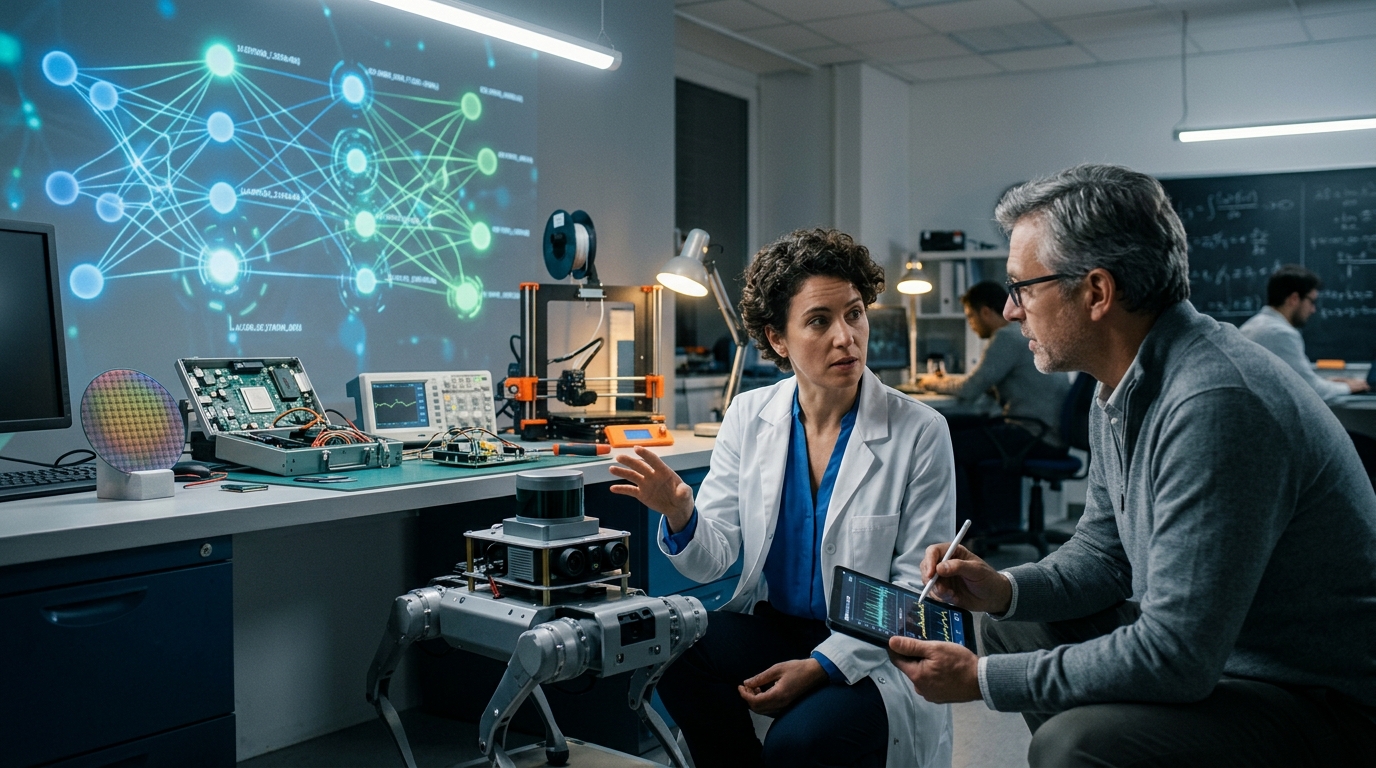
The recent news that top researchers from DeepSeek—the Chinese AI powerhouse that stunned the world with its hyper-efficient models—are migrating to DeepRoute.ai, an autonomous driving firm, is more than just a corporate shuffle. It marks the beginning of a profound paradigm shift. As Large Language Models (LLMs) approach a point of diminishing returns in pure digital processing, the next great frontier is "Embodied AI": the ability of algorithms to understand and interact with the three-dimensional, unpredictable physical world.
The Transition from Bits to Atoms
For years, AI research focused on mastering language and code. DeepSeek proved that high-level intelligence could be generated with extreme efficiency, challenging even Silicon Valley's giants. However, for many researchers, the digital universe of text has begun to feel constrained. The challenge of autonomous driving, as approached by DeepRoute, offers a field where intelligence doesn't just produce words, but motion, safety, and physical agency.
DeepRoute.ai has adopted an "end-to-end" approach, which discards traditional rule-based programming in favor of neural networks that learn to drive by consuming vast amounts of video and sensor data. This architecture is remarkably similar to how LLMs are trained, but with a critical difference: the cost of failure in the physical world is absolute. The migration of researchers from DeepSeek suggests that the "Scaling Laws" which made ChatGPT so powerful are now being applied to physical kinematics.
Why Autonomous Driving is the "Holy Grail"
Autonomous driving is often cited as the most difficult application of AI. It requires not just pattern recognition, but the ability to predict human behavior and make split-second decisions. Researchers leaving pure digital models for DeepRoute view driving as the ultimate laboratory for Artificial General Intelligence (AGI). If a machine can safely navigate the chaotic streets of Beijing or New York, it can theoretically handle almost any task in the physical realm.
- Real-World Data: Unlike the internet, where high-quality text data is being exhausted, the physical world generates infinite data through sensors.
- Real-Time Reasoning: AI must "think" while in motion, seamlessly blending perception with action.
- Economic Impact: Automating transportation is a multi-trillion-dollar industry, far eclipsing the market for digital subscriptions.
The Geopolitics of Embodied AI
This movement also highlights the unique strengths of the Chinese AI ecosystem. While the US leads in software and cloud infrastructure, China possesses an unparalleled manufacturing and electric vehicle (EV) supply chain. DeepRoute.ai benefits from this tight integration between code and hardware. The transfer of talent from a company specializing in algorithmic efficiency (DeepSeek) to one specializing in physical application (DeepRoute) indicates that China is positioning itself for the next phase of global competition: dominance in autonomous systems.
"Intelligence without a body is like a brain in a vat. The real challenge, and the real value, lies in the contact with matter," industry analysts observe.
In conclusion, the migration toward the physical world is not a retreat from LLM research, but its logical evolution. Researchers are betting that true intelligence will not be found within a chatbox, but on the roads, in factories, and in every form of robotics that can interact with us as physical peers.