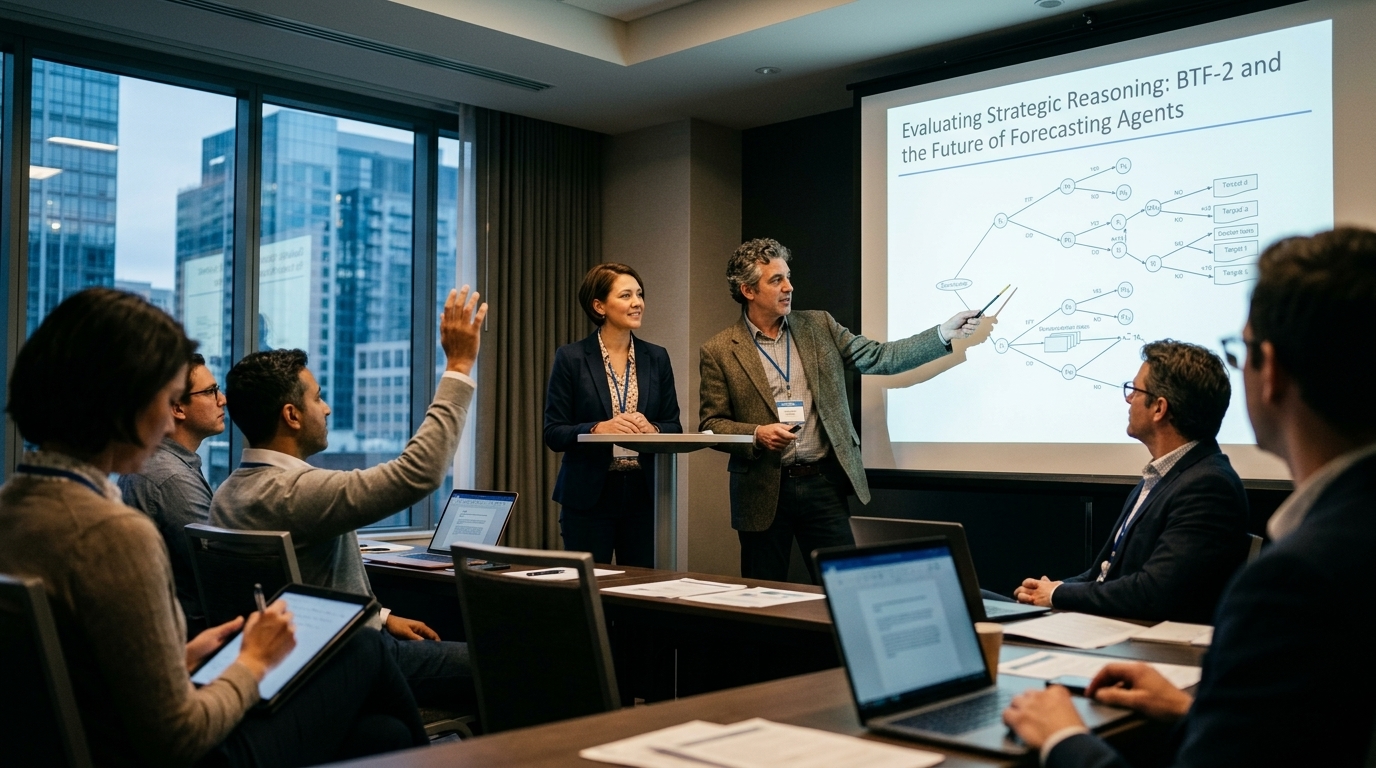
In the high-stakes world of Artificial Intelligence, the ability to predict future events—from market fluctuations to geopolitical shifts—is often considered the "Holy Grail." Yet, until now, evaluation benchmarks have focused almost exclusively on raw accuracy, leaving the underlying decision-making process in a "black box." New research published on ArXiv (2604.26106) introduces Bench to the Future 2 (BTF-2), an ambitious framework designed to map the "strategic reasoning" of AI forecasting agents.
BTF-2 is more than just another test; it is a diagnostic laboratory. It comprises 1,417 "pastcasting" questions, where models are tasked with "predicting" events that have already occurred, but using only a "frozen" research corpus of 15 million documents from that specific time period. This methodology effectively eliminates data leakage, ensuring that the AI isn't simply recalling facts from its training data, but is actually reasoning through the information available at the time.
Beyond Binary Accuracy: The Quest for Insight
The primary critique of current forecasting systems is their lack of transparency. A model might correctly predict an outcome through sheer statistical luck or by identifying correlations that lack causal logic. BTF-2 introduces tools to evaluate how AI agents search for information, prioritize evidence, and calibrate their confidence levels.
- Information Retrieval: How effectively does the agent sift through 15 million documents to find the "smoking gun"?
- Causal Reasoning: Can the model distinguish between transient noise and structural trends?
- Uncertainty Calibration: How does the agent adjust its probability estimates when faced with contradictory data?
According to the researchers, strategic reasoning is what separates a "lucky" forecaster from a reliable strategic advisor. Within the BTF-2 environment, AI agents are not just judged on whether they correctly predicted a 2022 election result, but on whether their analysis was grounded in the relevant economic and social indicators available at that moment.
The Power of the Frozen Corpus
One of the most technically impressive aspects of the study is the 15-million-document corpus. By creating a controlled information environment, scientists can observe AI behavior in a vacuum. "It’s akin to placing a historian in a room filled with period-accurate newspapers and asking them to predict the next week's headlines, without allowing them to peek at the future," the study authors suggest.
"Accuracy without justification is dangerous. In critical infrastructure and international relations, we need models that can explain the 'why' behind every probability percentage."
This approach reveals significant flaws in contemporary Large Language Models (LLMs). Despite their vast computational power, many models struggle to synthesize conflicting reports or tend to suffer from "recency bias," overvaluing the latest data point while ignoring the broader historical context. BTF-2 acts as a mirror, reflecting these inherent cognitive biases in AI.
The Future: AI Agents as Strategic Partners
The implications of BTF-2 extend far beyond academia. In business and governance, the ability of an AI to function as a "Superforecaster" could fundamentally alter how public policies or investment strategies are developed. If we can trust the logic behind a model's prediction, we can use it to simulate crisis scenarios and develop proactive responses.
However, the research emphasizes that we are still in the early stages. Strategic reasoning requires a level of "common sense" and an understanding of human motivation that AI still struggles to emulate. BTF-2 sets a high bar, challenging AI developers to move beyond the pursuit of raw accuracy and invest in the architecture of deep reasoning and epistemic transparency.