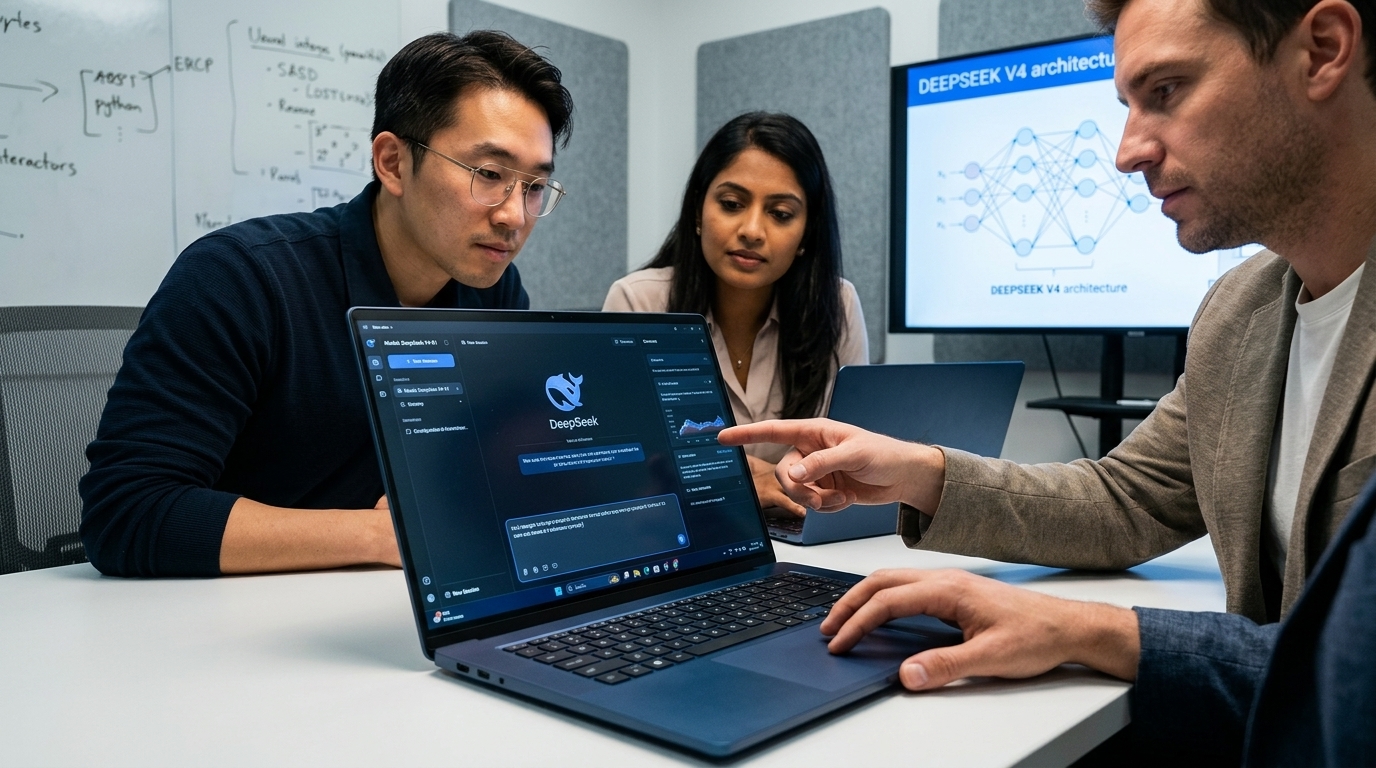
The global artificial intelligence landscape is witnessing a seismic shift. Where Silicon Valley once believed its monopoly on innovation was secured by billions of dollars in compute power, a startup from Hangzhou, DeepSeek, has arrived to upend the status quo. The announcement of DeepSeek V4 is not just another model release; it is a confirmation that algorithmic efficiency can overcome the brute force of GPUs.
The Architecture of Disruption: Pro and Flash
DeepSeek V4 is presented in two primary versions, following the strategy established by Google and OpenAI, but with a crucial difference: open access to model weights. The V4 Pro version directly targets top-tier models like GPT-4o and Claude 3.5 Sonnet, offering advanced reasoning, coding, and mathematical analysis capabilities. On the other hand, the V4 Flash version is designed for speed and low cost, making it ideal for real-time applications and integration into mobile devices.
DeepSeek's technical superiority is rooted in its sophisticated Mixture-of-Experts (MoE) architecture. Unlike traditional 'dense' models, V4 activates only a small subset of its parameters for each query. This allows the model to maintain vast knowledge without requiring proportional energy or compute power during inference. The use of Multi-head Latent Attention (MLA) dramatically improves processing speed, enabling V4 to handle massive context windows with minimal latency.
The End of the 'Compute Moat'?
For years, the dominant narrative was that whoever owns the most NVIDIA H100s wins the AI race. DeepSeek V4 proves otherwise. Trained on a fraction of the budget of its American rivals, the model manages to match or even surpass benchmarks in critical areas. This creates immense pressure on Western Big Tech, which sees its profit margins threatened by free or extremely cheap alternatives.
- Training Cost: DeepSeek employs Reinforcement Learning (RL) techniques that reduce the need for massive human-labeled datasets.
- Accessibility: The open-source nature of V4 allows developers worldwide to run it locally, bypassing the expensive APIs of OpenAI and Anthropic.
- Geopolitical Significance: Despite US chip export restrictions, Chinese innovation is finding ways to thrive through algorithmic ingenuity.
This move by DeepSeek is not just about technology; it's about dominating the developer ecosystem. By offering a model that is both powerful and free, the company is building a community that will rely on its standards, undermining the closed ecosystems of Silicon Valley.
Challenges and Ethical Dilemmas
Of course, the rise of DeepSeek is not without its critics. There are intense concerns regarding the origin of training data and whether it includes the intellectual property of Western companies without permission. Furthermore, the close relationship between Chinese tech giants and the state raises questions about censorship and data security. DeepSeek V4, despite its technical excellence, carries the built-in 'filters' required by Beijing, a fact that may limit its adoption in certain sensitive sectors in the West.
"DeepSeek didn't just change the game; it changed the rules of the game. Now, the question isn't how many billions you have, but how smartly you can use them."
In conclusion, DeepSeek V4 represents a milestone for 2026. It forces everyone to re-evaluate their strategy. If this trend continues, AI will cease to be an expensive privilege of the few and become a common good, accessible to every developer with a decent computer. The battle for AI supremacy has just gained a new, unpredictable protagonist.