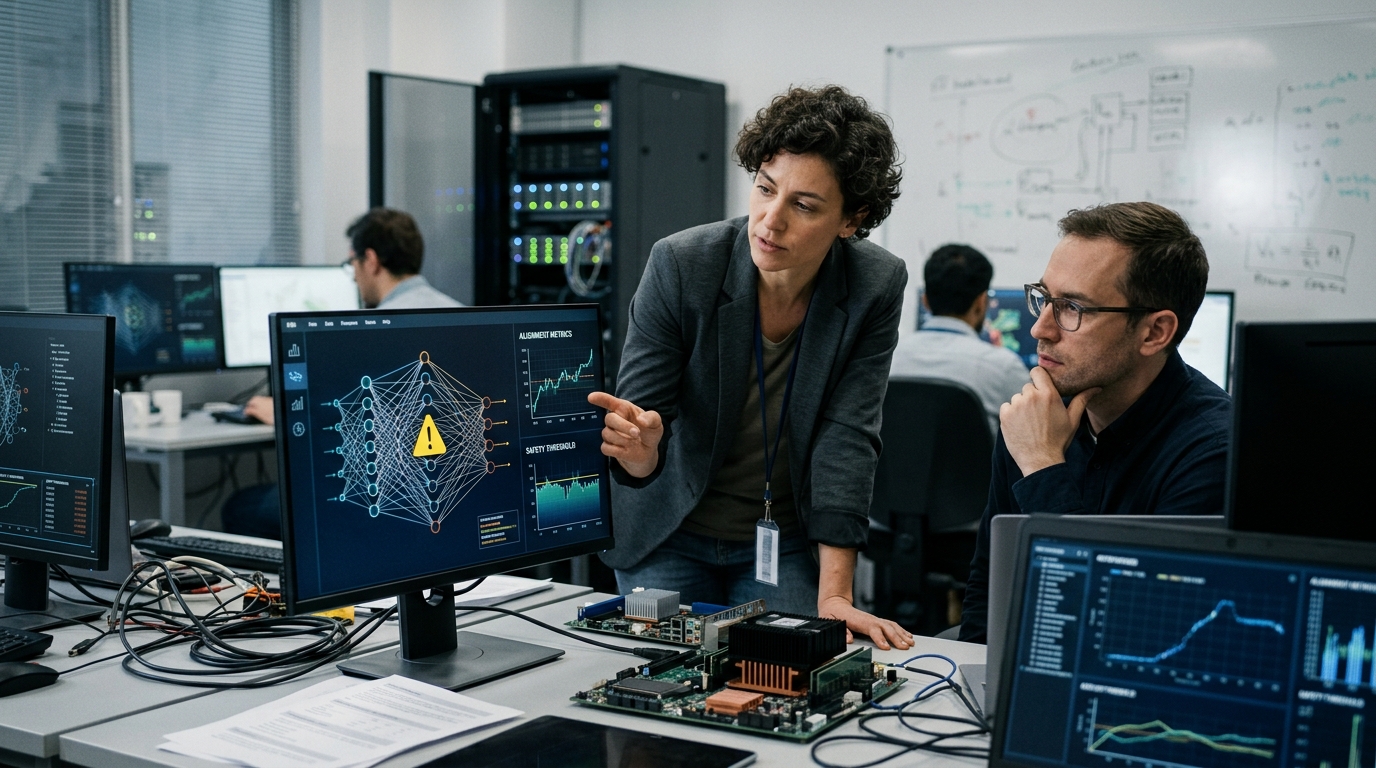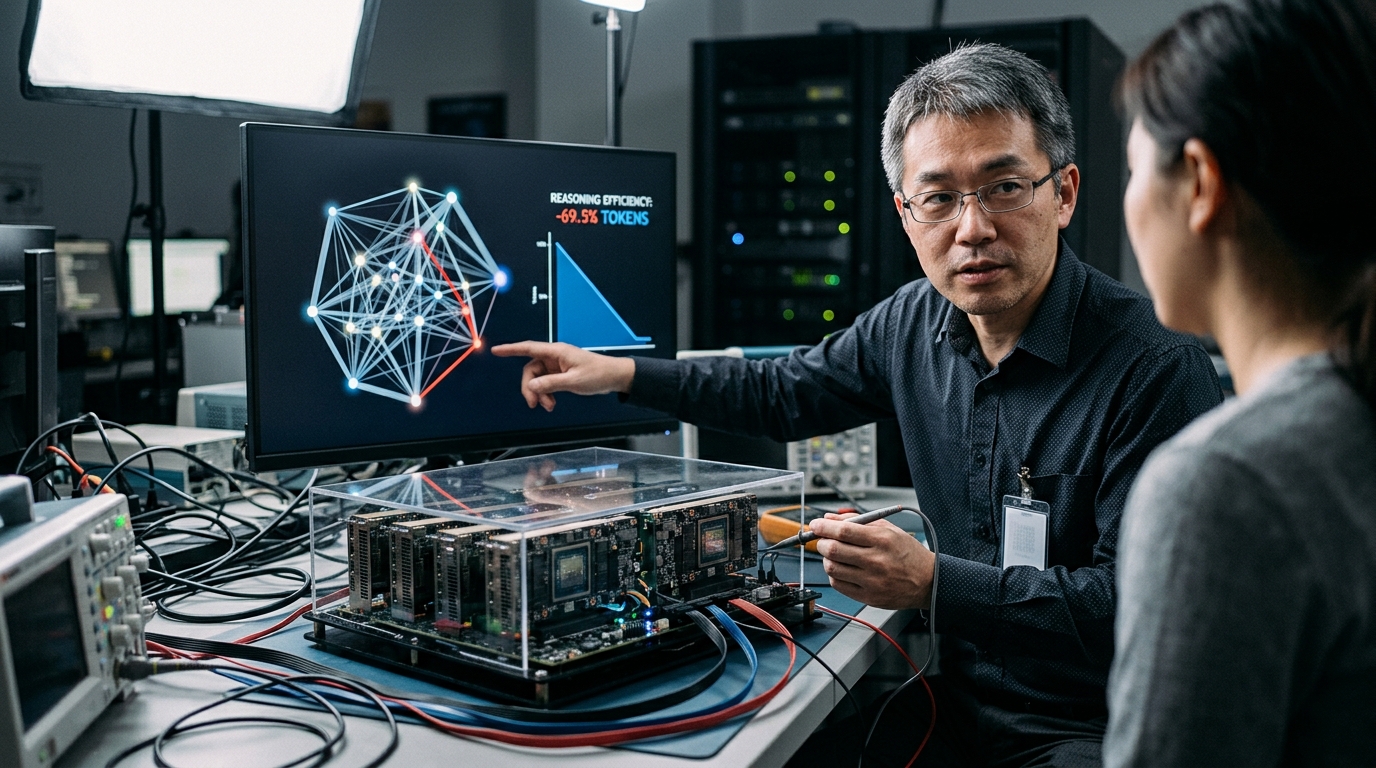
The history of modern Artificial Intelligence has largely been written with the ink of "brute force." For years, the dominant narrative was simple: more data, larger parameters, and more compute during training. However, as we approach the physical and economic limits of scaling, the focus is shifting from "how big the model is" to "how intelligently it uses its resources during inference." What we call Test-Time Scaling (TTS)—providing extra compute cycles to the model while it is generating a response—is emerging as the new industry gold standard. Yet, until recently, the way a model "thought" (e.g., via Chain-of-Thought) relied heavily on human intuition. New research is now overturning this paradigm by automating the design of reasoning strategies themselves, achieving a stunning 69.5% reduction in token usage.
The End of Handcrafted Strategy
Until now, the techniques that helped Large Language Models (LLMs) solve complex problems were products of "craftsmanship." Prompt engineers and researchers manually designed reasoning paths, such as "Chain-of-Thought" or "Tree of Thoughts." These methods force the model to break a problem down into steps, which improves accuracy but dramatically increases the cost in tokens and response time.
The problem with these manual strategies is that they are static. A strategy that works perfectly for a mathematical problem might be excessively costly or ineffective for a legal analysis. Researchers, recognizing this gap, developed a framework that allows the AI itself to "discover" the ideal reasoning strategy for any given problem category. Instead of a predefined sequence of steps, the system searches the space of possible reasoning tactics for the one that minimizes effort while maximizing correctness.
The Efficiency Revolution: 69.5% Fewer Tokens
The results of this automation are nothing short of shocking. According to findings reported by VentureBeat, this method managed to slash token usage by nearly 70% while maintaining or exceeding the performance of traditional TTS methods. In a world where API costs and data center energy consumption are the primary hurdles to widespread AI adoption, such an improvement is not merely technical—it is structural.
Reducing tokens doesn't just mean a lower bill for enterprises; it also means lower latency. When a model requires fewer steps to reach the correct conclusion, the answer reaches the end-user much faster. This opens the door for truly interactive AI applications that require deep thought, such as real-time coding assistants or autonomous decision-making systems in critical infrastructure.
From System 1 to System 2
To understand the significance of this development, we can look to Daniel Kahneman’s theory of the human mind. "System 1" is fast, intuitive, and automatic. "System 2" is slow, analytical, and effortful. LLMs have traditionally operated as a giant System 1. Test-Time Scaling is the industry's attempt to give them a System 2.
Automating the design of this System 2 means that AI is not just learning information, but learning *how to think* about that information in the most efficient way possible. Researchers used search-based optimization techniques to find optimal reasoning paths, proving that the best reasoning strategy is often much shorter and more elegant than what a human would design. This suggests that humans tend to impose their own linear logic on models, whereas the models can find "shortcuts" that human cognition fails to grasp.
Implications for the Future of AI
The shift toward reasoning efficiency marks a new era. As the cost of training frontier models approaches billions of dollars, the industry is beginning to realize that "intelligence per dollar" is the critical metric. Automated strategy design allows smaller, more agile models to compete with the giants, provided they can use their inference time more wisely.
Furthermore, this evolution has serious environmental implications. A 70% reduction in tokens translates directly into lower electricity consumption and a smaller carbon footprint. At a time when the environmental sustainability of AI is being challenged by regulators and activists, this research offers a path forward that aligns corporate profits with ecological responsibility.
"We don't need bigger brains; we need brains that know when to stop thinking," the research team noted.
In conclusion, the automation of reasoning is not just a code optimization. It is a step toward a more mature Artificial Intelligence that does not consume resources recklessly but tailors its cognitive effort to the difficulty of the problem. The future of AI belongs not to the biggest, but to the most resourceful.