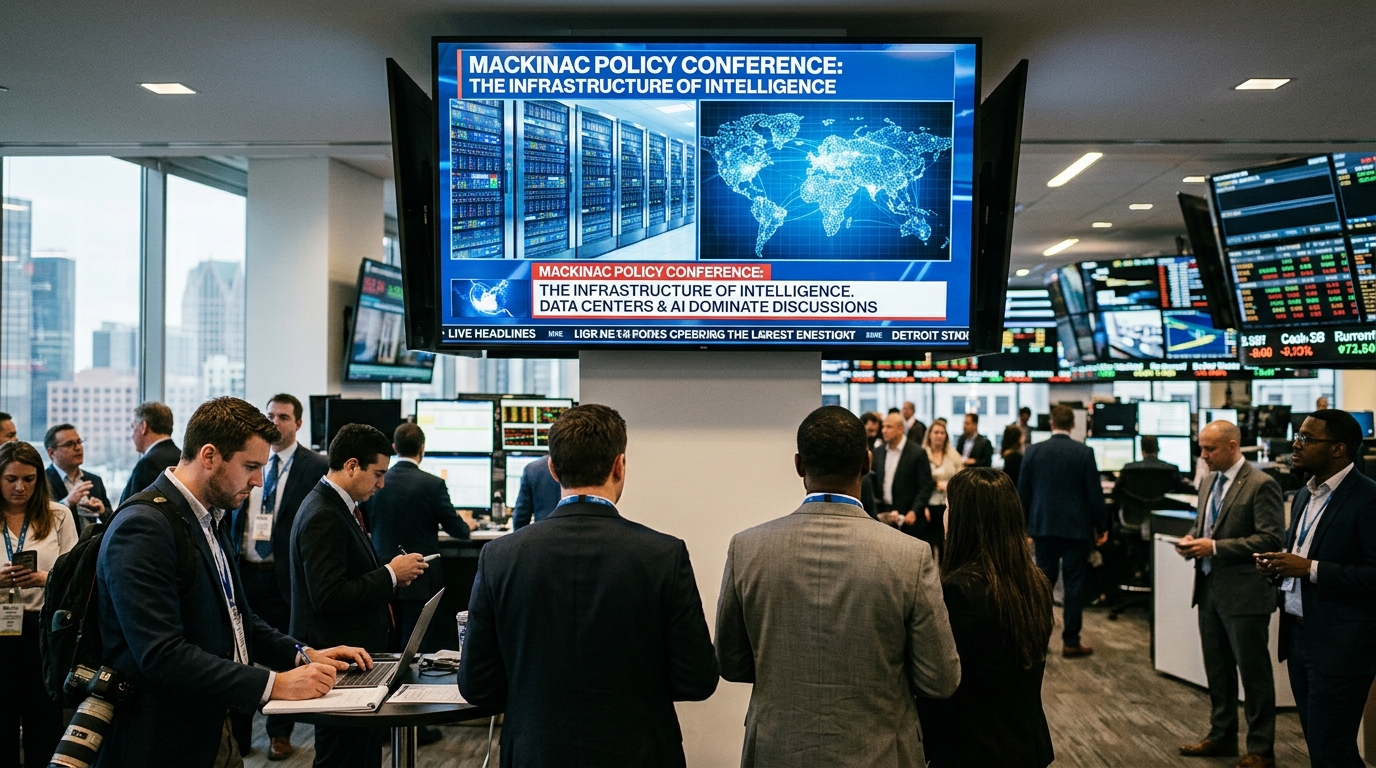
As business leaders, politicians, and pundits gathered at the historic Grand Hotel on Mackinac Island for the 2026 Policy Conference, the air was thick not just with the lake breeze, but with the urgency of digital transformation. While Michigan remains the heart of the American automotive industry, this year's agenda made it clear that the state's future—and that of the global economy—now hinges on the cloud and the algorithms that power it.
The New Heavy Industry: Data Centers
Data centers are no longer just server warehouses; they are the factories of the information age. At the heart of the discussions was the legislative push to provide tax incentives to attract giants like Microsoft, Google, and Amazon. Proponents argue that without this infrastructure, Michigan will fall behind in the Artificial Intelligence race.
However, the conversation was not without controversy. The main point of friction remains energy consumption. Data centers require massive amounts of electricity and water for cooling, raising concerns among environmentalists and power grid managers. As noted in one of the panels, "We cannot build tomorrow's economy with yesterday's grid." The need for clean energy and the pressure on utilities to upgrade their infrastructure is now imperative.
AI as a Catalyst for Growth
Artificial Intelligence (AI) was not just a topic of discussion but the axis around which all economic forecasts revolved. From autonomous driving to personalized medicine, Mackinac attendees examined how AI can boost productivity in an era where labor shortages are a persistent headache for businesses.
- Workforce training for the new digital reality.
- Integration of AI into the production lines of "smart" factories.
- Ethical use of data and protection of citizen privacy.
The governor and legislators were pressured to create a stable regulatory framework that encourages innovation without sacrificing workers' rights. AI is now considered the "key" to maintaining Michigan's competitiveness against tech hubs like Silicon Valley and Austin.
"Artificial Intelligence is not a future threat, but a present tool. Whoever does not adopt it today will be the illiterate of tomorrow," one keynote speaker remarked.
The Infrastructure and Sustainability Challenge
One of the most critical questions raised was the cost of this transition. While data centers bring billions in investment, the jobs they create after construction are relatively few. This creates a political dilemma: are millions in tax breaks worth a few hundred permanent jobs?
The answer, according to the conference's economic analysts, lies in the "multiplier effect." The presence of large data centers attracts startups and tech talent, creating an innovation ecosystem. Nevertheless, the strain on the energy grid remains the "thorn" in negotiations, with many calling for tech companies to invest in renewable energy sources themselves to meet their needs.
In conclusion, the 2026 Mackinac Policy Conference confirmed that policy and technology are now inextricably linked. Michigan is no longer just trying to build the best cars; it is trying to become the brain behind the global digital infrastructure.