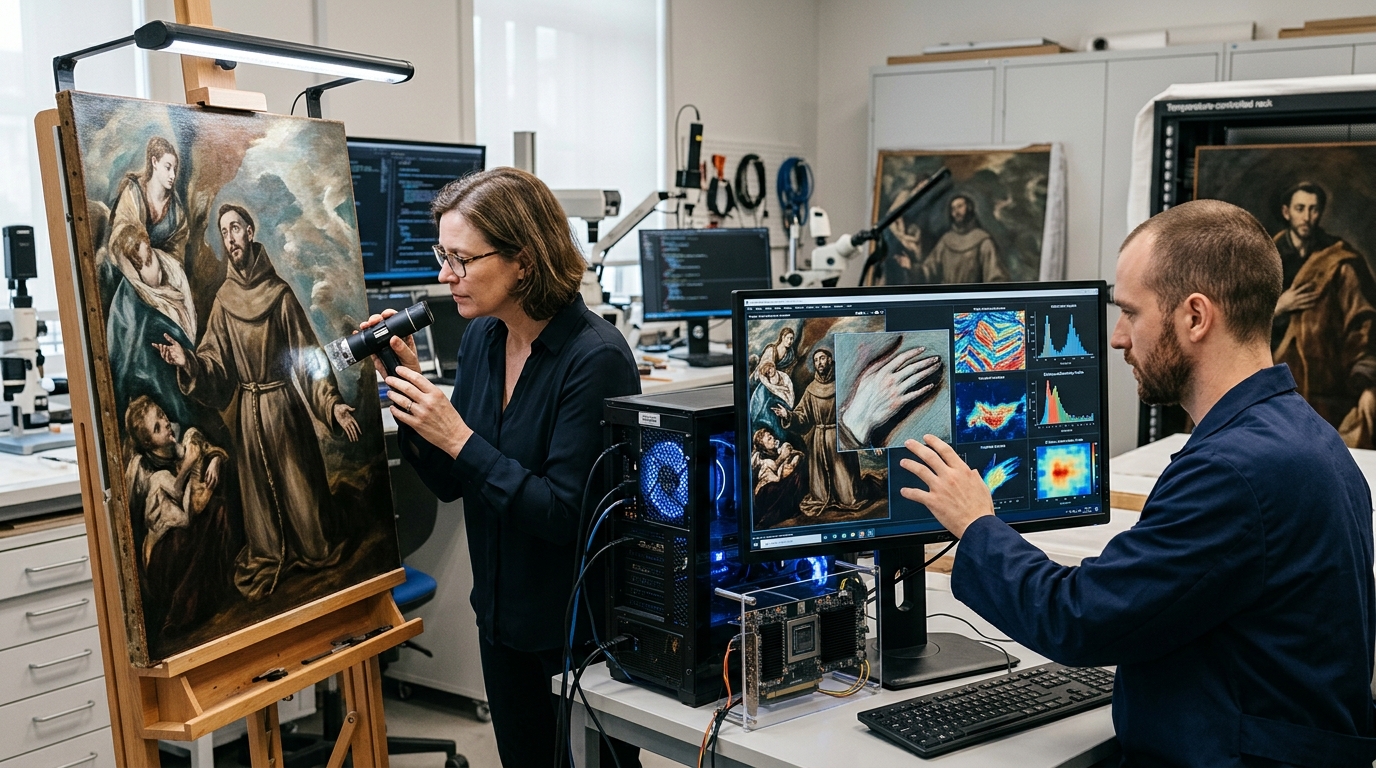
Art history has always been a field defined by the tension between the expert’s intuition and the cold reality of physical examination. For centuries, connoisseurs—scholars with a highly trained eye—were the final arbiters of whether a painting belonged to a master or a talented assistant in their workshop. Today, technology is offering a new, almost prophetic perspective on this mystery. Recent research, highlighted by Smithsonian Magazine, reveals how Artificial Intelligence has managed to "read" the brushstrokes of Domenikos Theotokopoulos, the iconic El Greco, solving puzzles that remained unanswered for over four hundred years.
The Workshop of the Cretan Master
El Greco, who flourished in Toledo, Spain, during the late 16th and early 17th centuries, did not work in isolation. Like all great masters of his era, he maintained a busy workshop where assistants and apprentices—including his son, Jorge Manuel—replicated his compositions to meet high demand. This practice created a vast body of work that carries El Greco’s style but not necessarily his hand in every square inch of the canvas. Distinguishing between an "authentic" work and a "workshop" piece is not just a matter of academic precision; it is an issue that affects cultural heritage and, of course, the astronomical value of works in the art market.
The Digital Anatomy of a Brushstroke
The new method, developed by researchers using Convolutional Neural Networks (CNNs), is based on the analysis of the "micro-structure" of the brushstroke. Just as every individual has a unique handwriting, every artist possesses a unique "fingerprint" in the way they apply paint to canvas. The pressure, speed, direction, and amount of material create patterns that are invisible to the naked eye but detectable by Artificial Intelligence.
- Model Training: Researchers fed the system thousands of high-resolution images of works that are indisputably created by El Greco.
- Comparative Analysis: The AI learned to recognize the subtle differences between the master’s free, almost expressionistic brushwork and the more hesitant or standardized approach of his assistants.
- Results: In tests conducted on disputed works, the system was able to accurately indicate which parts of a painting belong to El Greco and which to his collaborators.
"AI does not replace the art historian; rather, it provides them with a digital microscope capable of seeing through the layers of time and technique," the researchers noted.
The Case of 'The Agony in the Garden'
One of the most striking examples of this technology's application concerns the work 'The Agony in the Garden.' Several versions of this painting exist, and for years experts have debated which parts were executed by El Greco himself. AI analysis showed that while the central figure of Christ bears all the hallmarks of the Cretan’s genius, the secondary landscape elements and the figures of the sleeping disciples in certain versions clearly belong to other hands, most likely his son’s. This discovery does not diminish the value of the work as a whole, but it offers a more honest understanding of how Renaissance and Baroque art workshops operated.
Challenges and Ethical Dilemmas
Despite the excitement, the use of AI in art is not without its critics. There is a fear that a "wrong" decision by an algorithm could devalue a masterpiece or lead to incorrect conclusions if the training data is not perfectly accurate. Furthermore, art is more than the sum of its brushstrokes; it is emotion, context, and spirituality—elements that machines still struggle to grasp. However, the integration of these tools into museums and auction houses now seems inevitable. Science and art, two fields often considered opposites, are collaborating to ensure that the truth of the past remains vibrant for the future.