For decades, pure mathematics was considered the final fortress of human intellect. While computers could perform billions of operations per second, the capacity for abstract reasoning, identifying patterns in chaotic sets, and formulating new theorems remained the exclusive domain of the world's finest mathematical minds. This status quo was recently disrupted as Artificial Intelligence managed to provide answers to questions that had plagued the scientific community for over 80 years, particularly in the field of Ramsey Theory.
Ramsey Theory and the Challenge of Chaos
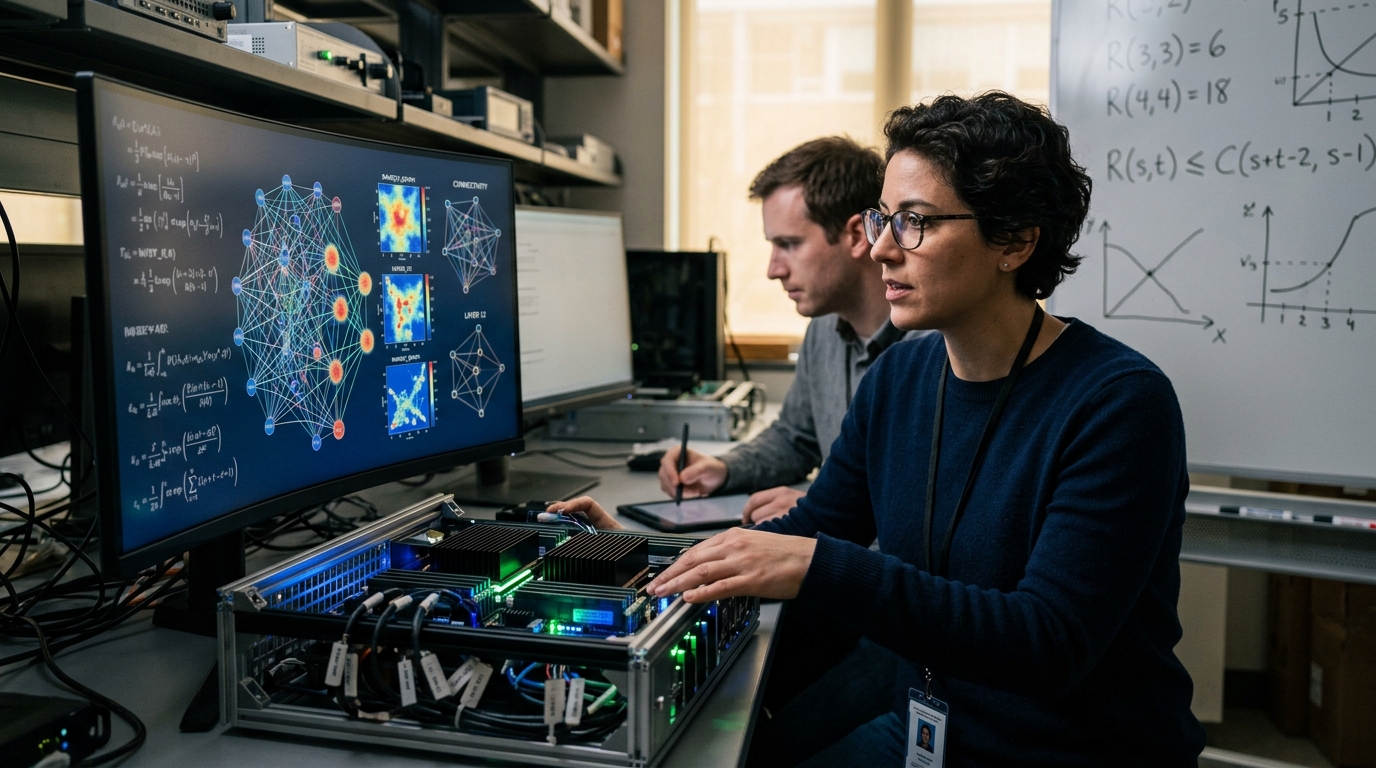
Ramsey Theory is often described as the study of "unavoidable order." Its core premise is that in any sufficiently large system, no matter how chaotic it appears, there will always be a structure. The most famous example is the "party problem": how many people must you invite to ensure that at least three of them know each other or at least three are total strangers? The answer is simple (6), but as the numbers grow, the complexity explodes exponentially.
The legendary mathematician Paul Erdős once joked that if an alien force threatened to destroy Earth unless we found the value of the Ramsey number R(5,5), we should marshal all our mathematicians and computers. But if they asked for R(6,6), we would be better off trying to destroy the aliens, as the calculation would be impossible. This "impossible" is exactly what AI has begun to challenge.
The FunSearch Revolution
The recent breakthrough did not come from a simple language model "guessing" answers, but from Google DeepMind's FunSearch. FunSearch combines a Large Language Model (LLM) with an evaluator. Instead of attempting to solve the mathematical problem directly, the system writes Python code that searches for the solution. The evaluator checks if the code works and if the results are correct, feeding successful iterations back into the model for further refinement.
Using this method, AI managed to improve the bounds for the "cap set problem" and offered new insights into Ramsey numbers, breaking records that had stood since the 1940s. The most significant aspect is not just the answer itself, but the fact that the AI produced human-readable code, explaining the *why* and *how* behind the discovery.
- Automated Discovery: AI is no longer just a digital calculator but a generator of new knowledge.
- Interpretability: Unlike the "black boxes" of the past, these new methods produce code that mathematicians can actually analyze.
- Human-Machine Synergy: Scientists are now using AI to push past the boundaries of their own intuition.
Why This Changes the World
While Ramsey Theory may sound abstract, its applications are foundational. From computer science and cryptography to network communication and statistical physics, understanding the limits of order within chaos is critical. When AI helps improve these mathematical bounds, it essentially enhances the efficiency of the algorithms that drive the modern world.
Furthermore, this success marks a shift in the scientific method itself. For centuries, progress relied on individual flashes of genius. Today, progress can be accelerated through an iterative process where machine learning proposes and human logic validates. This hybrid model promises to unlock secrets of nature that remained hidden due to our limited computational capacity to handle exponential complexity.
"This isn't just about a faster search. It's about a new form of creativity encoded into algorithms," noted one of the DeepMind researchers.
The Future of Mathematical Research
As we move toward 2027, the integration of AI into university mathematics departments will be taken for granted. The challenge is now shifting from finding the solution to understanding the deeper structures that AI highlights. The mathematicians of the future will need to be as skilled in programming and guiding AI models as they are in traditional pen-and-paper theorem proving. The "golden age" of mathematics has just begun, and its engine is silicon.