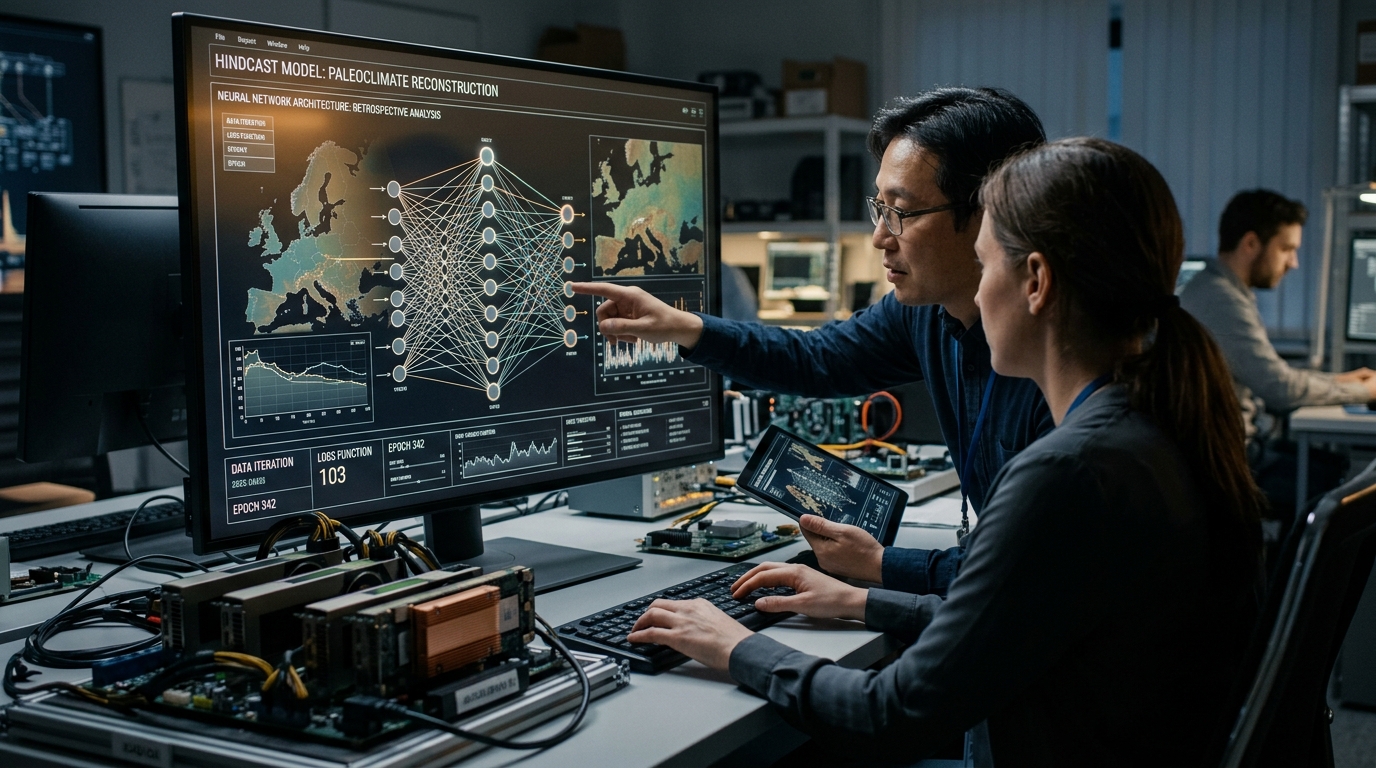
When we think of Artificial Intelligence (AI), our minds typically drift toward the future: self-driving cars, stock market predictions, or the next strategic move in a complex game. However, a compelling new frontier in scientific research is reversing the arrow of time. The question posed by Bloomberg and the international research community is provocative: Can AI be trained to "predict" the past? This process, known as "hindcasting," is not merely a theoretical exercise but a powerful tool for recovering lost human knowledge.
Digital Archaeology and the Deciphering of History
The most immediate application of this technology lies in archaeology and epigraphy. Thousands of ancient texts have survived only in fragmentary form, with weathered surfaces or missing sections that make reading them impossible for the human eye. This is where AI steps in. Using deep neural networks, researchers train models on vast corpora of texts from specific periods and regions. DeepMind’s "Ithaca" model is the most prominent example, successfully restoring damaged ancient Greek inscriptions with remarkable accuracy.
AI does not simply guess words. It analyzes context, grammatical structure, and even the individual style of the scribe. By "predicting" what should exist in the blank space of a stone tablet, the machine helps historians piece together a more complete narrative of the past. This form of prediction relies on probabilistic modeling: given elements A and B, what is the most likely word C that completes the meaning?
Filling the Data Voids: From Paleoclimate to Lost Markets
Beyond the humanities, AI’s ability to predict the past is critical for understanding our planet. Climatologists often face the problem of missing data for periods before the invention of modern measuring instruments. Using hindcasting, algorithms can take existing data—such as tree rings or ice core samples—and accurately reconstruct global temperatures or carbon dioxide levels from centuries ago.
- Restoring historical climate records to improve the accuracy of future climate change projections.
- Reconstructing economic indicators in eras where statistical agencies were non-existent.
- Modeling the spread of ancient pandemics through the analysis of genetic material and archaeological findings.
In the realm of economics, AI can help understand the root causes of major past crises by filling gaps in historical records of prices or trade flows. This allows analysts to test economic theories in "virtual" historical scenarios, offering lessons that remain highly relevant to today’s globalized market.
The Epistemological Trap: When Algorithms Hallucinate History
Despite the immense potential, using AI to reconstruct the past carries significant risks. The primary concern is model "hallucinations." An AI can generate a historical truth that appears convincing but is entirely erroneous, based on biases within the training data. If our datasets are Eurocentric, the AI will tend to "predict" a past that favors that narrative, effectively erasing the voices of other civilizations.
"Artificial Intelligence is not a time machine; it is a mirror of our data. If the mirror is distorted, the past we see will be a caricature."
Furthermore, there is the issue of authenticity. When a machine fills a gap in an ancient text, that text ceases to be a pure archaeological find and becomes a hybrid of human and artificial creation. Transparency in the use of these tools is essential to ensure that technology serves historical truth rather than manufacturing it for convenience.
Conclusion: A New Partnership with Time
The ability of AI to predict the past represents a new era for human knowledge. It is not about replacing historians or archaeologists but empowering them with tools that can process information at a scale impossible for humans. As algorithms become more sophisticated, the dark spots of our history will begin to light up, revealing connections and patterns that have remained hidden for millennia. The past, ultimately, is not static; it is a field of continuous discovery, where technology helps us remember what we had long forgotten.