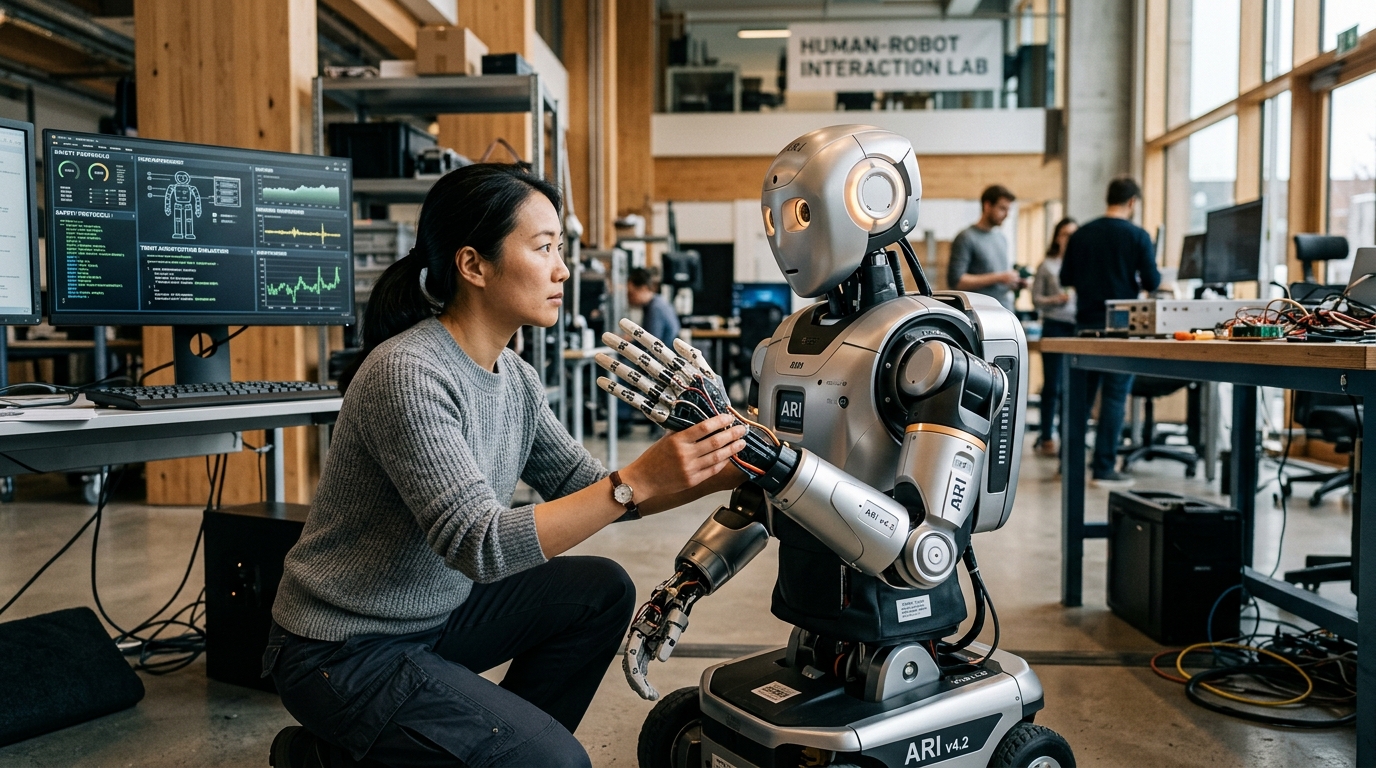
The migration of Artificial Intelligence from the digital realm of chatbots and image generators into the physical world of robotics represents the next great frontier of technology. However, this shift toward "embodied AI" brings a fundamental change in stakes: if a chatbot makes a mistake, the result is misinformation; if a robot makes a mistake, the result can be physical injury or even death. Recent analysis from Eurasia Review highlights that ensuring the safety of these systems is not merely a technical issue, but a complex equation involving ethics, legislation, and geopolitics.
Beyond the Screen: The Physical Risks of Embodied AI
For decades, industrial robots operated in strictly controlled environments, often behind safety cages, performing repetitive motions with mathematical precision. The new generation of AI-enabled robots, however, is intended to operate alongside humans—in homes, hospitals, and construction sites. These systems must be capable of perceiving their environment, making split-second decisions, and predicting human behavior, which is inherently unpredictable.
The core problem lies in "uncertainty." Machine learning models are probabilistic. While a 1% error rate might be acceptable for a search engine, it is catastrophic for an autonomous vehicle or a robotic surgical assistant. The challenge is to create systems that can guarantee safety even when faced with "edge cases"—situations that were not included in their training data.
Technical Challenges: From Latency to Generalization
Robot safety requires a holistic approach to architecture. First, there is the issue of "latency." Data processing from sensors must occur locally (edge computing) rather than in the cloud, as every millisecond counts during an impending collision. Second, "generalization" remains the holy grail. A robot trained in a lab must be able to navigate a cluttered living room with pets and children without causing an accident.
- Sensor Fusion: The need for multiple systems (LiDAR, cameras, ultrasound) that complement each other to avoid "blind spots" in AI perception.
- Formal Verification: The use of mathematical methods to prove that robot software will always adhere to certain safety rules, regardless of inputs.
- Digital Twins: Extensive testing of robots in virtual environments before deploying them in the real world.
The Legal and Ethical Void: Who is Liable?
One of the most thorny issues is the attribution of liability. If an autonomous robot causes damage, who is responsible? The algorithm programmer? The hardware manufacturer? The owner who failed to maintain it? Or perhaps the AI itself, if we consider its decision-making to be autonomous? Current legislation, such as the EU AI Act, attempts to categorize robots based on risk levels, imposing stricter standards on "high-risk" systems.
"Safety is not a feature to be added at the end, but a fundamental value that must be integrated into the design process from day one," state experts in robotics ethics.
Furthermore, there is the risk of "algorithmic bias" in the physical world. If a security robot or a nursing robot has been trained on data that does not represent the entire population, it may not correctly recognize the movements or needs of individuals with different physical characteristics, leading to discriminatory treatment or reduced safety for specific groups.
Geopolitics and International Standards
The race for dominance in robotics is not just economic but regulatory. The US, China, and the European Union are competing to set global safety standards. There is a fear that in the rush for faster innovation, some nations might loosen safety standards, creating a "race to the bottom." International cooperation through organizations like ISO is essential to create a common framework that protects citizens worldwide while ensuring the technology remains beneficial to humanity.