Pompeii, the city famously frozen in time by the eruption of Mount Vesuvius in 79 AD, is revealing its secrets once again. However, this time the revelation doesn't come from a brush or a shovel, but from the sophisticated algorithms of Artificial Intelligence. For over two centuries, visitors have been moved by the haunting plaster casts of victims trapped in volcanic ash. Today, technology is allowing us to look these individuals in the eye, transforming anonymous statues into faces with history, ethnicity, and biological identity.
From Plaster to Pixels: The Bio-Archaeological Revolution
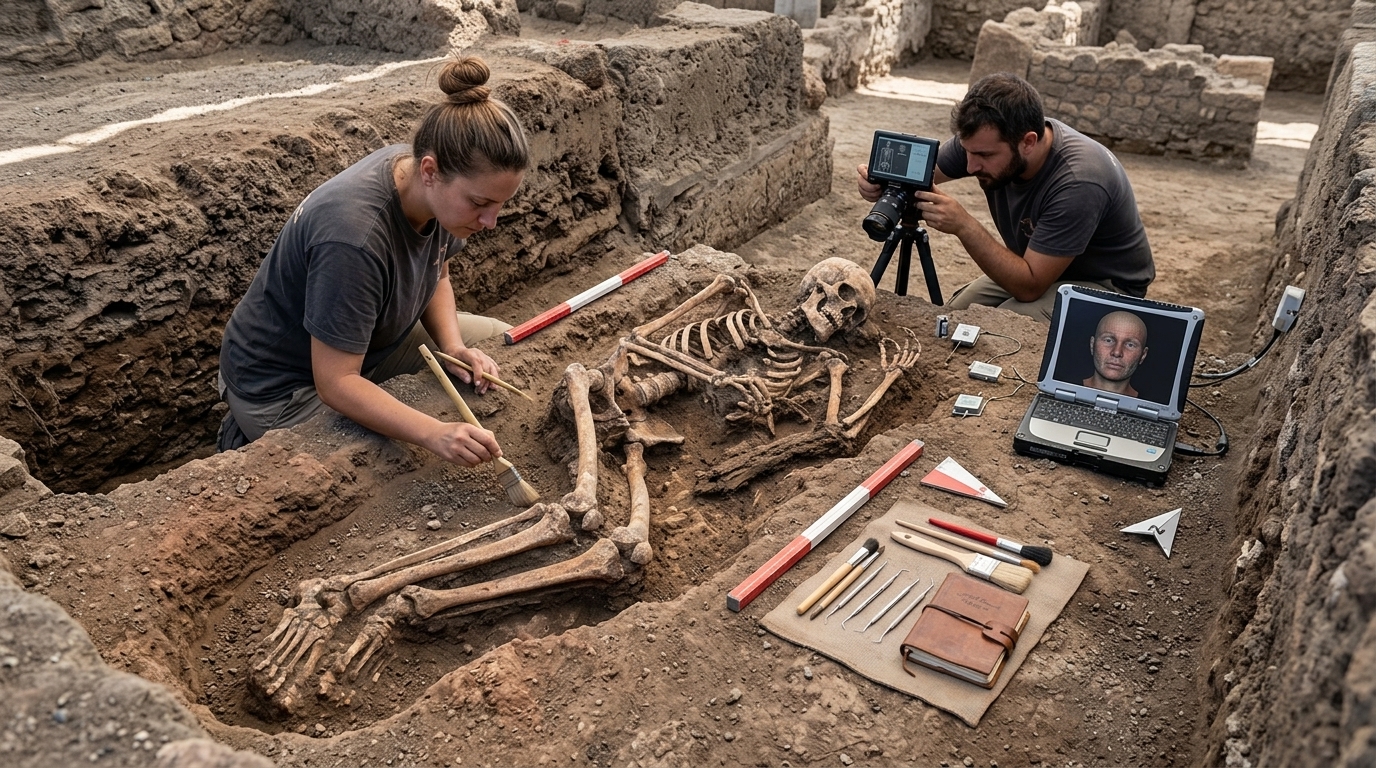
The traditional method pioneered by Giuseppe Fiorelli in 1863—filling the voids left by decomposed bodies with plaster—provided a visceral look at the victims' final moments and postures. Yet, the plaster often obscured the skeletal remains and compromised DNA samples. A new interdisciplinary approach, combining genomic sequencing with AI-driven facial reconstruction, is bypassing these physical limitations. Researchers have successfully extracted genetic material from the 'petrous bone' (a dense part of the skull that preserves DNA exceptionally well) of a man discovered in the 'House of the Craftsman' (Casa del Fabbro).
This individual, aged between 35 and 40, was more than just a set of bones. Genomic analysis revealed he suffered from spinal tuberculosis (Pott’s disease), a condition that likely impaired his mobility and explains why he might have been unable to flee the city as the ash descended. AI utilized this biological data—skull morphology, genetic markers of Mediterranean descent (linked specifically to central Italy and Sardinia), and phenotypic traits—to generate a 3D reconstruction that is startlingly lifelike.
The Reconstruction Process: How AI Visualizes the Past
The process is far more than an artistic rendering; it is a data-driven forensic exercise. It employs complex machine learning models trained on thousands of CT scans of modern humans. These algorithms calculate the depth of soft tissue—muscle, fat, and skin—across the skull's surface, factoring in the individual's age, estimated BMI, and known pathologies. In the case of the Pompeii victim, AI was able to predict the shape of the nose, the prominence of the cheekbones, and the orbital depth with unprecedented accuracy.
- Genomic Mapping: Identifying eye color, skin tone, and hair texture via DNA.
- 3D Micro-Scanning: Capturing every structural nuance of the skull.
- Neural Networks: Simulating realistic skin textures and aging patterns based on environmental factors.
The result is a man with olive skin, dark eyes, and features that would appear perfectly at home in any modern Mediterranean town. The power of AI lies in its ability to fill the gaps where traditional archaeology reaches its limit, providing a bridge of empathy between the present day and the Roman world of two millennia ago.
Ethics and the 'Digital Haunting' of History
Despite the scientific achievement, the 'digital resurrection' of the deceased raises profound ethical questions. Is it appropriate to reconstruct the face of a victim of a catastrophic event without their consent? Some critics argue that this borders on 'dark tourism' or the commodification of tragedy. Conversely, many archaeologists argue that this process humanizes history, moving it away from the clinical study of artifacts toward a deeper understanding of human life.
"Artificial Intelligence doesn't just provide an image; it restores an identity. It transforms archaeology from a science of objects into a science of people," noted experts involved in the project.
The reconstruction of the man from the House of the Craftsman is just the beginning. As AI evolves, we may soon be able to visualize entire ancient communities, gaining insights into social hierarchies, migration patterns, and public health with a resolution previously thought impossible. This technology does not merely 'bring back' the dead; it forces us to confront our own relationship with time, heritage, and the shared human experience of mortality.