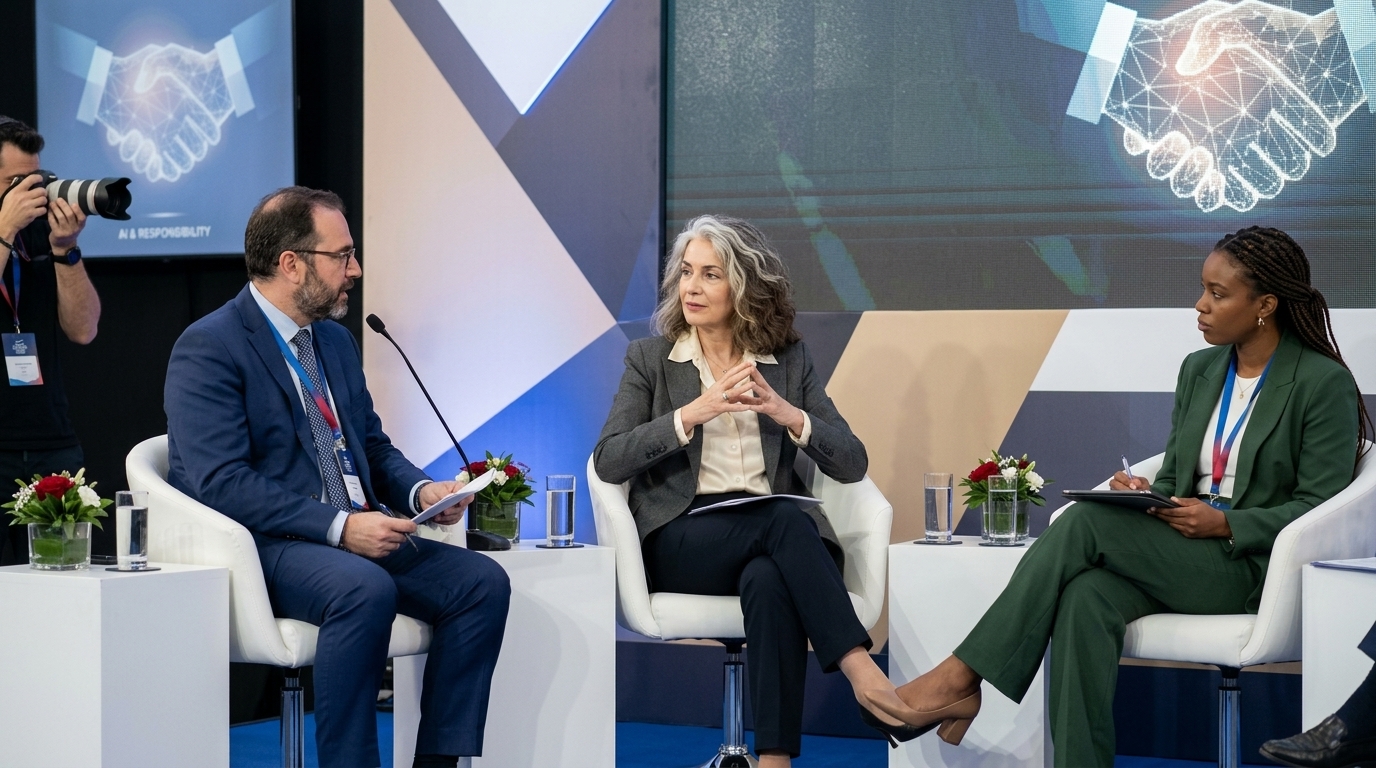
At the foot of Mount Parnassus, where ancient wisdom meets contemporary geopolitical and economic challenges, the 11th Delphi Economic Forum (DEF XI) served as the backdrop for a critical discussion on the future of work and leadership. People for Business, a leading executive search and talent management firm, addressed the elephant in the room: Artificial Intelligence (AI) is radically transforming the business landscape, yet the ultimate responsibility for decision-making remains—and must remain—a strictly human affair.
The Illusion of Automated Leadership
During the sessions, a fundamental truth emerged: AI can process vast amounts of data, identify patterns invisible to the human eye, and suggest optimized solutions, but it lacks the moral framework and emotional intelligence required to assume responsibility. People for Business executives emphasized that technology is a "co-pilot," not the captain. The trend toward over-reliance on algorithms carries the risk of "responsibility shedding," where leaders might hide behind data to justify unpopular or ethically questionable decisions.
Leadership in the AI era requires a new form of courage. It is no longer about who possesses the most information—which is now accessible to everyone via LLMs—but about who can synthesize that information with the organization's values and society's needs. "Human judgment" is being upgraded from a simple skill to a strategic imperative.
Talent in the Age of Meta-Specialization
One of the most compelling aspects of People for Business's presence at the Forum was the analysis of shifting executive selection criteria. While technical skills (hard skills) remain important, their expiration date is becoming shorter. The emphasis is now shifting to "meta-skills": adaptability, critical thinking, and, above all, ethical integrity.
- Adaptability: The ability to learn, unlearn, and relearn in real-time.
- Critical Thinking: The ability to challenge AI outputs and identify biases within algorithms.
- Emotional Intelligence: Managing human teams who feel threatened by automation.
According to People for Business, the organizations that will lead in the coming years are those that manage to create an environment of "psychological safety," where employees feel free to experiment with AI without the fear of replacement.
Ethics as a Competitive Advantage
At DEF XI, the conversation about AI was not limited to productivity; it extended to ethical governance. People for Business argued that the responsible use of technology is now part of a company's brand equity. Customers, investors, and potential employees are looking for organizations that do not use AI merely for cost reduction, but for creating value with a human-centric focus.
"Artificial Intelligence can give us the answer, but it is the human who must ask the question and bear the weight of the consequence," was a poignant remark made during one of the panels.
The challenge for HR departments and management is the creation of a new "social contract" within enterprises. A contract that clearly defines where automation ends and human intervention begins. People for Business suggests the establishment of "AI Ethics Committees" in every large organization to oversee not only the efficiency of systems but also their impact on human dignity and social cohesion.
Conclusion: Redefining Success
Concluding their presence in Delphi, People for Business executives sent a clear message: technology is neutral; its use is what makes it beneficial or dangerous. Success in the new economic environment will not be measured solely by profits or the speed of adopting new tools, but by the ability of leaders to remain "human" in a world of machines. The responsibility of decision-making is the final bastion of human uniqueness, and safeguarding it is the greatest challenge of our generation.