The ability to foresee the future has always been the 'Holy Grail' of politics, economics, and military strategy. From the oracles of Delphi to modern Wall Street analysts, humanity has consistently relied on the intuition and experience of experts. However, a disruptive new study from the University of Michigan’s Ross School of Business is shaking these foundations, proving that Artificial Intelligence is not merely an assistant, but a superior 'strategic prophet.'
The Tournament: Humans vs. Algorithms
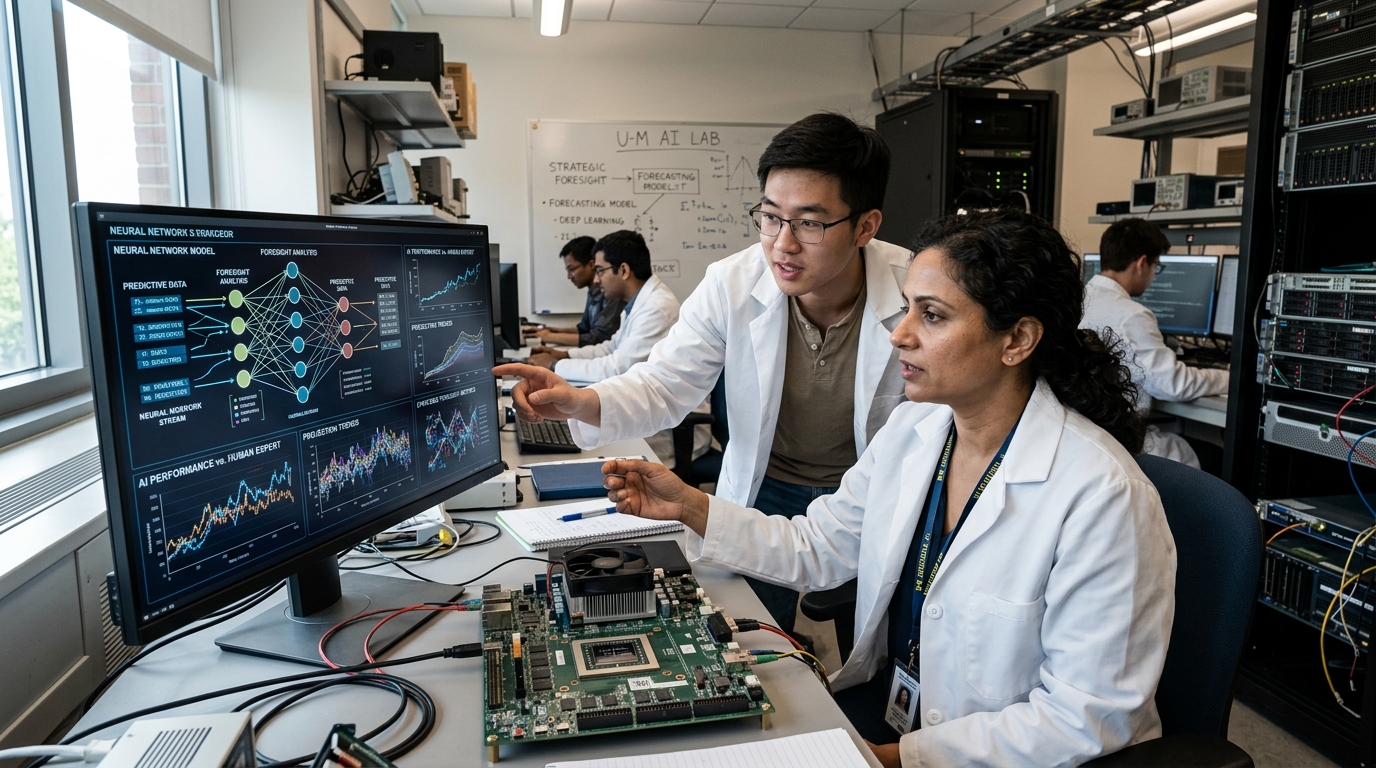
The study, conducted in the form of a 'Strategic Foresight Tournament,' pitted advanced Large Language Models (LLMs) against a group of elite humans known as 'superforecasters.' These individuals are not average citizens but experts trained in analytical thinking with a proven track record of accurate predictions in geopolitical and economic domains. Participants were asked to answer questions regarding future events—ranging from election outcomes and interest rate fluctuations to the likelihood of international conflicts.
The results were eye-opening. AI models did not just compete with humans; in many instances, they significantly outperformed them in accuracy and, crucially, in 'calibration.' Calibration refers to a forecaster's ability to correctly match their confidence level with the actual probability of the event occurring. While humans often fall prey to overconfidence or emotional bias, the AI models remained dispassionately objective.
Why Does AI Outperform?
The AI's superiority in strategic foresight is not due to some 'magical' insight but rests on three fundamental pillars: data processing capacity, the absence of cognitive biases, and the ability to synthesize disparate information. Michigan researchers noted that AI models can analyze millions of pages of historical data, news reports, and white papers in seconds, identifying patterns that the human brain simply cannot retain.
- Elimination of 'Noise': Humans are influenced by recent news cycles, fatigue, or even the time of day. AI operates with consistent computational logic.
- Multi-Scenario Synthesis: LLMs can simulate thousands of possible outcomes simultaneously, assigning probabilities to each based on statistical modeling.
- Impartiality: Unlike analysts who may hold political or ideological leanings, AI (when properly tuned) focuses exclusively on the data evidence.
Implications for Global Leadership
The realization that AI can predict the future more accurately than human experts has colossal implications for the corporate and political worlds. In the boardrooms of major corporations, strategy will no longer rely solely on the 'gut feeling' of a CEO. Instead, billion-dollar investment decisions will be guided by algorithmic forecasts that weigh risks with mathematical precision.
"We are not just looking at a new tool, but a paradigm shift in what 'expertise' means in the 21st century," the study notes.
However, the rise of algorithmic forecasting also raises serious questions. If we trust AI to predict geopolitical crises, do we risk creating 'self-fulfilling prophecies'? Furthermore, the moral responsibility of a failed prediction remains a thorny issue. The Ross School of Business study concludes that the future belongs to 'Centaurs'—the combination of human judgment and artificial intelligence—where humans define values and goals, and the machine maps the path forward.