The global transition toward a hydrogen economy has long been stalled by a fundamental material science bottleneck: the scarcity and cost of precious metals. Proton Exchange Membrane Fuel Cells (PEMFCs), the leading technology for heavy-duty electric transport and maritime applications, rely heavily on platinum. While platinum is an exceptional catalyst for the Oxygen Reduction Reaction (ORR), its exorbitant price and volatile supply chain make mass adoption of hydrogen power economically fragile. As of May 2026, Artificial Intelligence (AI) is fundamentally rewriting this narrative, transforming a decades-old process of trial and error into a rapid, data-driven digital quest.
The Needle in a Chemical Haystack
Discovering a new catalyst that is simultaneously efficient, durable, and inexpensive is akin to finding a needle in a vast chemical haystack. The number of possible combinations of metals, alloys, and nanostructures is virtually infinite. Traditionally, materials scientists had to physically synthesize each candidate in a lab and manually test its performance—a process that could take months for a single sample. Computational chemistry, specifically Density Functional Theory (DFT), provided a digital alternative, but these simulations are computationally expensive and slow when dealing with complex, multi-element systems.
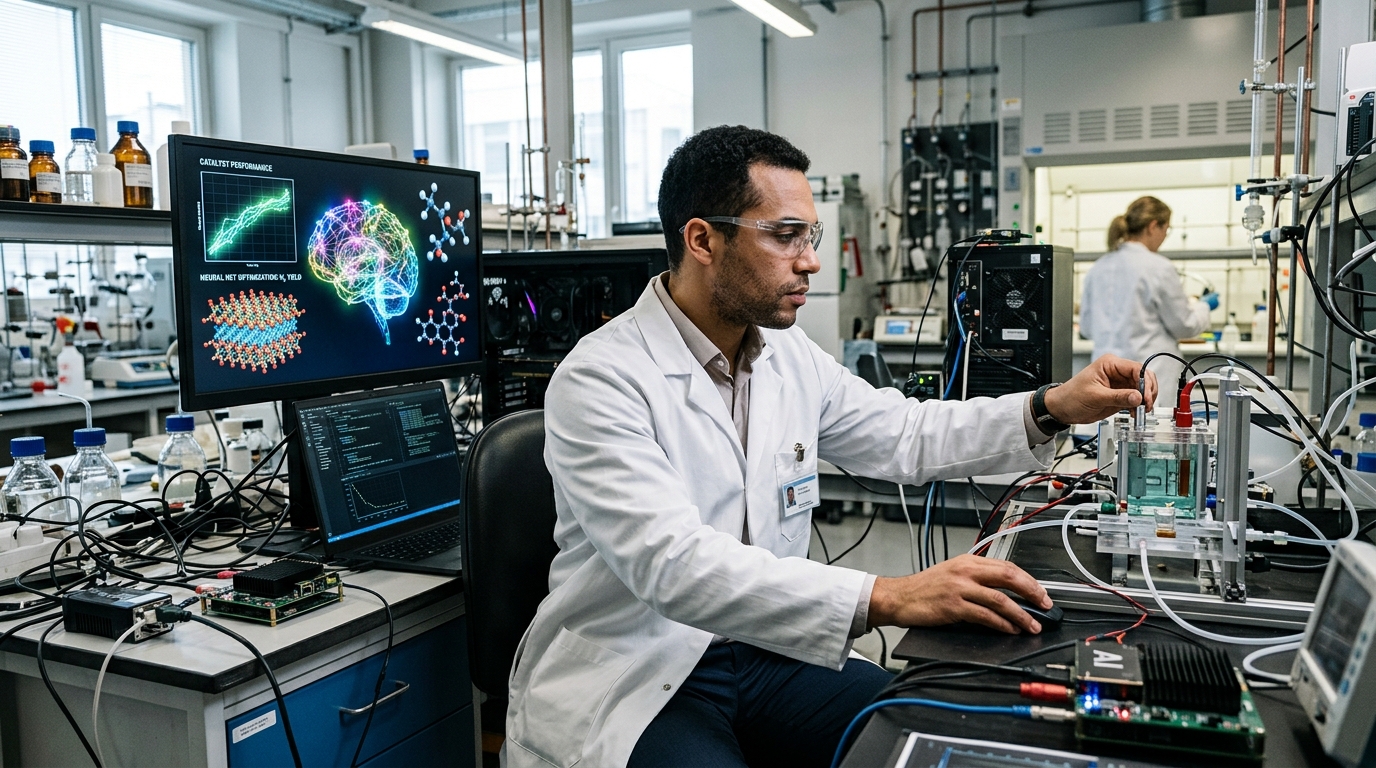
This is where Machine Learning (ML) intervenes as a force multiplier. Instead of simulating every atomic interaction from scratch, ML models are trained on massive datasets of previous experiments and simulations. Modern neural networks can now predict the catalytic activity and stability of a theoretical alloy in milliseconds. This 'smarter search' allows researchers to bypass millions of unviable materials in the digital realm, focusing their physical laboratory resources only on the most promising 'goldilocks' candidates.
From Data Points to Real-World Performance
Recent breakthroughs, highlighted in reports from Phys.org, emphasize the shift toward 'active learning' frameworks. In this model, the AI doesn't just suggest materials; it designs the next experiment. Once a physical test is completed, the data is fed back into the algorithm, which self-corrects and refines its predictive accuracy. This closed-loop system has accelerated the discovery of High-Entropy Alloys (HEAs)—complex mixtures of five or more elements that offer structural stability far surpassing traditional platinum-based catalysts under the harsh, acidic conditions of a fuel cell.
- Reducing fuel cell production costs by up to 70% through platinum replacement.
- Accelerating R&D cycles from 10 years to less than 18 months.
- Optimizing catalyst durability for heavy-duty long-haul transport.
The implications of this shift extend far beyond the laboratory. For the European Union and North America, securing energy independence means moving away from critical raw materials controlled by geopolitical rivals. AI-driven discovery enables the use of earth-abundant elements like iron, nitrogen, and carbon to create 'single-atom catalysts.' These innovations promise to bring the cost of hydrogen propulsion down to parity with diesel, a crucial milestone for the 2030 climate targets.
The Future: Self-Driving Laboratories
Looking ahead, the convergence of AI with laboratory automation is giving rise to 'self-driving labs.' In these facilities, AI agents not only design the catalyst but also instruct robotic systems to synthesize and test them autonomously, 24/7. This is no longer the realm of science fiction; in 2026, it is the new standard for materials science. The urgency of the climate crisis has forced a paradigm shift where the speed of human intuition is augmented by the processing power of silicon.
"We are no longer searching in the dark. Artificial Intelligence has provided us with a map of a chemical landscape that was previously invisible," say leading researchers in the field.
In conclusion, the smarter search for catalysts via machine learning is not merely a technical upgrade. It is the catalyst—both literally and figuratively—that will allow hydrogen to fulfill its promise as the fuel of the future, ensuring that the green transition is both technologically viable and economically inclusive.