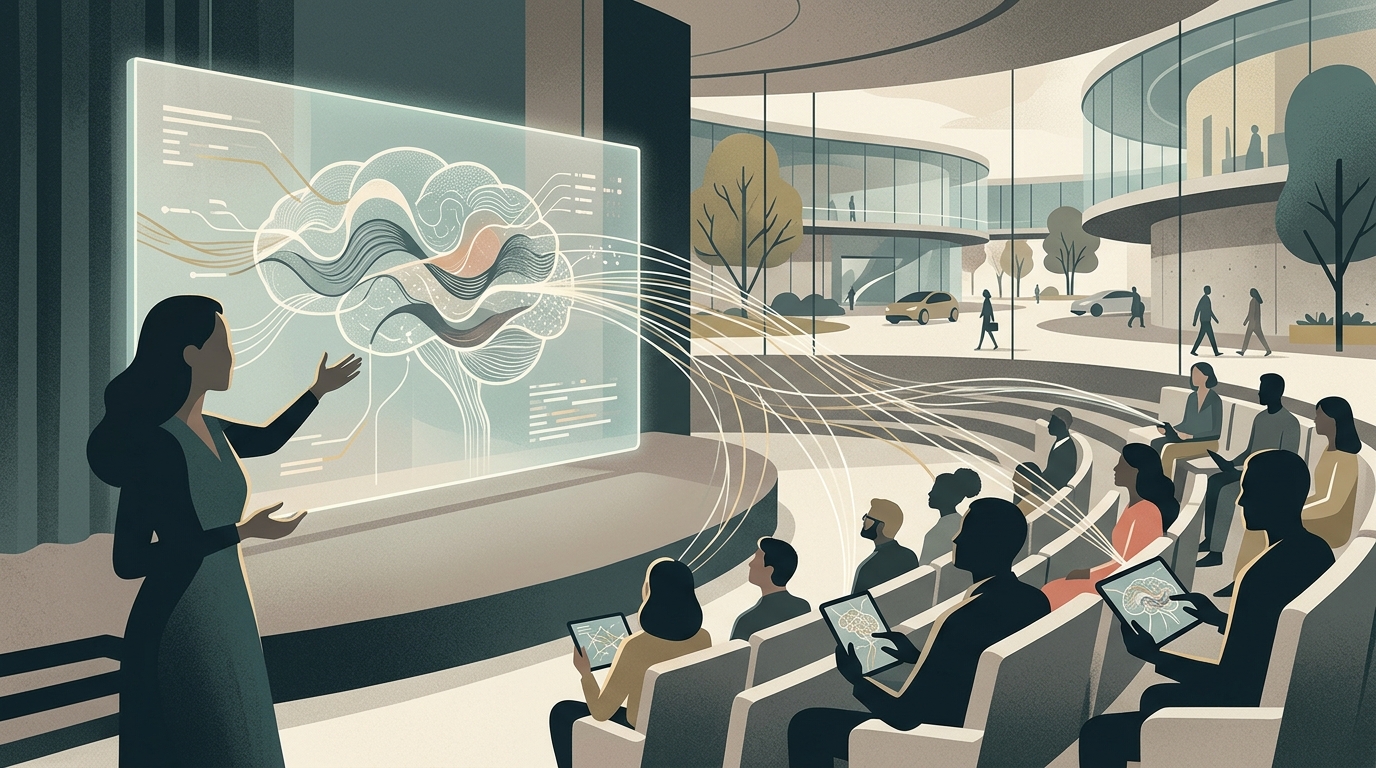
The departure of Mira Murati from OpenAI in late 2024 sent shockwaves through the tech ecosystem. As the architect behind ChatGPT and DALL-E, Murati was not merely an executive but the face of the operational strategy for the world’s most influential AI firm. Today, with the formal announcement of her new venture, Thinking Machines, Murati appears poised to rectify what many consider the 'lost opportunity' of the current generation of Large Language Models: the quality of interaction.
From Prompting to the 'Interaction Model'
The core philosophy of Thinking Machines revolves around what the company terms 'interaction models.' To date, our relationship with artificial intelligence has been largely transactional. We provide a prompt and receive a response. If the output misses the mark, we iterate manually. Murati argues that this workflow is restrictive and alien to the way humans naturally collaborate with one another.
Interaction models aim to create a continuous feedback loop where the AI is not a passive recipient of instructions but an active participant in the cognitive process. 'We want to build systems that collaborate with people the way we naturally collaborate,' the company’s mission statement reads. This implies models capable of understanding context, asking clarifying questions before executing, and adjusting their behavior based on the subtle nuances of human intent.
The Strategy of Autonomy and Trust
While industry giants like OpenAI and Google remain fixated on scaling laws—increasing compute and parameter counts—Thinking Machines is charting a more 'cognitive' path. The focus is not just on what the AI knows, but how it communicates and co-creates with the user. This approach directly addresses one of generative AI's most persistent flaws: the 'black box' nature of its reasoning process.
- Collaborative Reasoning: The model’s ability to explain its step-by-step logic to the user in real-time.
- Adaptive Learning: Systems that learn an individual’s specific workflow style without requiring constant retraining.
- Hallucination Mitigation: Through dialogue, the system can 'pause' when it detects uncertainty, seeking human guidance rather than guessing.
Economic Stakes and the 'OpenAI Diaspora'
Thinking Machines is the latest high-profile startup to emerge from the 'OpenAI diaspora,' joining the ranks of Anthropic and Ilya Sutskever’s Safe Superintelligence (SSI). However, Murati possesses a unique edge: her proven track record of turning cutting-edge research into mass-market products. Silicon Valley investors are betting heavily on this experience, with early reports suggesting valuations exceeding $100 million before a single public product has been released.
'AI should not be a black box that spits out results, but a mirror of human creativity that enhances it through dialogue,' Murati reportedly told investors in a private briefing.
The primary challenge for Thinking Machines will be scale. Developing proprietary models requires astronomical resources in terms of GPUs and energy. Murati will need to balance the quest for technological superiority with her philosophy of a more 'human-centric' AI, all within a market that frequently rewards speed over substance.
The Future of Work
If Thinking Machines succeeds, the future of work could shift from 'replacement' to 'symbiosis.' In fields such as software engineering, creative writing, and industrial design, AI would function as a senior partner that knows when to take initiative and when to defer to human judgment. While this vision is compelling, it also raises critical questions regarding cognitive dependency and the potential atrophy of fundamental human skills.
The trajectory of Thinking Machines will be the next major chapter in the history of artificial intelligence. With Murati at the helm, the industry is waiting to see if the 'machine' can finally learn not just how to think, but how to partner.