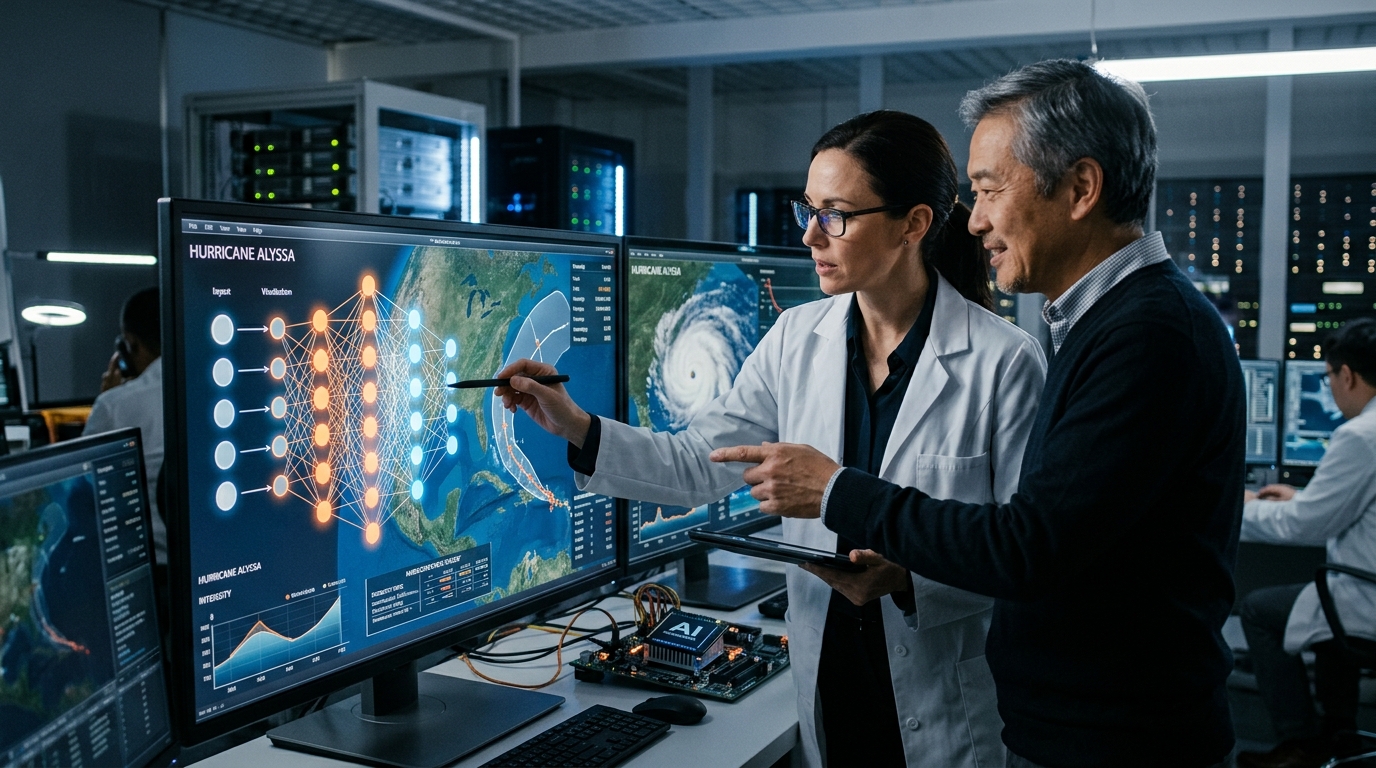
In an era where the climate crisis is making extreme weather events increasingly volatile, the science of meteorology is standing on the precipice of a historic transformation. The traditional method of hurricane forecasting, which relies on complex physics-based models and immense computational power, has gained a formidable ally: Artificial Intelligence (AI). Recent analysis by ABC11 News highlights how the combination of algorithmic speed and human expertise is weaving a safety net that seemed impossible just a few years ago.
The Shift from Physics to Data-Driven Modeling
For decades, weather forecasting has been the domain of Numerical Weather Prediction (NWP). These models solve incredibly complex differential equations describing fluid dynamics and atmospheric thermodynamics. While reliable, they require massive supercomputers and hours of processing time to generate a single forecast. AI, however, takes a different path. Instead of trying to "calculate" nature from first principles, it is trained on decades of historical reanalysis data (such as ERA5). Models like Google DeepMind’s GraphCast and Huawei’s Pangu-Weather have demonstrated the ability to produce ten-day forecasts in seconds, with accuracy that often rivals or exceeds traditional models.
This speed is not merely a technical convenience. In the context of a hurricane, every minute counts. The ability for scientists to run hundreds of "ensemble" scenarios simultaneously allows for a much deeper understanding of uncertainty. If 100 different iterations of an AI model converge on a specific landfall location, the confidence of emergency management officials to issue evacuation orders increases substantially.
The Intensity Challenge and the Human Element
Despite the breathtaking progress in predicting a hurricane's track, intensity remains the "Achilles' heel" of AI. The rapid intensification of a cyclone depends on micro-scale processes and localized ocean conditions that current machine learning models still struggle to capture fully. This is where the role of the human meteorologist remains indispensable. Experts at the National Hurricane Center (NHC) do not passively accept AI outputs; they filter them through the lens of experience, identifying when an algorithm might be led astray by data anomalies.
- AI excels at identifying patterns within massive datasets that are beyond human cognitive capacity.
- Meteorologists provide the necessary context, interpreting the societal and infrastructural implications of a forecast.
- The hybrid approach allows for the issuance of warnings much earlier, saving lives and property.
As noted in the report, AI acts as a "super-fast assistant" that relieves scientists of the data-processing burden, allowing them to focus on critical decision-making. Communicating risk to the public remains a profoundly human skill. An algorithm can predict a flood, but a meteorologist can explain what that means for a specific neighborhood's safety.
Economic Implications and the Future of Forecasting
The adoption of AI in meteorology also carries significant economic weight. Reducing computational costs allows developing nations, which may lack multi-billion dollar supercomputers, to access high-quality forecasting tools. Furthermore, the insurance and maritime industries are already investing in these technologies to minimize losses. Accuracy in forecasting translates to fewer unnecessary evacuations, which can cost millions of dollars in lost productivity and resource deployment.
"AI won't replace the meteorologist, but the meteorologist who uses AI will replace the one who doesn't," industry experts frequently observe.
Looking ahead, we anticipate the emergence of "foundation models" for weather, similar to GPT-4, which will understand the atmosphere on a global, multi-modal scale. The challenge will be maintaining transparency. As algorithms become more complex, the need for "Explainable AI" becomes imperative, ensuring scientists know *why* a model is predicting a certain hurricane path. The dawn of this new era promises a world better prepared to face the fury of nature.