The history of humanity is riddled with silent gaps—libraries burned, knowledge lost to the sands of time, and voices extinguished by catastrophe. Yet, the eruption of Mount Vesuvius in 79 AD, which famously interred Pompeii and Herculaneum under layers of volcanic ash, created one of the most paradoxical preservation events in history. In the so-called "Villa of the Papyri," hundreds of scrolls were carbonized instantly. They retained their form but became fragile lumps of charcoal, destined to crumble into dust at the slightest touch. For centuries, these scrolls were deemed unreadable. Until now.
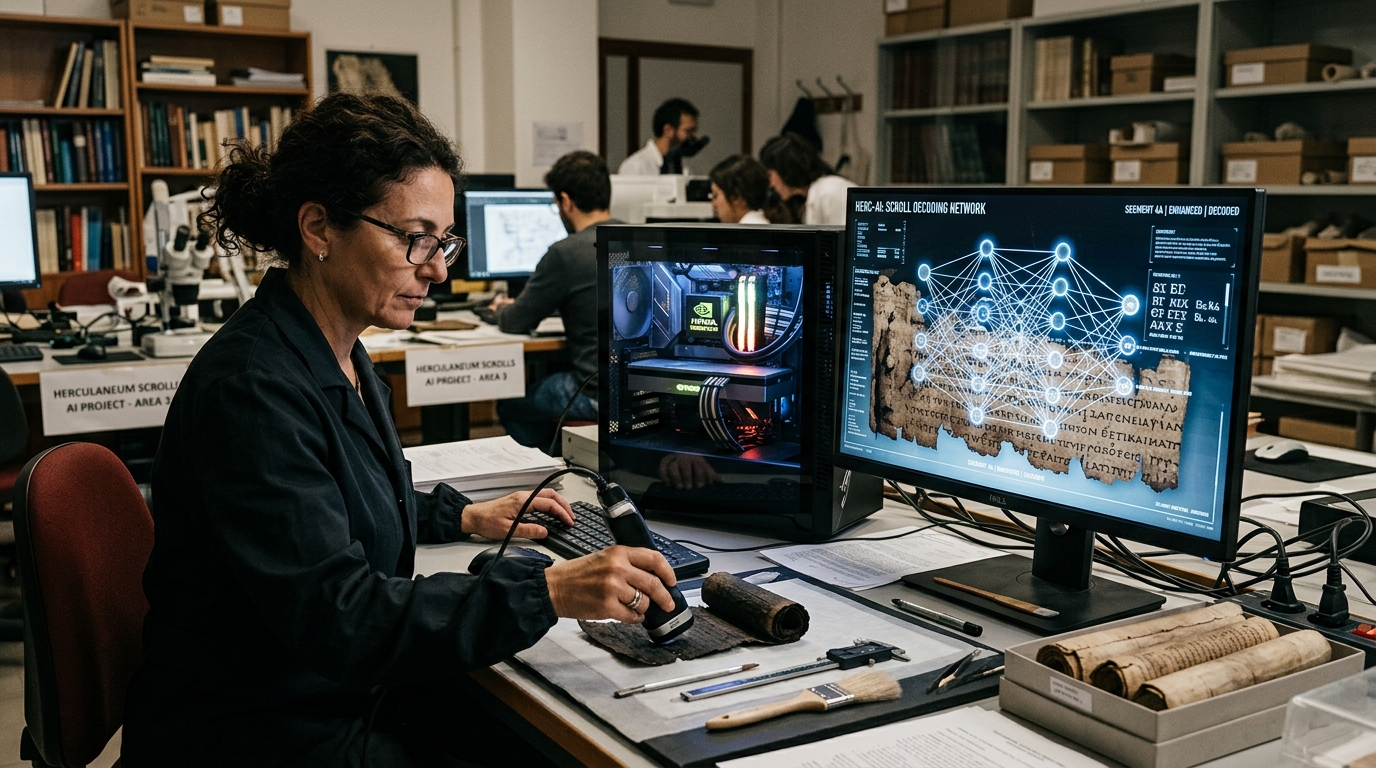
Thanks to Artificial Intelligence and the "Vesuvius Challenge" initiative, the scientific community is celebrating what may be the most significant archaeological breakthrough of the 21st century. By employing advanced machine learning algorithms and high-resolution micro-CT scans, researchers have successfully "virtually unrolled" these scrolls, reading the text hidden within without risking their physical integrity. It is a triumph of silicon over ash.
The Vesuvius Challenge: A Silicon Valley Intervention
The project was spearheaded by Professor Brent Seales of the University of Kentucky and received critical backing from Silicon Valley entrepreneurs like Nat Friedman and Daniel Gross. The challenge was simple yet daunting: a $1 million prize pool for anyone who could decipher at least four passages of text from the scanned scrolls. The primary obstacle was that the ink used in the 1st century was carbon-based—chemically identical to the charred papyrus itself. Traditional X-rays could not distinguish the writing from the background.
The solution lay in deep learning. Researchers trained AI models to detect the subtle, microscopic textures on the papyrus surface that indicated the presence of ink. The AI learned to "see" the ink where the human eye saw only black-on-black. The winners of the Grand Prize—a team of young researchers from Egypt, Germany, and Switzerland—managed to decode over 2,000 Greek characters, effectively proving that the entire library could eventually be read.
Philosophy and Pleasure: What the Scrolls Reveal
The first recovered passages are believed to belong to the Epicurean philosopher Philodemus of Gadara. The text discusses themes that remain strikingly relevant today: music, food, and the sensory pleasures of life. Philodemus argues that the availability of goods, such as food, does not necessarily enhance the pleasure they provide—a sophisticated meditation on the nature of desire and satisfaction.
The implications for classical studies are staggering. The Villa of the Papyri is the only library from antiquity to have survived in its entirety. If AI can decipher the remaining 800 scrolls already recovered, or the thousands more believed to be buried in the lower, unexcavated levels of the villa, we could potentially double the extant body of ancient Greek and Latin literature. Lost works by Aristotle, Sophocles, or Livy might be waiting in the dark, preserved by the very fire that sought to destroy them.
The Future of Digital Archaeology
This success marks a pivot point in how we interact with the past. Archaeology is no longer just about shovels and brushes; it is about data points and neural networks. The ability to analyze damaged artifacts non-invasively protects global cultural heritage while democratizing access through open-source data. This digital resurrection allows scholars worldwide to collaborate on texts that haven't been seen for two millennia.
However, this new frontier also brings challenges. The cost of high-resolution scanning and the computational power required are immense. Furthermore, the reliance on private funding for such monumental academic work raises questions about the future of institutional research. Regardless of these debates, the image of the first Greek words emerging from the darkness of two thousand years onto a computer screen remains a testament to human ingenuity's ability to conquer time and decay.
- Virtual unrolling technology enables the reading of scrolls without physical contact.
- AI detected carbon-based ink on carbonized papyrus by identifying microscopic textures.
- The recovered texts focus on Epicurean philosophy, specifically the nature of pleasure.
- Thousands more scrolls may still be buried in the unexcavated parts of the Villa of the Papyri.