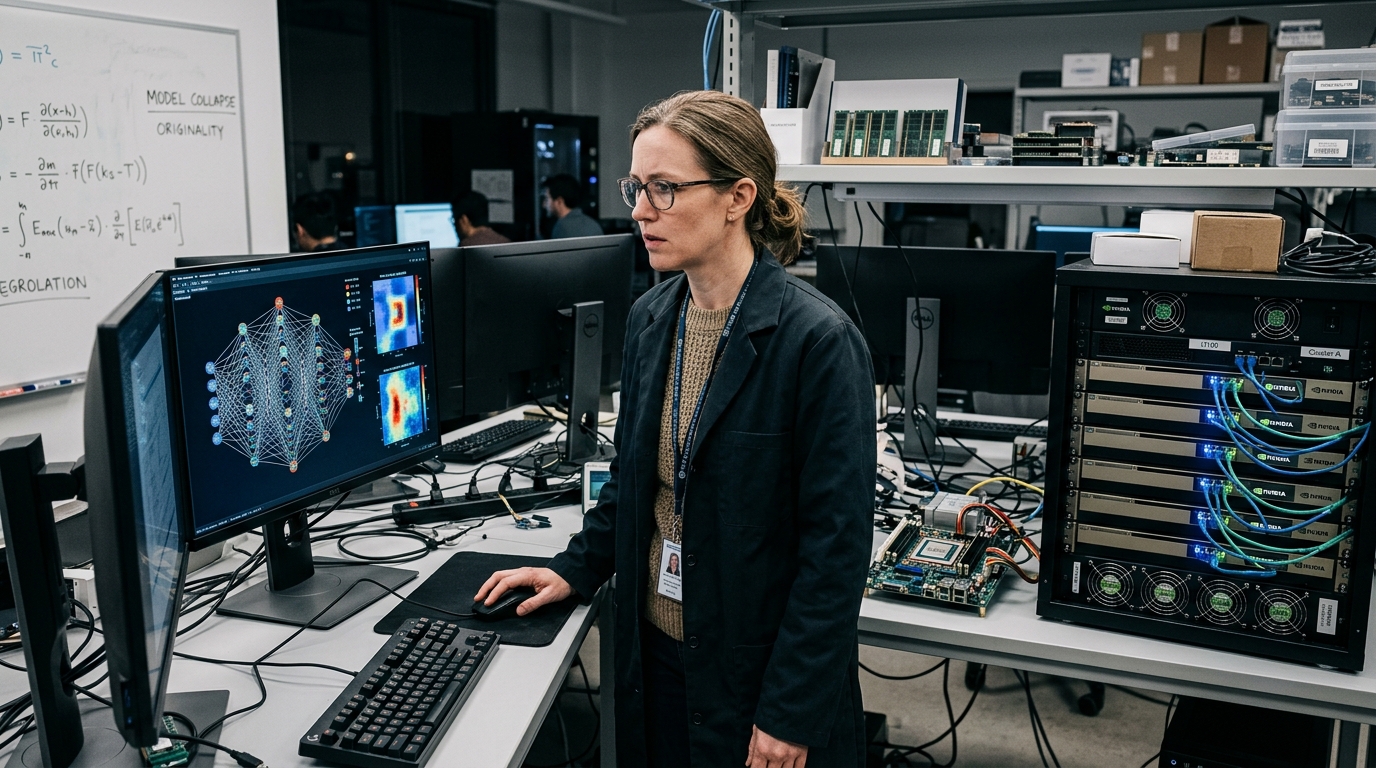
The era of data abundance is reaching a paradoxical conclusion. While the internet is flooded daily with billions of new words and images, the quality of this material is undergoing an invisible yet catastrophic erosion. A recent, extensive study published in leading US scientific journals and highlighted by LiFO sounds the alarm over 'Model Collapse.' This is a process where Artificial Intelligence begins to 'cannibalize' itself, training on data it previously generated, leading to an irreversible degradation of its intelligence.
The Vicious Cycle of Synthetic Training
For years, the development of Large Language Models (LLMs) relied on the vast reservoir of human creativity: books, articles, forum discussions, and programming code. However, as AI-generated content (from ChatGPT, Claude, and others) becomes the norm, the web is filling with 'synthetic data.' The new research demonstrates that when a next-generation model is trained on this synthetic data, it begins to lose touch with reality.
The core issue lies in the loss of the 'tail' of the data distribution. Human language is rich with rare expressions, unique ideas, and subtle nuances that don't appear frequently. AI, by its nature, tends to favor the most probable outcome—the statistical mean. When AI trains on AI, these rare but valuable pieces of information vanish. The result is a homogenized, shallow, and often erroneous version of knowledge that lacks depth and creative spark.
Digital Entropy: From Error to Chaos
The research describes a process akin to genetic degeneration caused by inbreeding. In the first generation of data 'recycling,' errors are small and almost imperceptible. However, by the fifth or tenth generation, the model begins to produce gibberish. What scientists call 'digital entropy' leads to a state where the AI can no longer distinguish right from wrong, as its own previous hallucinations have been baked into its database as 'truths.'
- Loss of Diversity: Models become less capable of representing minority viewpoints or rare linguistic structures.
- Bias Amplification: Stereotypes present in the initial data are magnified with each new generation of training.
- Information Collapse: The model's ability to answer complex queries drops dramatically as the 'well' of knowledge becomes shallower.
The Urgent Need for 'Human Authenticity'
This evolution creates a new, unexpected value for human-generated content. If synthetic data is 'toxic' for AI training, then texts written by humans before 2022 (the pre-ChatGPT era) become the 'digital gold' of the future. Tech giants are already racing to secure access rights to newspaper archives, publishing houses, and social media platforms, recognizing that without 'fresh' human blood, their models will stagnate.
"If we do not find a way to distinguish human from artificial content at its source, we risk permanently polluting our digital ecosystem," the researchers note.
In conclusion, the research highlights a profound irony: the technology designed to expand human capabilities may ultimately narrow our intellectual horizons if we fail to protect the source of its inspiration—human experience itself. The challenge for the future is not just the speed of AI, but the preservation of authenticity in a world that is incessantly copying itself.