In the realm of artificial intelligence, the milestone of "defeating a human" has shifted many times. From Deep Blue’s chess victory in 1997 to AlphaGo’s triumph in 2016, AI has proven its superiority in games of strategy and logic. However, the physical world remained the last bastion of human dominance. The ability to react to a ball traveling at 100 kilometers per hour, accounting for spin, air resistance, and the opponent's slightest movement, requires a synthesis of sensory perception and motor skill that robots have long struggled to emulate. Until now.
The Anatomy of a Digital Champion
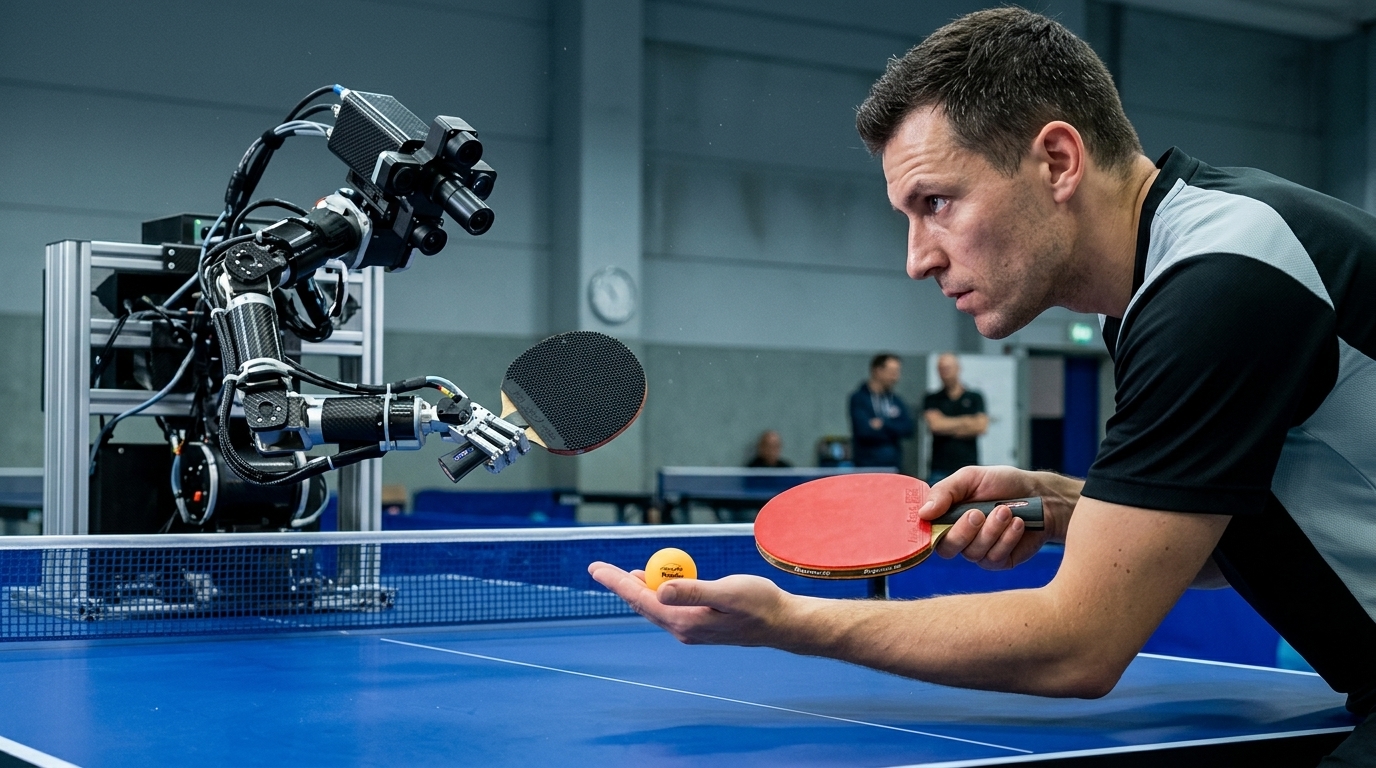
Ace, the robot developed to push the boundaries of robotic sports, represents a pivotal moment in machine learning. Unlike earlier attempts that relied on rigid, pre-programmed movements, Ace utilizes reinforcement learning. This means the robot "learned" to play table tennis through millions of simulations, testing different strike angles and speeds before ever touching a real racket.
Ace’s vision system is the heart of its success. Using high-speed cameras that capture hundreds of frames per second, the robot can locate the ball in 3D space with millimeter precision. But the real challenge isn't position; it's spin. Table tennis is a game of rotations. If you don't understand how the ball is spinning, your return will end up in the net or off the table. Ace has been trained to recognize the subtle movements of a human opponent's hand to predict spin before the ball even crosses the net.
From Simulation to Reality: The Sim-to-Real Gap
One of the greatest difficulties in robotics is the so-called "sim-to-real gap." In a computer, the laws of physics are perfect. In the real world, humidity, wear on the racket's rubber, and minor floor vibrations can invalidate an algorithm. Ace’s creators employed a technique called "domain randomization," intentionally introducing noise and variability into their simulations so the robot learns to be adaptive rather than just precise.
When Ace faces a human, the experience is almost uncanny. The robot doesn't tire, doesn't get distracted, and isn't affected by the psychological weight of a crucial point. Its movement is economical and terrifyingly efficient. Players who have faced it report that Ace possesses a "defensive genius," returning balls thought to be winners and forcing the human into making a mistake.
Beyond the Table: Societal Implications
But why are so much capital and time being invested in teaching a robot to hit a plastic ball? The answer lies in applications far beyond sports. The technology that allows Ace to react instantaneously in a dynamic environment is the same that will enable future robots to perform surgeries with greater precision than a human or work in warehouses alongside people without the risk of accidents.
- Automated Surgery: The ability to predict movement can help robotic arms compensate for organ movement during a procedure.
- Industrial Production: Robots that "feel" and adapt to changes on the production line without needing reprogramming.
- Search and Rescue: Machines that can navigate unstable terrain, predicting falling objects in real-time.
Ace is not just a ping-pong player; it is proof that AI is beginning to master the physical body. The era of robots being clunky and slow is ending. As computational power increases and vision algorithms become more sophisticated, the gap between human and mechanical dexterity will continue to shrink until it disappears entirely.
"Table tennis is the perfect testing ground. It is a dance of physics and strategy that happens in fractions of a second. If we can solve this, we can solve almost anything regarding physical interaction."
At the end of the day, Ace poses a question: What happens when the machine surpasses us not just in thought, but in movement? The answer likely lies in the evolution of our collaboration with them, where the robot is not the opponent, but the coach or partner pushing us to our own limits.