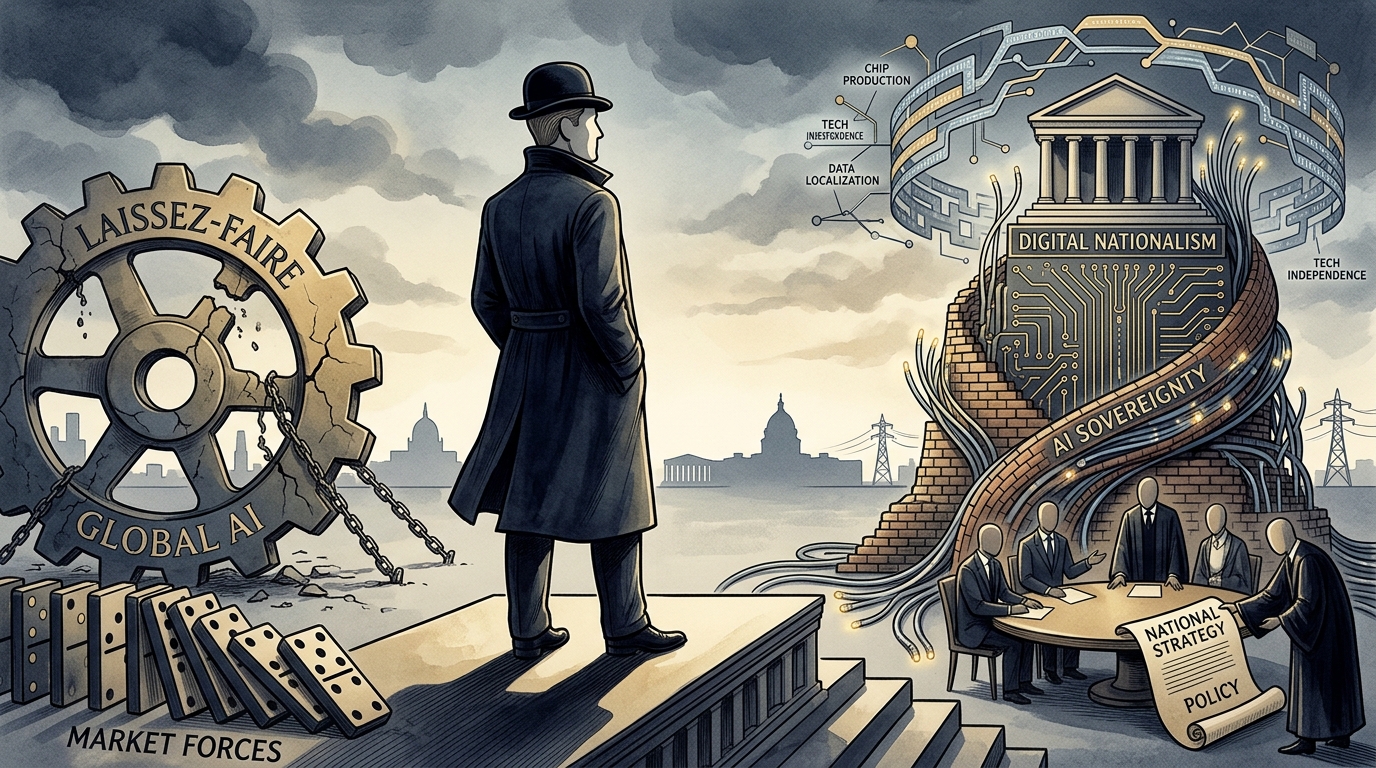
In the evolving political landscape of the United States, the traditional Republican adherence to the doctrine of laissez-faire—minimal government intervention in the economy—is visibly retreating in the face of the urgent need for supremacy in Artificial Intelligence (AI). Recent analyses of Donald Trump’s policy agenda, emerging from internal discussions and public statements by his advisors, reveal a strategy that bears little resemblance to classical liberal economics. Instead, it promotes a form of "digital nationalism" that places the state firmly at the helm of technological development.
The Death of Self-Regulation and the Birth of State Direction
For decades, Silicon Valley thrived in an environment where the government remained at a distance, intervening only when markets failed spectacularly. However, the rise of AI as the ultimate tool of geopolitical power has changed the rules of the game. Trump’s strategy, often described as a "Manhattan Project for AI," proposes an unprecedented level of coordination between the federal government and Big Tech. The goal is not consumer protection or the ethical use of technology—concepts that dominated the Biden administration's executive order—but absolute dominance over China.
This approach means the government will no longer be a mere bystander. It will direct resources, remove bureaucratic hurdles for data center construction, and, most importantly, link national energy policy to AI requirements. The abandonment of laissez-faire is evident in the incoming administration's intent to directly or indirectly subsidize specific infrastructures deemed of "national importance," bypassing free-market forces that might prefer slower or different growth trajectories.
Energy as the New Frontier of Technological Sovereignty
One of the most compelling aspects of the Trump framework is the explicit link between AI and energy production. AI demands vast amounts of electricity, a requirement that current U.S. infrastructure struggles to meet. Here, Trump proposes aggressive deregulation of the energy sector, favoring fossil fuels and nuclear power, not for the sake of free choice, but to fuel the massive server farms needed to train the next generation of models.
This move is a direct blow to laissez-faire principles because the government is actively picking "winners" in the energy sector to serve a specific technological end. Environmental regulations and international climate agreements are viewed as secondary to the need for cheap, abundant energy that would make the U.S. the global "AI factory." This strategy implies that the economy must serve national power, rather than the other way around.
The Geopolitics of AI: US vs. China
The central argument for overturning traditional economic policy is the existential threat posed by China. Trump’s advisors argue that in a world where Beijing utilizes its full state resources to dominate AI, the U.S. cannot remain tethered to 18th-century ideas of free trade. The "weaponization" of trade policy and the use of tariffs as a tool to protect the domestic technological base are central to this new agenda.
Furthermore, the intention to rescind Biden’s AI safety executive order is not aimed at general liberty, but at unshackling American firms from constraints that could slow their progress against Chinese rivals. It is an "arms race" where the state provides protection and resources, and corporations provide the technology, creating a complex that mirrors the Cold War era more than the era of globalization.
Conclusion: A New Roadmap for Innovation
Trump’s shift away from laissez-faire in the AI sector is not merely a policy change; it is a paradigm shift. It marks the admission that technology is now too critical to be left entirely to the hands of the market. For Europe and the rest of the world, this development is pivotal. If the U.S. adopts a model of state-directed innovation, the pressure on the EU to loosen its regulatory framework (the AI Act) and increase its own sovereign investments will become overwhelming. Digital nationalism appears to be the new status quo, and the era of Silicon Valley’s "innocence" has ended for good.