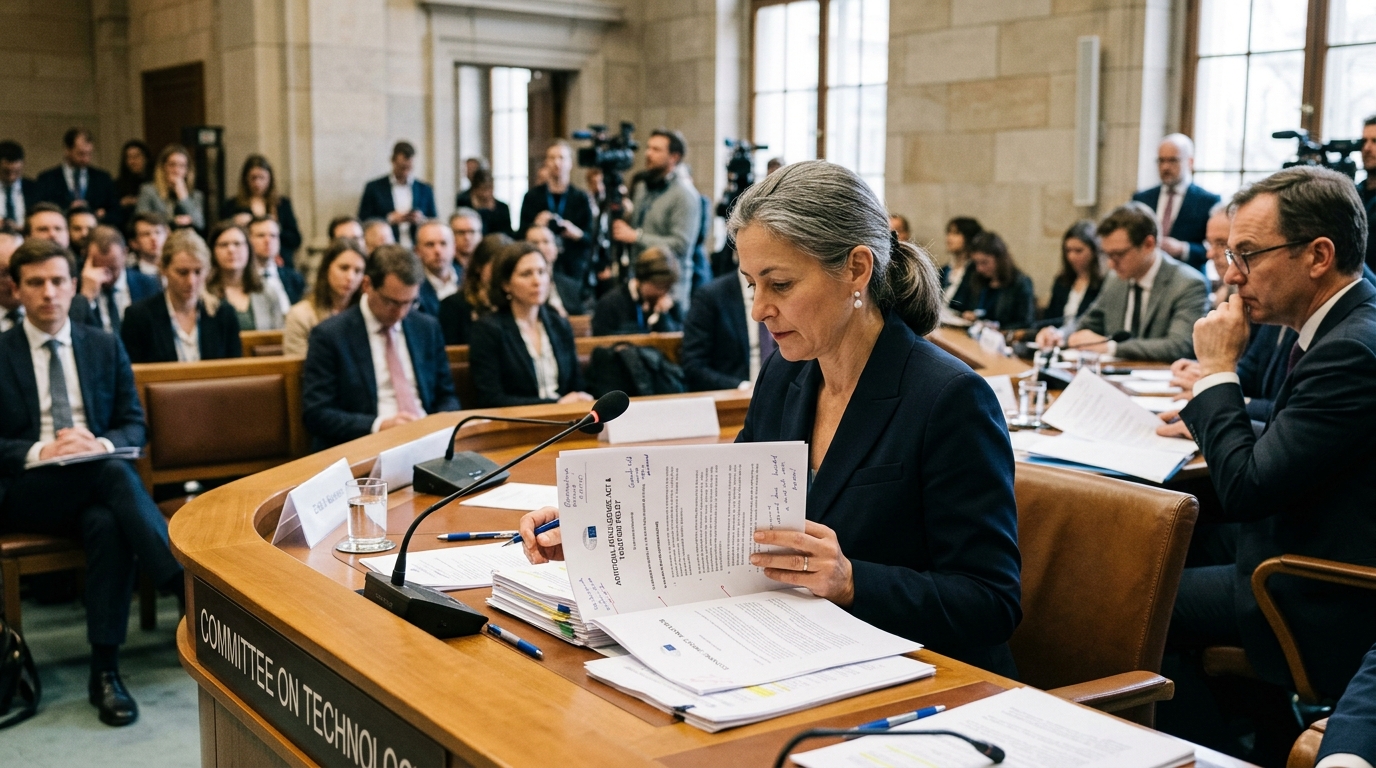
As Artificial Intelligence (AI) fundamentally reshapes the global economic landscape, a heated debate has erupted in the halls of power in Brussels, Washington, and Beijing: Should we tax "algorithms" to offset the social impacts of automation? While the concept of a "robot tax"—once famously proposed by figures like Bill Gates—sounds equitable in theory, a deeper analysis reveals that such a move could be the single greatest strategic blunder of the current decade.
The Brake on Productivity and Innovation
The core objection from economists and policy analysts lies in the fact that AI is not merely a product, but a general-purpose technology (GPT), akin to electricity or the steam engine. Taxing AI is equivalent to taxing efficiency itself. At a time when the global economy is struggling with productivity stagnation, AI offers perhaps the only viable path to rapid growth. Imposing additional financial burdens on companies adopting these technologies would act as a powerful disincentive to modernization.
Furthermore, an AI tax risks disproportionately harming small and medium-sized enterprises (SMEs). While tech giants have the capital to absorb costs or shift operations to more favorable jurisdictions, startups would find the barrier to market entry insurmountable. This would lead to a further concentration of power in the hands of a few, stifling the healthy competition that fuels progress and discovery.
The Problem of Definition and Global Competitiveness
One of the most significant practical hurdles is the definition of "Artificial Intelligence" itself. Where does sophisticated software end and AI begin? Should an Excel spreadsheet utilizing basic machine learning be taxed? This ambiguity would create a bureaucratic nightmare, with tax authorities attempting to categorize algorithms, leading to endless legal disputes and investment uncertainty.
On a geopolitical level, taxing AI could be suicidal. If the European Union or the United States imposes heavy taxes on AI while China or other emerging economies choose to subsidize the technology, the shift in technological supremacy will be instantaneous. Innovation knows no borders, and capital will flow to where returns are highest and the regulatory environment is most welcoming. Losing "algorithmic sovereignty" would have long-term consequences not just for the economy, but for national security as well.
Alternative Solutions Over Taxation
Instead of punitive technology taxation, governments should focus on restructuring the tax system to favor labor without hindering capital. Currently, in many jurisdictions, the tax burden on labor is significantly higher than on capital. Balancing these rates could reduce the incentive for "artificial" replacement of workers without targeting innovation itself.
"The solution to the AI challenge is not to make technology more expensive, but to make humans more capable of collaborating with it."
Investing in workforce retraining and creating new social protection models, such as lifelong learning accounts, are far more sustainable approaches. History has taught us that every industrial revolution creates more jobs than it destroys, provided the transition is managed with wisdom rather than fear. A tax on AI is a tax on the future, and the future is something we cannot afford to delay.