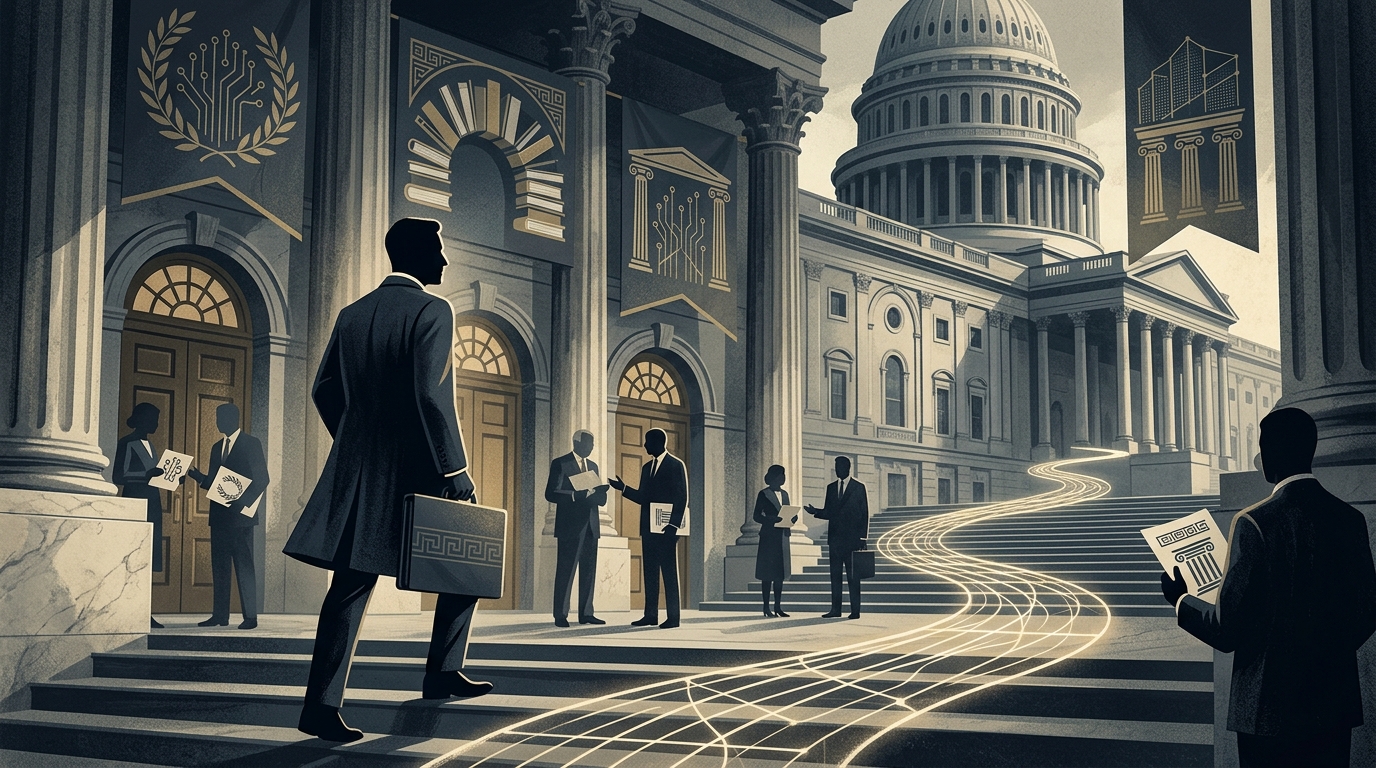
In a period where geopolitical balances are being redefined and technological progress dictates the terms of economic survival, the presence of the Greek delegation in Washington, on the sidelines of the IMF Spring Meetings, took on a particular dimension. Beyond strict fiscal figures and macroeconomic forecasts, the Minister of Education, Religious Affairs, and Sports, Kyriakos Pierrakakis, led a parallel diplomatic effort: that of the "extroversion of knowledge."
Linking Education and Economic Growth
Mr. Pierrakakis's presence in the U.S. capital was no coincidence. In modern economic theory, human capital is considered the most important factor of production. In his meetings with top State Department officials and representatives of iconic universities, the Minister highlighted the new face of Greece. A Greece that no longer only exports culture and tourism but seeks to become a regional hub for education and research in the Eastern Mediterranean.
The central narrative of his contacts was based on the recent reform to strengthen the Public University and the institutionalization of the framework for the operation of non-state, non-profit branches of foreign institutions. For Washington, this move is interpreted as a strategic alignment with Western standards of academic freedom and competitiveness. Discussions with universities such as Columbia and Harvard focused on creating joint degree programs, student exchanges, and, most importantly, attracting investment in cutting-edge fields.
Artificial Intelligence: From the Ministry of Digital Governance to Classrooms
One of the most interesting points on Mr. Pierrakakis's agenda was the integration of Artificial Intelligence into the educational process. Drawing on his experience from the digital transformation of the Greek state, the Minister presented his vision for the "Digital School." In Washington, best practices were discussed for using AI tools that will help teachers personalize instruction while reducing the administrative burden.
- The installation of interactive whiteboards in thousands of classrooms across Greece.
- The creation of a digital assistant for students and teachers.
- The development of distance learning platforms for remote areas.
These initiatives are not merely technological additions but a structural change in how the country perceives learning. The use of AI in education is now considered essential for preparing future workers in a labor market that is changing rapidly due to automation.
Tackling Brain Drain and the Bet on Brain Regain
In his contacts with the Greek diaspora and Greek scientists excelling in the US, Mr. Pierrakakis sent a clear message: Greece is ready to welcome them back. The creation of a modern academic environment, free from the constraints of the past, is the strongest incentive for the repatriation of the "bright minds" who left during the crisis.
"Education is not just a social good; it is our national infrastructure for the future. Without strong universities and modern schools, we cannot talk about sustainable growth," the Minister emphasized in one of his speeches.
This strategy is directly linked to the government's effort to attract tech giants. When companies like Microsoft, Google, and Amazon Web Services invest in Greece, they seek specialized personnel. Upgrading education is, therefore, the answer to the need for a highly skilled workforce.
Conclusions and Perspectives
Kyriakos Pierrakakis's visit to Washington, although taking place within the framework of an economic summit, proved that education is the "hard currency" of the new era. Greece seeks to play a leading role in developments, taking advantage of its geopolitical position and the high level of its human capital. The bet is significant: to transform the educational system from an introverted mechanism into an open gateway of innovation that will fuel the economy and shield democracy.
The coming months will be decisive for the implementation of the agreements discussed in the US capital. The success of this effort will be judged by the speed with which the reforms move from paper to classrooms and lecture halls, permanently changing the country's productive model.