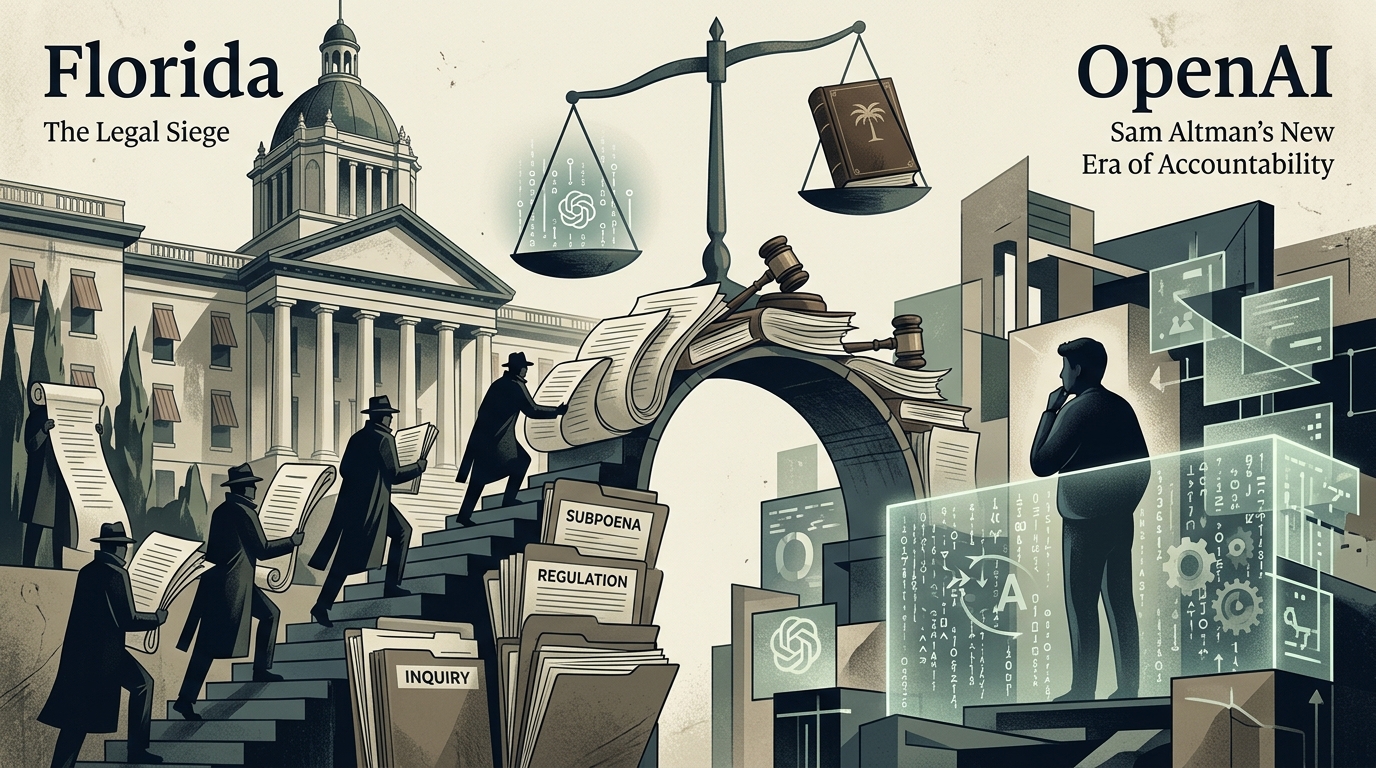
June 1, 2026, will likely be recorded as the day Silicon Valley's legal immunity began to crumble under the weight of state sovereignty. In a move that sent shockwaves through the global tech landscape, the State of Florida filed an exhaustive 83-page lawsuit against OpenAI and its CEO, Sam Altman. This is not merely another copyright dispute, but the first time a U.S. state has deployed the full arsenal of consumer protection laws to challenge the fundamental operations of generative AI.
The 83-Page Indictment: Beyond the Algorithms
The lawsuit, filed in a Tallahassee court, centers on what Florida's Attorney General describes as a "systematic deception of the public." The core argument extends beyond unauthorized data usage, alleging that OpenAI intentionally concealed the risks of "hallucinations" and misinformation produced by ChatGPT. According to the filing, the company marketed a product as "market-ready" and "safe" while knowing its large language models lacked robust truth-verification mechanisms.
Particular emphasis is placed on the Florida Deceptive and Unfair Trade Practices Act (FDUTPA). The state contends that OpenAI operated in a manner that misled Florida citizens by offering a service promising objectivity, while in reality functioning as a "black box" filled with opaque biases and inaccuracies. The lawsuit includes dozens of examples where ChatGPT produced defamatory information about public figures and ordinary citizens within the state, causing both moral and economic harm.
Sam Altman in the Crosshairs: Personal Liability
Perhaps the most striking element of the lawsuit is the explicit naming of Sam Altman as a defendant. It is rare for a CEO of a company of this magnitude to be personally targeted at the state level for technical failures of a product. Florida argues that Altman, through his public pronouncements and leadership, cultivated a false sense of security while simultaneously pushing for the rapid commercialization of technologies that had not been sufficiently vetted.
"Innovation is not a license to violate consumer trust. Mr. Altman and OpenAI chose profit over truth, turning our citizens into guinea pigs for an imperfect technology," the filing states.
Legal analysts interpret this move as an attempt to "pierce the corporate veil." If Florida succeeds in proving that Altman had personal knowledge of the system's flaws and chose to suppress them, the implications for his personal assets and his future at the company would be catastrophic.
Political Dimensions and the Clash with Silicon Valley
Florida’s move cannot be detached from the broader political climate in the United States. Under its conservative leadership, the state has been a pioneer in the battle against "Big Tech," often accusing platforms of censorship and ideological bias. In the case of OpenAI, the lawsuit alleges that the company's AI is programmed with "politically charged constraints" that distort reality, violating users' rights to neutral information.
This creates a dangerous precedent for OpenAI. If other states—whether conservative or progressive—follow Florida's lead, the company will face a "patchwork" of legal requirements that would make operating in the U.S. extremely costly and complex. Already, reports suggest that Attorneys General in Texas and Ohio are closely studying the text of the Florida filing.
Market Implications and the Future of AI
For the global AI industry, this lawsuit serves as a major red flag. Until now, AI companies relied on the notion that their technology is "experimental" and that users accept risks via terms of service. Florida is challenging this logic, arguing that terms of service cannot override fundamental consumer protection laws.
Should the court rule in Florida's favor, OpenAI could be forced to disclose its training data and weighting algorithms—secrets the company guards fiercely. Furthermore, the fines stipulated by FDUTPA for each individual violation could escalate into billions of dollars, threatening the viability of OpenAI's financial model.
In conclusion, the case of "Florida vs. OpenAI" is more than a legal battle; it is a fight for the control of truth in the digital age. As AI becomes increasingly integrated into our daily lives, the question remains: Who monitors the monitors? Florida's answer is clear: The law, not the codes of Silicon Valley.