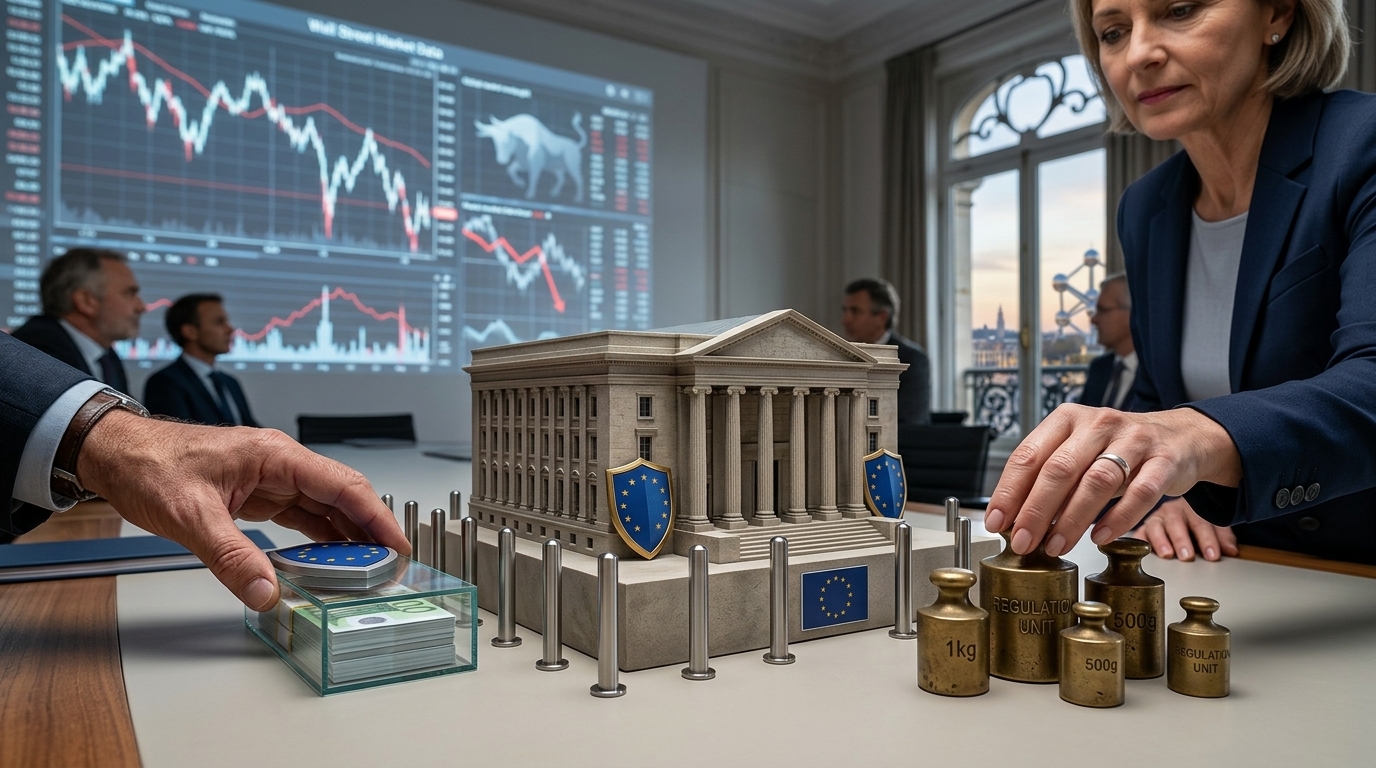
In a move that highlights growing concerns over the international competitiveness of the European financial sector, the European Commission has decided to offer a "breather" to the continent's banks. The decision to extend protection against the stricter capital adequacy rules, known as "Basel III" (or often referred to as Basel IV), is not merely a technical adjustment but a profound political and economic statement of protectionism in a world where Wall Street banks increasingly dominate.
The Stakes of Basel III and the Output Floor
The Basel rules were designed in the aftermath of the 2008 financial crisis with a clear goal: to ensure that banks have enough capital to withstand future shocks. However, the implementation of the final phase of these rules has evolved into a battlefield. The central point of friction is the so-called "output floor," a mechanism that limits banks' ability to use their own internal models to calculate the risk of their assets.
For European banks, which tend to hold more low-risk mortgages and corporate loans on their balance sheets compared to their American counterparts, the output floor threatens to dramatically increase their capital requirements. The Commission, recognizing that an abrupt implementation could lead to credit strangulation for the European economy, chose the path of gradual adjustment. This extension allows banks to maintain the flow of lending to small and medium-sized enterprises (SMEs), which form the backbone of the EU economy.
Competition with Wall Street and the American Retreat
Brussels' decision was not made in a vacuum. Observing developments across the Atlantic, European officials saw the Federal Reserve facing fierce backlash from the American banking lobby. The initial proposal for the "Basel III Endgame" in the US met with such pressure that American regulators were forced to reconsider and soften the requirements.
In this context, Europe could not remain idle. If European banks were forced into stricter rules while their American competitors enjoyed greater flexibility, the result would be a further erosion of the market share of European institutions. Already, banks like JP Morgan and Goldman Sachs have expanded their presence in Europe, taking advantage of the EU's fragmented banking union and their own higher profitability.
"Ensuring a level playing field is not a matter of favoring banks, but a matter of economic sovereignty for Europe," say sources close to the Commission.
Internal Conflict: Commission vs. ECB
However, this move by the Commission does not find everyone in agreement. The European Central Bank (ECB), through its supervisory arm, has repeatedly warned against weakening the Basel rules. For Frankfurt's supervisors, the priority is financial stability and system resilience. The ECB argues that full and timely implementation of international standards is the only way to avoid a new crisis.
This conflict highlights the eternal dilemma of European policy: growth or stability? The Commission, under pressure from member states like France and Germany, whose large banks are most affected, seems to prioritize supporting the real economy and competitiveness. The concern is that if banks are forced to tie up billions in new capital, they will restrict lending, undermining the EU's green and digital transition.
Conclusions and Future Challenges
The extension of protection is a tactical victory for the European banking sector, but challenges remain. Europe still suffers from the lack of a completed Banking Union and a single capital markets union. Without these structural reforms, European banks will remain "dwarfs" compared to American giants, regardless of how many extensions are granted for regulatory implementation.
In the future, the EU will be called upon to balance compliance with international standards and the need to protect its own economic model. The Basel III case shows that the era of unquestioning acceptance of global rules has passed, giving way to a more pragmatic and geopolitically sensitive approach to financial supervision.