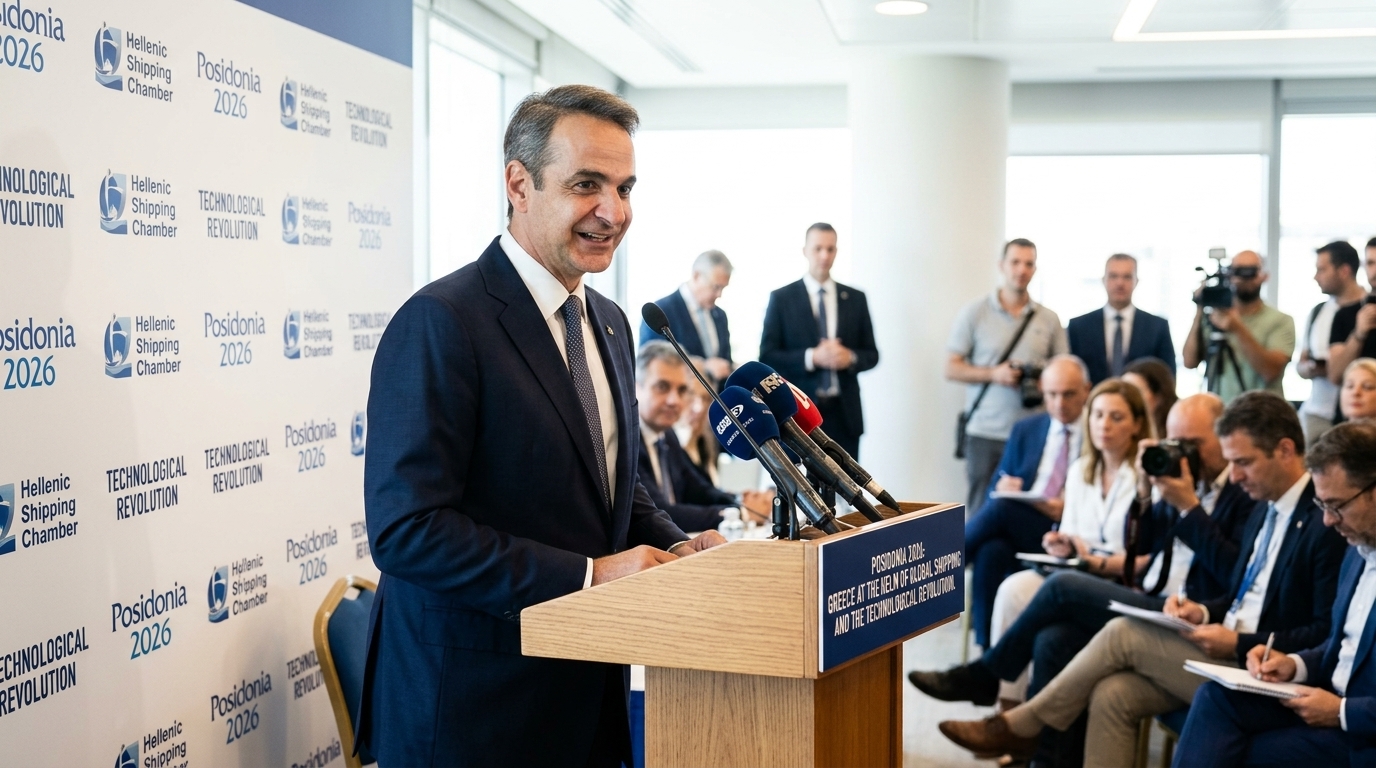
Athens and Piraeus are preparing to welcome the global maritime community for Posidonia 2026, an event that this year serves not merely as a commercial exhibition but as a critical geopolitical and technological milestone. Vassilis Korkidis, President of the Piraeus Chamber of Commerce and Industry (PCCI), emphasizes that this year’s gathering occurs as shipping finds itself in the vortex of a 'twin transition': digital and environmental. As the gates of the Metropolitan Expo open, Greece reaffirms its position as the world's leading maritime power, managing over 20% of global carrying capacity.
The Green Transition and the Alternative Fuels Bet
The central theme dominating discussions at Posidonia 2026 is decarbonization. With regulations from the IMO (International Maritime Organization) and the EU (FuelEU Maritime) becoming increasingly stringent, shipowners are called to make strategic decisions regarding the future of their fleets. The use of ammonia, methanol, and hydrogen is no longer a theoretical pursuit but a practical application showcased at the booths of major shipyards.
Mr. Korkidis points out that Greek shipping is at the forefront of this sector, investing billions in next-generation vessels. However, the challenge remains the land-based infrastructure. Posidonia 2026 acts as a platform for dialogue between shipowners and energy providers, as the availability of green fuels in ports remains the 'thorn' in the side of full technology adoption. Greek entrepreneurship, through the PCCI, is pushing for faster development of bunkering infrastructure in Piraeus to establish the port as a model 'green hub' in the Mediterranean.
Artificial Intelligence on the High Seas
If energy is the heart of shipping, data is its lifeblood. At Posidonia 2026, the presence of technology companies is more pronounced than ever. Artificial Intelligence (AI) is now utilized for route optimization to reduce fuel consumption, predictive maintenance of engines, and real-time supply chain management.
- Autonomous Vessels: Prototypes of ships with reduced crews relying on AI for navigation are being showcased.
- Digital Twins: Creating digital replicas of ships allows companies to simulate vessel performance in various weather conditions.
- Cybersecurity: As ships become 'floating data centers,' protection against cyberattacks has emerged as a top priority.
The integration of these technologies is not just about efficiency but also about safety. Mr. Korkidis emphasizes that Greek shipping, despite its traditional character, has proven remarkably adaptive, adopting solutions that simultaneously reduce operational costs and environmental footprints.
Geopolitical Instability and Greek Resilience
The event takes place against a backdrop of intense geopolitical challenges. Crises in the Red Sea and Ukraine have reshaped global trade routes, increasing the risks and complexity of transportation. In this fluid landscape, the Greek-owned fleet acts as a guarantor of global food and energy security.
"Posidonia is not just an exhibition; it is shipping's answer to global crises. Greece shows that seamanship, combined with modern technology, can overcome any obstacle," Mr. Korkidis states.
The economic footprint of the exhibition for Attica is immense. It is estimated that over 30,000 visitors from 100 countries will contribute more than 60 million euros to the local economy, boosting tourism, catering, and services. However, the true value lies in the multi-billion dollar deals signed in the aisles and booths, defining the future of global trade for the next decade.
Conclusions and Outlook
In conclusion, Posidonia 2026 sends a powerful message: Shipping is changing, but Greece's leadership remains undisputed. The challenge for the coming years will be balancing strict environmental targets with maintaining competitiveness. With Piraeus evolving into a global innovation center, Greek shipping is not just following developments; it is shaping them.