In a global business environment transforming at the speed of light, the concept of leadership is no longer a static state but a dynamic process of continuous evolution. Rebecca Pitsika, Managing Partner of N2Growth Greece, in an extensive discussion on the future of work and management, hits the nail on the head: in the age of Artificial Intelligence (AI), a leader's greatest value is no longer "what they know," but "how fast they can learn."
N2Growth, as one of the world's leading executive search firms, is at the forefront of the hunt for talent that will lead businesses through the fifth industrial revolution. Ms. Pitsika emphasizes that traditional experience, while still respected, is no longer a guarantee of success unless accompanied by the ability to adapt to new data and tools.
Learning Agility as a Competitive Advantage
The concept of "Learning Agility" is the cornerstone of N2Growth's philosophy. According to Ms. Pitsika, the leaders of tomorrow are those who possess the intellectual curiosity to explore the unknown and the humility to "unlearn" obsolete practices. In the 2026 environment, where AI models are updated every few months, stagnation is equivalent to regression.
"We are no longer just looking for people with a rich CV, but people with a 'growth mindset'," she explains. This means that an executive's ability to manage ambiguity and make decisions under conditions of uncertainty is more critical than ever. AI can provide the data, but synthesizing that data into a strategic vision remains a profoundly human function.
Artificial Intelligence: A Tool, Not a Replacement
The discussion about AI in executive selection often sparks fear. However, Rebecca Pitsika clarifies that technology acts as an accelerator rather than a substitute for human judgment. N2Growth uses advanced algorithms to analyze massive volumes of data, identifying patterns of behavior and skills that the human eye might overlook.
However, the final selection of a C-level executive requires something AI lacks: intuition and an understanding of corporate culture. "AI can tell us who is the best fit on paper, but a human will judge who fits the soul of the organization," she notes. The ethical dimension of AI use is also central, as ensuring bias-free selection is a priority for modern HR firms.
The Greek Reality and Global Talent
For the Greek market, the challenges are twofold. On one hand, there is the need for the digital transformation of traditional businesses, and on the other, the competition to attract top talent from abroad (brain gain). Ms. Pitsika observes that Greek companies are becoming increasingly extroverted, seeking leaders who can stand on an international stage.
- Agility: The ability to change course when data shifts.
- Empathy: Understanding the needs of the team in a hybrid work environment.
- Resilience: Maintaining composure and focus during periods of crisis.
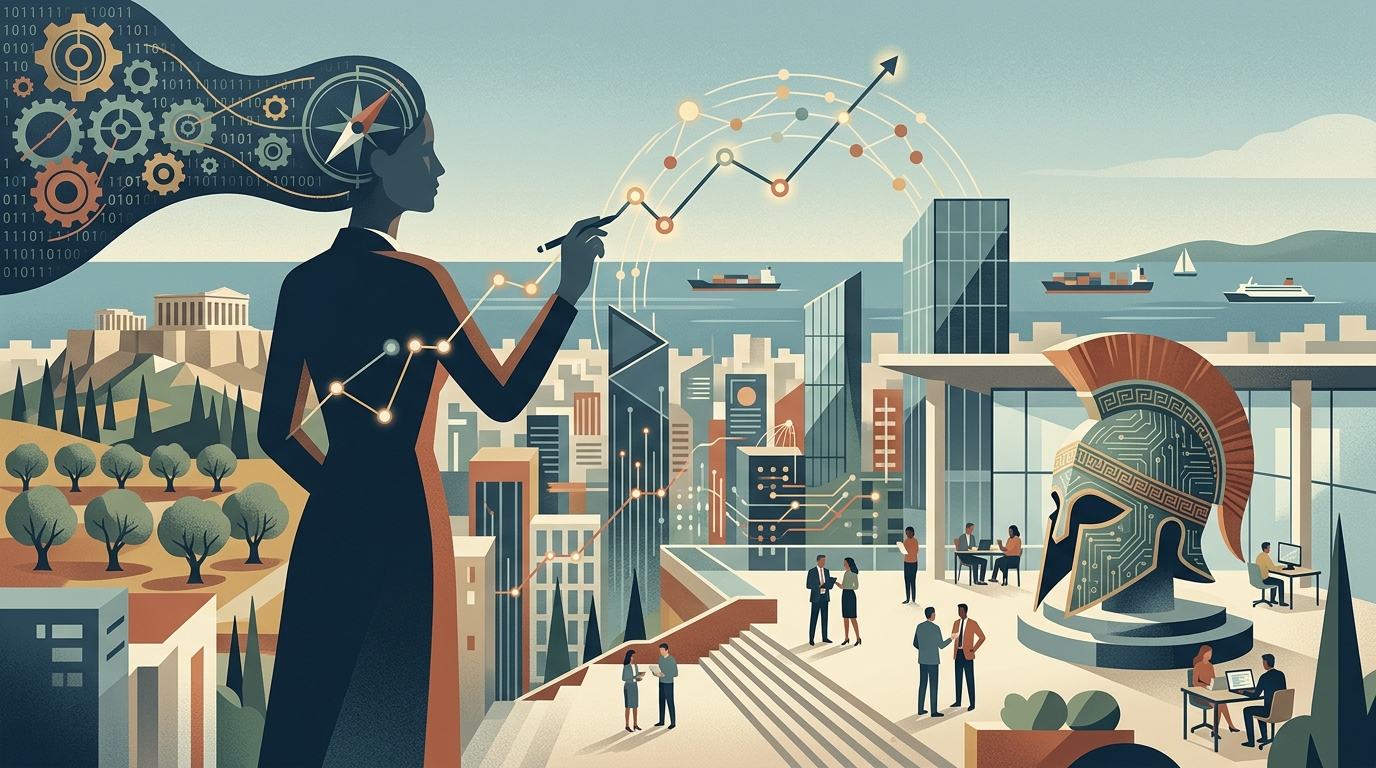
In conclusion, Rebecca Pitsika sends a powerful message: technology is here to make us more efficient, but leadership remains an art based on human values. The leaders who will dominate are those who manage to marry algorithmic precision with human sensitivity, creating organizations that learn, evolve, and thrive.